
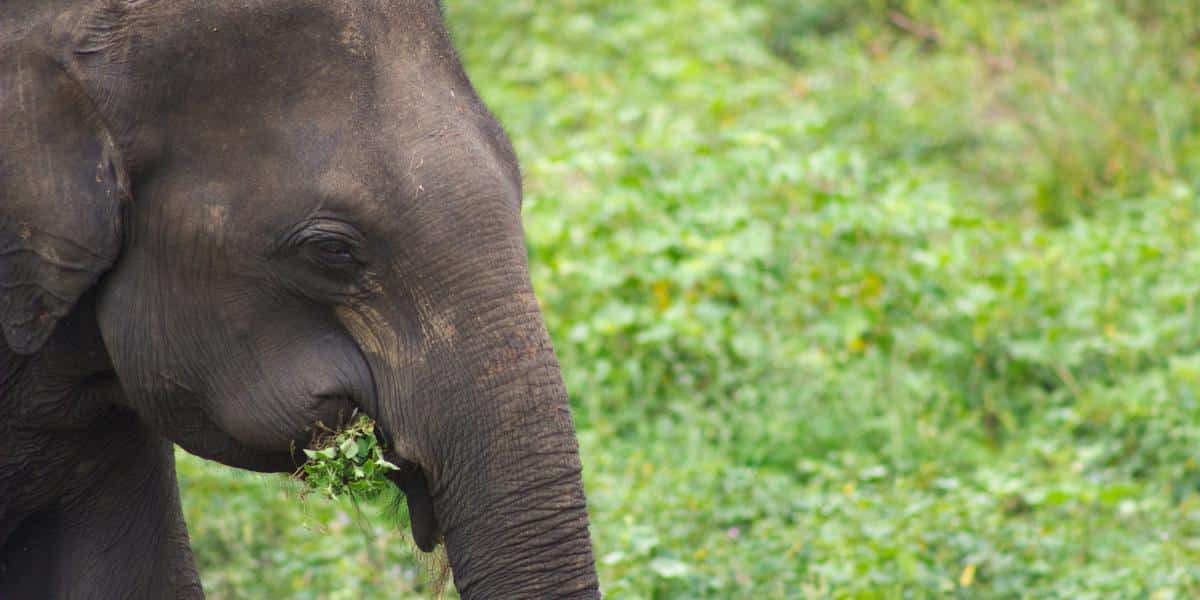
Elephants are the largest land animals on Earth, and feeding a body that big is a full-time job — they spend up to 16–18 hours a day eating and put away 150 to 300 pounds of food. But what exactly is on the menu? Elephants are pure herbivores, and their diet shifts by species, habitat and season. Here’s a complete look at what elephants eat, how much, and how their eating shapes entire ecosystems.
The short answer: elephants are herbivores that eat grasses, leaves, bark, twigs, roots, fruit and shrubs — roughly 150–300 lb (68–136 kg) per day, washed down with 25–50 gallons of water.
What do elephants eat?
Elephants are strict herbivores — they eat only plants, never meat. Their diet is varied but built around a few staples:
- Grasses — the foundation of most elephants’ diet, especially in the wet season.
- Leaves and twigs (browse) — stripped from trees and shrubs with the trunk.
- Bark — a key source of fibre and minerals, especially in the dry season.
- Roots and tubers — dug up with tusks and trunk.
- Fruit — a favourite, and crucial for forest elephants.
They gather all of it with the most versatile tool in nature — the trunk, which can rip up grass or pluck a single berry (see what the elephant trunk does).
How much do elephants eat (and drink)?
A lot. An adult elephant eats roughly 150–300 pounds (68–136 kg) of vegetation every day and spends 16–18 hours doing it. They also drink 25–50 gallons (95–190 litres) of water a day, and more in hot weather.
An elephant can spend three-quarters of its day eating — up to 18 hours — just to fuel its enormous body.
What do African vs Asian elephants eat?
All elephants are herbivores, but the exact diet depends on the species and where it lives:
| Elephant | Diet leans toward | Notes |
|---|---|---|
| African bush elephant | Grass + browse | Mixed grazer-browser; switches to bark and woody plants in the dry season |
| African forest elephant | Fruit + leaves | A major fruit-eater and vital rainforest seed disperser |
| Asian elephant | Grass + browse | Mostly grazes on grasses, supplemented with leaves, bark and crops |
Curious about the differences between the species themselves? See the three species of elephant.
What do elephants eat in the wild?
In the wild, an elephant’s diet follows the seasons. In the wet season they gorge on fresh, nutritious grasses. As the dry season sets in and grass dies back, they switch to tougher browse — leaves, woody twigs, roots and especially bark, which they strip from trees for fibre and minerals. This seasonal switching is why elephants range over huge areas in search of food.
Salt licks: an essential mineral supplement
A plant-only diet has one significant gap: sodium. To plug it, elephants seek out natural salt licks — mineral-rich deposits of clay or rock loaded with sodium, calcium and magnesium. These are not casual visits; elephants will travel up to 50 km specifically to reach a good mineral source.
At a salt lick, elephants use their tusks to gouge and break up the mineral-rich earth, then scoop it up with their trunks. In some places this behaviour has reshaped the landscape entirely. At Mount Elgon in Kenya, generations of elephants have carved out caves up to 160 metres deep into the volcanic rock, digging purely in pursuit of sodium-laced deposits.
Salt lick visitation is particularly well-documented in African forest elephants and Asian elephants, both of which inhabit dense forest environments where mineral-rich soils are a critical dietary supplement. Clearings around natural salt licks are often the best places in the world to observe wild elephants at close range.
What do elephants eat in zoos and sanctuaries?
In captivity, elephants are fed a managed version of their wild diet: large amounts of hay and grass, plus fresh produce (leafy greens, carrots, apples, bananas, melon), branches to browse, and specially formulated herbivore pellets. You can see this first-hand at the best elephant sanctuaries and experiences in the US.
What do baby elephants eat?
Baby elephants live on their mother’s milk — which is remarkably rich, around 15% fat — before gradually adding plants from a few months old. They also eat fresh dung early on to acquire the gut bacteria needed to digest vegetation. For the full feeding timeline, see our dedicated guide to what baby elephants eat.
How do elephants use their trunk to eat?
The trunk is the elephant’s feeding tool, and it is a remarkably precise one: around 40,000 muscle units and no bone at all, capable of uprooting a tree or plucking a single berry depending on what is needed. Our guide to the elephant trunk covers the full anatomy.
The technique changes with the food. Grazing, an elephant wraps the trunk tip around a clump of grass, twists, and pulls to tear it free before carrying the bundle to its mouth. For bark, it hooks a tusk underneath a strip and levers it away using trunk and head together. For fruit, the trunk tip works like a hand, feeling out and picking individual pieces.
African and Asian trunks work differently
There is a small anatomical difference with real consequences at the tip. African elephants have two finger-like projections, giving them a pincer grip well suited to lifting small items. Asian elephants have one, and use more of a scoop-and-press motion against the underside of the trunk. Both work, but the African two-finger grip is the more dexterous of the two with small foods. Our guide to African vs Asian elephants covers the other differences.
How elephants find food: foraging and ranging
Elephants do not hold a territory and feed within it. They are wanderers, and an individual can cover up to 30 miles (around 50 km) in a single day moving between feeding grounds and water. That movement is not incidental to the diet, it is a direct consequence of it: a body that needs 150 to 300 pounds of vegetation daily strips an area quickly and has to keep moving.
It also creates a feedback loop. Walking those distances burns considerable energy, which raises the amount the animal needs to eat, which in turn forces more movement. It is why elephant herds range over such enormous areas and why habitat fragmentation hits them harder than most species.
Most of what they eat is taken at or near ground level — grasses pulled up by the roots, fallen fruit, bark stripped from trunks — though they will also push over whole trees to reach the canopy, which is covered in why elephants destroy trees. Where they go and when is driven largely by water and the seasons, and by the mineral deposits described above.
Do elephants actually digest all that food?
To break down 150–300 pounds of tough vegetation every day, elephants rely on six sets of massive molars that replace each other across a lifetime — because flat, peg-like cheek teeth would wear out fast on that diet. Even so, Elephants absorb only around 40–50% of what they eat — which is exactly why they have to eat so much. The reason is the mechanism. Elephants are hindgut fermenters: rather than breaking food down with stomach acid, they pass it to a large chamber past the stomach where gut bacteria ferment the plant matter. It handles an enormous range of vegetation but extracts nutrients inefficiently, which is the trade-off behind those eating hours. (For the digestive anatomy, see how many stomachs an elephant has.) The upside is ecological: their dung is full of undigested seeds, making elephants one of nature’s greatest seed dispersers. (For the full story, see every fact about elephant poo.)
The bottom line
Elephants are herbivores that eat 150–300 pounds of grasses, leaves, bark, roots and fruit a day — up to 18 hours of near-constant feeding — with the exact menu shifting by species and season. Keep exploring: elephant pregnancy, how long elephants live, and elephant herds.
Frequently asked questions
Elephants are herbivores. They eat grasses, leaves, twigs, bark, roots, shrubs and fruit — about 150–300 pounds of plant matter a day.
An adult elephant eats roughly 150–300 lb (68–136 kg) of vegetation daily and spends 16–18 hours feeding. It also drinks 25–50 gallons of water a day.
No. Elephants are strict herbivores and eat only plants.
Mostly grasses in the wet season, switching to bark, leaves, woody browse and roots in the dry season when grass is scarce.
Elephants are especially fond of fruit, and in captivity relish bananas, apples, carrots and melon — though grass and browse make up the bulk of their diet.
Calves nurse on their mother’s milk for 4–6 years. Elephant milk is high-fat (~15% fat), essential for rapid growth. Calves begin nibbling plants from around 3–4 months but rely on milk as their primary nutrition source for years.
Yes, and it causes significant human–elephant conflict. Asian elephants in particular raid rice, sugarcane, banana and millet farms at night. African elephants raid maize and fruit crops. This is a major conservation challenge in range countries.
Bark is a dry-season fallback rich in fibre and minerals when grass is scarce. Elephants strip it with their tusks. Over-browsing on bark is why large elephant populations can reshape entire tree communities.
They use memory (matriarchs recall sources from decades earlier), scent (elephants can smell water up to 12 miles away), and digging — dry-season riverbeds are excavated with feet and trunks to reach subsurface water.
With the trunk. They wrap it around grass and twist to pull it free, hook a tusk under bark and lever it away, and use the trunk tip like a hand to pick fruit. Food is then ground down by six sets of large ridged molars that replace each other across the animal’s life.
By moving constantly. An elephant may cover up to 30 miles a day between feeding grounds and water, following seasonal growth and known mineral sites. Herd memory matters here: a matriarch’s recall of where food and water are during drought is one reason older females are so important to a herd.

One reply on “What Do Elephants Eat? Diet, Food & Feeding Habits”
[…] in temperature and rainfall patterns can also lead to changes in vegetation patterns, affecting the food supplies of elephants and leading to malnutrition and reduced […]