The elephant trunk is one of the most extraordinary structures in the animal kingdom — a single organ containing between 40,000 and 150,000 distinct muscle units, yet not a single bone. Capable of uprooting a tree one moment and delicately picking up a coin the next, the trunk is the Swiss Army knife of the natural world. Understanding what it is, how it works, and what it does reveals just how deeply evolution has shaped these animals into something genuinely unlike anything else on Earth.
What is an elephant’s trunk?
Anatomically, the elephant trunk is a highly elongated fusion of the nose and upper lip. It is classified as a muscular hydrostat — the same category as a human tongue or an octopus arm — meaning it achieves movement and force entirely through muscle action rather than a rigid skeletal framework. There are no bones inside the trunk whatsoever.
Running through the entire length of the trunk are two separate nostrils, which merge at the base into a single nasal passage that connects to the respiratory system. That connection is what lets an elephant use the trunk as a snorkel, covered in how elephants breathe. In an adult African elephant, the trunk typically measures between 5 and 6 feet (1.5 to 2 meters) in length and weighs roughly 300 pounds (140 kilograms). That is more weight than most adult humans — hanging off the animal’s face.
The outer surface is thick, wrinkled skin, usually sparsely covered with bristle-like hairs that help with tactile sensing. Beneath that skin lies a dense network of muscle fascicles arranged in longitudinal, transverse, and oblique orientations, giving the trunk its extraordinary range of motion in every direction.
For a deeper look at how the trunk fits into the broader body plan, the elephant anatomy hub covers the full skeletal and muscular system.
How many muscles does an elephant’s trunk have?
This question has produced a surprisingly wide range of answers in the scientific literature. Early estimates cited around 40,000 muscle units; more recent imaging and dissection studies have pushed that figure as high as 150,000 discrete muscle fascicles. The difficulty in arriving at a precise number lies in how “muscle” is defined — whether researchers are counting individual fiber bundles, fascicles, or larger functional units.
What is not in dispute is the sheer scale of the complexity. The entire human body contains roughly 650 named skeletal muscles. The elephant trunk, by the most conservative estimate, houses more distinct muscle units in a single appendage than a human has in their entire body. By the upper estimate, it contains more than 230 times as many.
This density of musculature is what underpins the trunk’s dual identity: enormous strength and hair-trigger precision, existing in the same organ simultaneously.
What does the elephant trunk do?
The trunk is not a single-purpose tool. It performs at least six distinct major functions, several of which would, in other animals, require completely separate body parts.
Breathing and smelling
The trunk’s primary biological function — the one it evolved for — is respiration and olfaction. Elephants breathe exclusively through their trunks; the mouth plays no role in breathing. The two nasal passages carry air continuously, and the trunk can be extended above water to act as a snorkel during river crossings.
The olfactory capabilities of the elephant trunk are staggering. Research published in Genome Research found that elephants possess approximately 2,000 olfactory receptor genes — the most of any mammal studied, and roughly five times more than humans, who have around 400. In practice, this means elephants can detect the scent of water from up to 12 miles (19 kilometers) away. They can identify individual animals by scent, track the reproductive status of potential mates, and detect predators long before they are visible. Smell, mediated entirely through the trunk, is arguably the elephant’s most important sense.
Drinking
Elephants do not drink directly through their mouths. Instead, the trunk acts as a siphon. An adult elephant can draw up to 2 gallons (about 8 liters) of water into the trunk in a single intake, then curl the tip toward the mouth and release the water down the throat. The speed at which this happens is remarkable — research from Georgia Tech found that elephants can suck water at a rate exceeding 500 kilometers per hour (around 300 mph), a flow rate roughly 30 times faster than a human sneeze.
A fully grown elephant needs around 50 gallons (190 liters) of water per day, which means repeated trips to the water source and dozens of trunkfuls each session. The trunk is also used to spray water over the body for cooling and bathing — a behavior explored in more detail in the piece on why elephants throw dirt on themselves.
Feeding
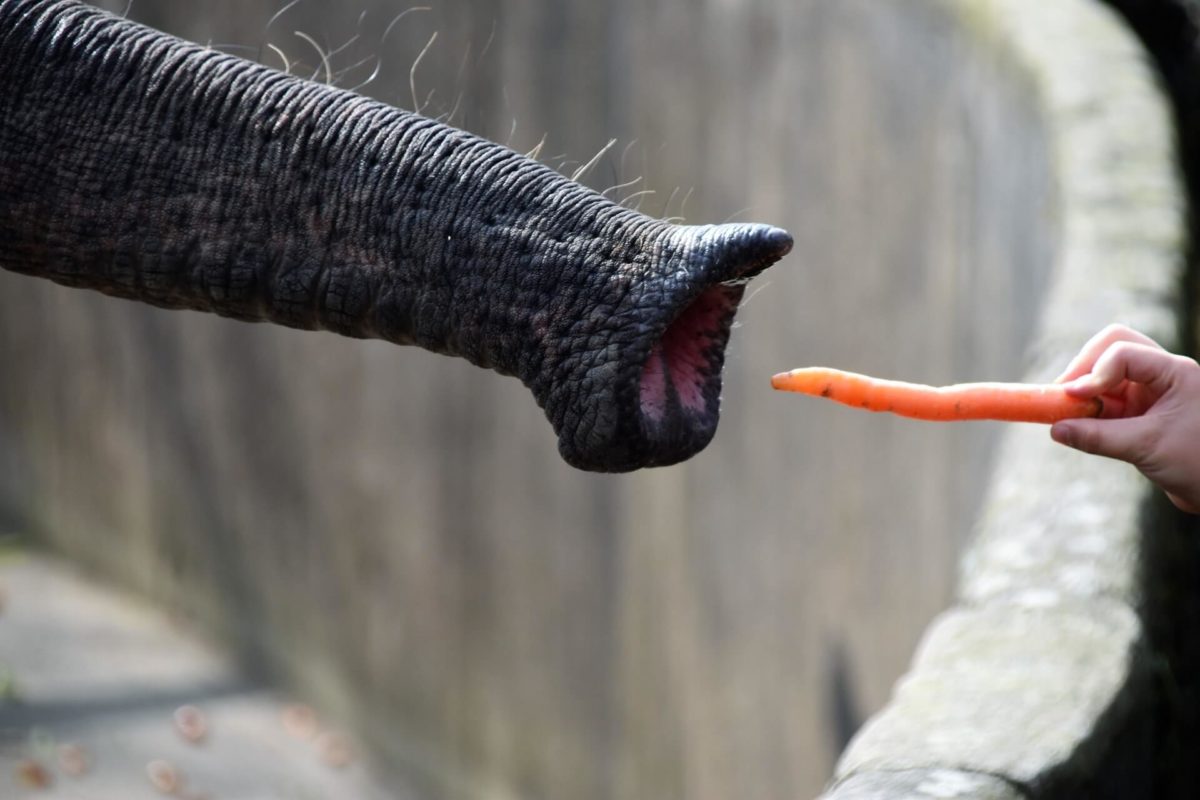
Elephants are large herbivores that consume between 200 and 600 pounds (90 to 270 kilograms) of vegetation each day. The trunk handles nearly all of the food collection. It can strip bark from trees, pull up entire clumps of grass by the roots, pluck individual pieces of fruit from branches, and delicately pick up a single seed from the ground. The range from brute force to surgical precision is extraordinary.
The grasping mechanism differs by species. African elephants have two finger-like projections at the tip of the trunk, giving them a pincer grip that allows very fine manipulation. Asian elephants have a single finger-like projection at the tip, which they typically use in a thumb-and-trunk wrapping motion. For a full breakdown of what elephants eat, see the elephant diet guide.
Communication
The trunk is the primary instrument of elephant vocal and tactile communication. Trumpeting — the loud, bugle-like call most associated with elephants — is produced by forcing air through the trunk rapidly. But elephants also produce rumbles, snorts, and squeaks through the trunk, many of which occur at infrasonic frequencies below the threshold of human hearing, allowing communication across distances of several miles.
In social interactions, the trunk is used like a hand in a greeting ritual: individuals extend their trunks toward each other’s mouths, a behavior researchers interpret as an identity check and social bonding signal. Calves and their mothers frequently entwine trunks as a gesture of reassurance. Understanding these behaviors in context is easier with the full elephant behaviors hub as a reference.
Fighting and defense
In conflicts between bulls, the trunk is used both offensively and defensively. It can be swung as a club, used to grab and throw opponents, or employed to deflect incoming blows. A trunk strike from an adult elephant can deliver enormous force. Mothers defending calves from predators will lash out with the trunk to strike or knock away threats, and there are documented cases of elephants using their trunks to overturn vehicles they perceived as threatening.
Interestingly, elephants are careful to protect their trunks in fights — a badly injured trunk is potentially life-threatening, given how central it is to feeding and drinking.
Lifting and carrying
The trunk can lift objects weighing up to approximately 770 pounds (350 kilograms), making it one of the strongest appendages relative to its length in the animal kingdom. Working elephants in Asia have historically been used to move large logs precisely because the trunk can grip, drag, and maneuver heavy timber with a degree of control that machines often struggle to match in dense jungle terrain.
In the wild, elephants use trunk strength to push over trees (to access high branches or bark), clear paths, and in rare observations, to carry or support injured herd members.
African trunk vs. Asian trunk — what’s the difference?
While both African and Asian elephant trunks are fundamentally the same organ, there are clear anatomical and behavioral differences between the two species.
The most visible distinction is at the tip. African elephant trunks have two distinct finger-like projections — one on the upper surface and one on the lower — creating a pincer that allows extremely precise grasping of small objects. Asian elephant trunks taper to a single projection on the upper surface, with the lower side ending in a flatter pad. Asian elephants compensate with a wrapping technique, curling the trunk around objects rather than pinching them.
African elephant trunks are generally longer relative to body size, which reflects their habitat: reaching high into acacia trees requires more length than browsing in the denser, lower-canopy forests that Asian elephants also frequent. The skin texture also differs slightly — African trunks tend to have more pronounced wrinkles and a rougher surface texture.
Behaviorally, researchers have observed that African elephants more frequently use the two-fingered pincer for precision tasks, while Asian elephants more often use a curl-and-squeeze motion. Both are highly capable, but the structural difference does lead to slightly different foraging strategies. For more on how the two species compare overall, the elephant species hub covers the full picture.
Can elephants breathe through their mouths?
No. This is one of the most important and often overlooked facts about elephant anatomy. The elephant’s airway connects exclusively through the nasal passage — the trunk. There is no direct connection between the mouth and the lungs that would allow oral breathing. This means that if an elephant’s trunk is severely injured or obstructed, the animal faces a genuine respiratory crisis.
This anatomical reality has a striking practical implication: when elephants swim across rivers — which they do readily and skillfully — they use the trunk as a snorkel, extending it above the surface to breathe while the rest of the body is submerged. The trunk’s muscular control is precise enough to seal the tip against water while maintaining an air channel down the center.
The inability to breathe through the mouth is also why an elephant cannot simply lower its head to drink; without the trunk’s siphoning action, getting water to the stomach would be nearly impossible for an adult animal. Elephants are strong swimmers for their size — find out more about how fast elephants move on land and in water.
Fascinating elephant trunk facts
- The trunk contains between 40,000 and 150,000 distinct muscle units — more than the entire human body by a wide margin.
- Elephants can smell water from up to 12 miles (19 km) away.
- Elephants have approximately 2,000 olfactory receptor genes — the highest count of any known mammal.
- A trunk can hold up to 2 gallons (8 liters) of water in a single intake.
- Water intake speed can exceed 500 km/h — roughly 30 times faster than a human sneeze.
- Baby elephants suck their trunks for comfort, much like human infants suck their thumbs — this also builds muscular coordination.
- An elephant’s trunk can lift approximately 770 pounds (350 kg).
- African elephants have two finger-like tips; Asian elephants have one — the quickest way to tell the species apart up close.
- The trunk functions as a built-in snorkel, allowing elephants to swim with their bodies fully submerged.
- Elephants cannot breathe through their mouths — the trunk is their only airway.
- The word “trunk” in reference to an elephant’s nose first appears in English print in Richard Hakluyt’s Principal Navigations (1589).
Frequently asked questions
An elephant’s trunk can lift approximately 770 pounds (350 kilograms) and deliver powerful strikes in combat. It is strong enough to uproot mature trees and push over vehicles, yet precise enough to pick up a single grape without crushing it.
No. Elephants breathe exclusively through their trunks. There is no direct airway between the mouth and the lungs. This is why elephants use their trunks as snorkels when swimming underwater.
Both. The trunk sucks up water and transfers it to the mouth. For food, the trunk grabs, strips, plucks, and delivers vegetation directly. Neither eating nor drinking is possible without a functional trunk.
Baby elephants suck their trunks as a self-soothing behavior, similar to human infants sucking their thumbs. It also helps calves develop the muscular coordination they will need to use the trunk effectively as they grow.
Rarely. The trunk is essential for drinking, feeding, and breathing. There are a small number of documented cases of elephants surviving with partial trunk loss in the wild, but full survival without any trunk is not considered viable under natural conditions.
The word “trunk” in reference to the elephant’s nose first appeared in English print in Richard Hakluyt’s Principal Navigations in 1589. The exact etymology is uncertain, but it likely derives from a root word meaning the main body or stem of a structure.

3 replies on “test”
[…] What is the elephant trunk and what does it do for an elephant? […]
[…] a single limb weighing as much as two adult humans, with no skeleton inside it. Our guides to the elephant trunk and elephant tusks cover both in […]
[…] an elephant’s “nose” is properly called its trunk (a fusion of nose and upper lip — see what the trunk does), its long ivory teeth are tusks, and its broad, cushioned feet help it move almost silently […]