
Elephants are among the most behaviourally complex animals on Earth — they mourn their dead, recognise themselves in mirrors, form lifelong friendships, and communicate in ways we’re only beginning to understand.
Elephant Social Behaviour and Herd Life
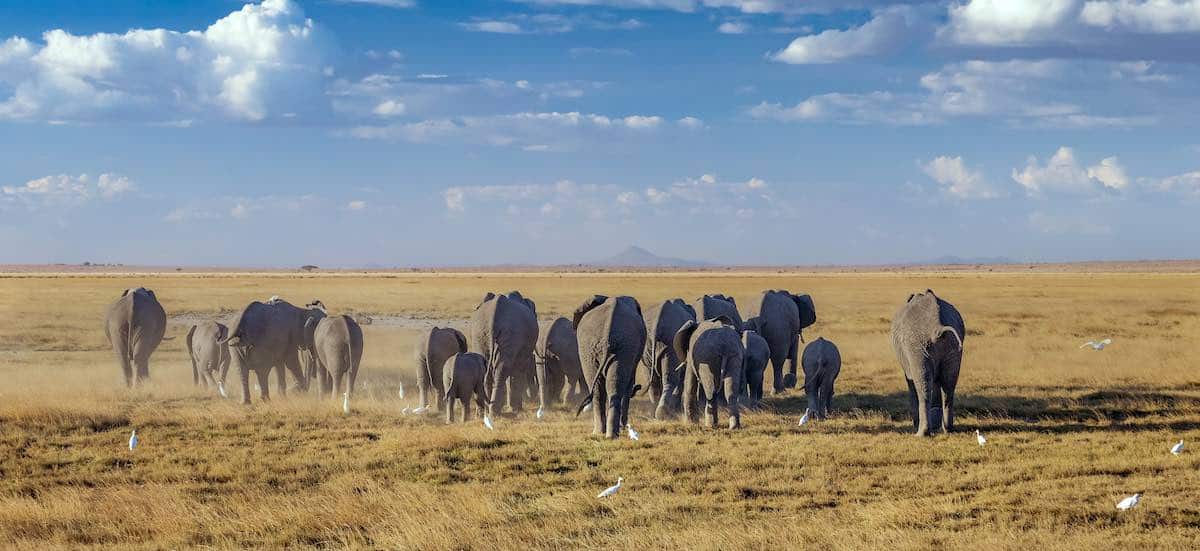
Elephant herds are matriarch-led societies made up of closely related females and their calves. A typical herd numbers anywhere from six to twenty individuals, all following the lead of the oldest and most experienced female. Bulls are raised within the herd but leave at around fourteen years of age, going on to form loose bachelor groups or live semi-solitary lives — rejoining female herds only to mate. This fluid but deeply structured social system means every elephant grows up embedded in a rich web of family relationships.
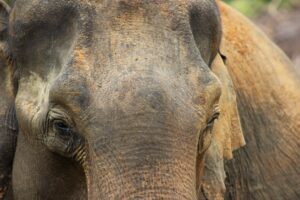
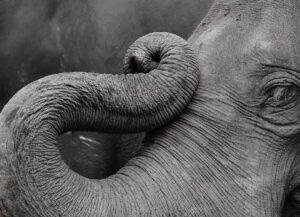
Communication within a herd goes far beyond what the human ear can detect. Elephants produce infrasound rumbles — low-frequency calls that sit below 20 Hz and can travel several miles through the ground and air. These calls coordinate movement, signal distress, and maintain contact between individuals separated by dense bush. Above the threshold of hearing, elephants also use ear posture, trunk gestures, and full-body displays to convey mood and intent with extraordinary nuance. Their emotional intelligence is perhaps most vividly demonstrated in mourning behaviour: elephants will return repeatedly to the bones of deceased herd members, gently touching and turning them with their trunks — a response observed nowhere else in the animal kingdom at this level of consistency.
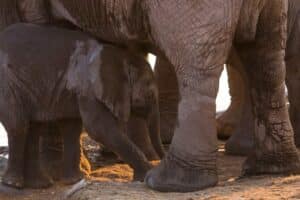
That emotional depth is matched by raw cognitive power. Elephants pass the mirror self-recognition test — placing them alongside great apes, dolphins, and corvids as one of the very few species confirmed to possess self-awareness. They use tools (plugging water holes with chewed bark to prevent evaporation, for example), solve multi-step puzzles to reach food, and remember the locations of water sources and mineral licks across ranges spanning hundreds of kilometres. It is genuinely hard to overstate how intelligent elephants are.
Bonds between individual elephants can last decades. Females within a herd show clear preferential associations — spending more time close to certain companions, greeting them with elaborate rumble-and-touch ceremonies after separation, and showing measurable signs of distress when those companions are lost. Elephant loyalty is not a metaphor: it is a documentable behavioural pattern that shapes every decision a herd makes.
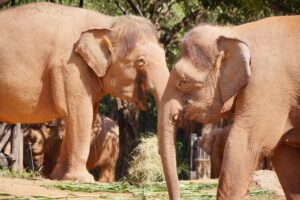
Understanding the full elephant life cycle — from the 22-month gestation and first steps as a calf, through adolescence and adulthood, to the final years governed by a worn sixth set of molars — reveals just how much of an elephant’s intelligence and social sophistication is accumulated rather than instinctive. These are animals shaped by decades of lived experience within their herd.
Fascinating Everyday Elephant Behaviours
A lot of elephant behaviour is really thermoregulation in disguise. Those enormous ears aren’t just for hearing — flapping them pumps blood through a dense network of surface vessels, cooling it by several degrees before it recirculates through the body. Mud wallowing goes even further: a thick layer of mud acts as sunscreen, insulation, and parasite repellent all at once. Throwing dirt on themselves after bathing seals that protective layer in place. And when the mud is out of reach, scratching against trees and termite mounds keeps the skin in good condition while removing external parasites — a behaviour you’ll see repeated dozens of times a day in the wild.
Elephants are not naturally aggressive, but they have a sophisticated repertoire of defensive and threat behaviours worth understanding. A mock charge — head raised, ears spread wide, with a lot of dust and noise — is almost always a warning display rather than a genuine attack. A real charge is silent, head lowered, and committed. In adult bulls, the periodic hormonal state known as musth dramatically elevates testosterone and raises the probability of aggressive encounters; temporal gland secretions streaming down the face are the visible tell. Knowing the signs of elephant aggression — and the difference between a mock charge and a genuine one — is essential for anyone spending time around wild elephants.
Some elephant behaviours are simply delightful. Despite their size, elephants are capable swimmers — using their trunk as a natural snorkel in deep water. They sleep in short bursts, often standing, and only lie down for deep REM sleep every few days. The rhythmic swaying seen in some elephants is a stereotypy associated with stress or captivity, though gentle rocking can also occur in relaxed wild individuals. And despite their apparent fearlessness, there are things elephants genuinely fear — the sound of disturbed bees is enough to send an entire herd running, a fact now used by conservation projects to protect crops from raiding elephants.
Elephant Behaviour: Our Latest Articles
Dive deeper into the world of elephant behaviour with our latest articles — covering everything from herd dynamics and communication to the quirky, surprising things elephants do every single day.
- How Do Elephants Communicate? Sounds, Infrasound & Body Language
- The Elephant Life Cycle: From Birth to Old Age
- How Smart Are Elephants?
- Do Elephants Cry? What Science Says About Elephant Tears and Emotion
- Do Elephants Have Graveyards? The Myth of the Elephant Graveyard

- What Sound Does an Elephant Make? Elephant Sounds Explained

Elephants love reunions. They recognize one another after years and years of separation and greet each other with wild, boisterous joy.
Jennifer Richard Jacobson
What Elephant Behaviour Means to Us
The behaviours on this page are also the reason the elephant carries so much symbolic weight. Its memory, its loyalty to the herd and the way it mourns its dead are exactly the traits people reach for when they choose an elephant as a symbol. We cover that side in elephant symbolism, what a raised or lowered trunk means and elephant tattoo meaning, or browse everything in symbolism & meaning.
Why should you read our articles?
- Our team is composed of seasoned African wildlife journalists with extensive field knowledge.
- Contributors have been showcased in esteemed productions such as “Planet Earth” and National Geographic Magazine.
- Celebrated photographers with a keen eye for capturing the essence of African elephants in their natural habitats.
- Devoted advocates who’ve participated in hands-on elephant conservation projects, making tangible impact.
- Unwavering commitment to enlightening readers on the wonders of the incredible elephants and the importance of preserving their ecosystems.