
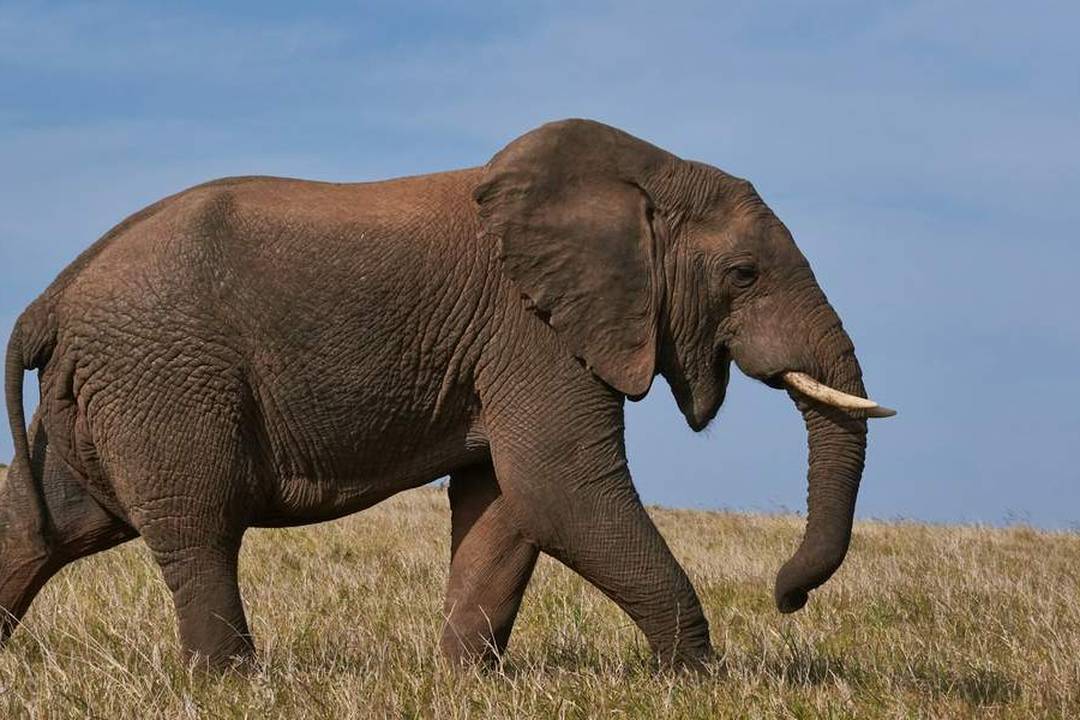
Ask what noise an elephant makes and everyone says the same thing: that brassy trumpet. It is the right answer to the wrong question. Trumpeting is one call out of a repertoire that runs from a bark you could mistake for a dog to a rumble so deep that most of it falls below the bottom edge of human hearing.
This is a guide to the sounds themselves: what each one actually sounds like, the frequency and volume behind it, and the anatomy an elephant uses to produce it. For what the calls mean and how elephants use them socially, that is a separate subject and we cover it in full in how elephants communicate.
The short answer: elephants make at least seven distinct sounds — trumpets, rumbles, roars, barks, snorts, growls and chirps. The trumpet is the famous one, reaching around 470 Hz through the trunk, but the rumble is the one they use most, with a fundamental frequency of roughly 14 to 35 Hz that often falls into infrasound below the 20 Hz limit of human hearing.
What does an elephant sound like?
If you have only heard an elephant in a film, you have heard a trumpet: a loud, brassy, rising blast forced out through the trunk at up to around 470 Hz. It carries a long way and it is unmistakable, which is exactly why it became the stock sound effect.
In the field it is not what you hear most. Spend time near a herd and the dominant sound is a low, throaty rumble that feels closer to a purr or a distant engine than to anything brass. Much of it you will not hear at all. Elephants are among the most vocal land mammals on earth, and the majority of that vocal output sits at the very bottom of, or below, the range our ears can register.
The seven sounds elephants make
Researchers have catalogued dozens of call types and variants, but these are the seven you can reliably tell apart by ear, with the acoustic detail behind each.
| Sound | What it sounds like | Rough frequency | How it is produced |
|---|---|---|---|
| Trumpet | A loud, brassy, rising blast. The signature call | Up to ~470 Hz | Air forced at speed through the trunk, which acts like a brass instrument |
| Rumble | A deep purr or growl you feel as much as hear | ~14–35 Hz fundamental, often infrasonic | Vocal folds in the larynx, amplified by the animal’s sheer size |
| Roar | An open-mouthed, harsh cry | Mid to high, broadband | Larynx, mouth open, high airflow |
| Bark | Short and abrupt, surprisingly dog-like | Broadband, very short duration | A clipped burst from the larynx |
| Snort | A sharp puff or blast of air | Broadband noise, no clear pitch | Air expelled rapidly through the trunk |
| Growl | A rough, grating low sound | Low, overlaps the rumble range | Often the audible upper part of a rumble |
| Chirp / squeak | Short, high, bird-like notes | High frequency | Characteristic of Asian elephants, rare in African ones |
That last row is the one to remember if you are trying to tell the two species apart by ear: chirping and squeaking are strongly associated with Asian elephants and are rarely recorded in African ones. The rest of the repertoire is broadly shared. Our guide to the three species of elephant covers the other differences between them.
How elephants physically make these sounds
Elephants have two instruments and they use them differently. The larynx produces the low end, and the trunk produces and shapes the high end.
The rumble was a genuine scientific puzzle for years, because a sound that low seemed to demand some special muscular mechanism. It does not. Work on an excised elephant larynx showed that rumbles are made the same way human speech is: airflow sets the vocal folds vibrating, and they sustain that vibration on their own without any neural pacing. The reason the pitch is so extraordinarily low is simply scale. An elephant’s vocal folds are many times longer and heavier than ours, and longer, heavier folds vibrate more slowly.
The trumpet works on a completely different principle. There the trunk is the instrument, with air driven through a two-metre tube that resonates and projects the sound much as a trumpet’s tubing does. It is one more job for an organ that already does most of the animal’s work — see what the elephant trunk does.
Elephants do not have a special organ for making impossibly deep sounds. They make them the same way we speak. They are just very, very large.
How loud is an elephant?
Loud enough to be genuinely uncomfortable at close range. Elephant calls have been measured at up to roughly 117 decibels near the animal, which puts a full-volume rumble or trumpet in the same territory as a chainsaw or a rock concert, and above the threshold at which sustained exposure damages human hearing.
Volume is only half of why the sound carries, though. The other half is pitch. Low-frequency sound loses energy far more slowly over distance than high-frequency sound does, and it bends around obstacles like trees and terrain instead of being blocked by them. A high, loud trumpet is the call that turns heads nearby; a low, deep rumble is the one that is still travelling kilometres later.
The elephant sounds you cannot hear
Human hearing bottoms out at about 20 Hz. A large part of the elephant rumble sits underneath that line, in the band we call infrasound, which is why standing near a rumbling elephant can feel like a physical sensation in the chest rather than a sound in the ears. You are picking up the harmonics above 20 Hz while the fundamental passes you by.
This is also why recordings are misleading. Consumer microphones and phone speakers roll off sharply at the bottom of the range, so an elephant recording almost always sounds thinner than the animal does in person. What is being used for, and how far it reaches, is the communication side of the story — covered in how elephants communicate.
What do baby elephants sound like?
Higher, shorter and far more frequent. Calves have smaller vocal folds, so their calls sit well above an adult’s in pitch, and they vocalise constantly — squeaks, chirps, short trumpets and a distinctive high cry when separated from their mother.
Calves also snore audibly while sleeping, which is one of the more charming things to witness in the wild. They learn to produce the full adult range over their first couple of years. Our guides to baby elephants and how elephants sleep cover more of that early behaviour.
The bottom line
An elephant does not make one sound, it makes at least seven. The trumpet is the loud, high one everybody knows, produced through the trunk at up to around 470 Hz. The rumble is the one elephants actually rely on, made in the larynx at 14 to 35 Hz and frequently dropping below the limit of human hearing, and it is the reason a herd can stay in contact across several kilometres of bush. If you want to know what all that noise is for, read how elephants communicate, and for the anatomy doing the work see the elephant trunk.
Frequently asked questions
At least seven distinct sounds: trumpets, rumbles, roars, barks, snorts, growls and chirps. The trumpet is the famous one, but the rumble is the call elephants use most.
The trumpet is a loud, brassy, rising blast through the trunk reaching around 470 Hz. Far more common in the wild is a deep rumble that sounds like a purr or a distant engine, much of which is too low for human ears to register.
Human hearing stops at about 20 Hz. The fundamental frequency of an elephant rumble runs from roughly 14 to 35 Hz, so a large part of it falls into infrasound below our limit. Standing close to a rumbling elephant often feels like a vibration in the chest rather than a sound.
Calls have been measured at up to around 117 decibels close to the animal, comparable to a chainsaw or a rock concert and above the level at which sustained exposure harms human hearing.
Rumbles come from vocal folds in the larynx, using the same airflow-driven mechanism as human speech — the pitch is so low simply because elephant vocal folds are enormous. Trumpets are produced separately, by forcing air through the trunk, which resonates like a brass instrument.
Mostly they share the same repertoire, but chirping and squeaking are strongly associated with Asian elephants and are rarely recorded in African ones. That is the most reliable way to tell them apart by ear.
Higher and shorter versions of the adult calls — squeaks, chirps, short trumpets and a distinctive high cry when separated from the mother. Calves also snore audibly while they sleep.