Only two species of elephants have been recognized until quite recently: the African and Asian elephants. However, conclusions from several research studies revealed that there are actually three species of elephants roaming the earth:
- African bush elephant (also known as the African savanna elephant)
- African forest elephant
- Asian elephant
As the names imply, all three species can be found in different areas of Africa and Asia. However, their natural habitats and the way the live in the wild differ greatly.
Forest elephants live in tropical rainforests and swamps while bush elephants live on open savanna grasslands. Asian elephants mainly reside in dry forests but also inhabit wet swampy areas near rivers or lakes for bathing and cooling purposes.
In this article we’ll break down the many differences between the three different species of elephant.
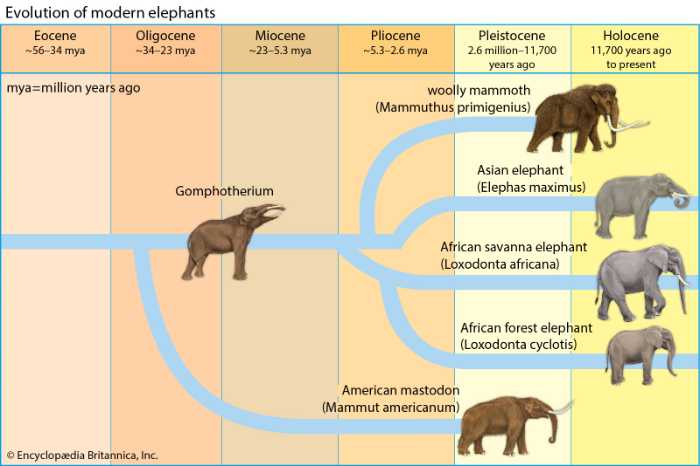
(Evolution of elephant species: https://www.britannica.com/animal/elephant-mammal)
The three elephant species at a glance
Before we dive into the detail, here is how the three living elephant species compare side by side. The African bush and African forest elephants were officially recognised as separate species by the IUCN in 2021 after decades of genetic evidence.
| Feature | African Bush | African Forest | Asian |
|---|---|---|---|
| Scientific name | Loxodonta africana | Loxodonta cyclotis | Elephas maximus |
| Weight (adult) | 4,500–6,800 kg | 2,700–4,500 kg | 3,000–5,000 kg |
| Shoulder height | 3.0–4.0 m | 2.0–2.5 m | 2.5–3.5 m |
| Ears | Very large, fan-shaped | Smaller, rounder | Smaller, round |
| Tusks | Both sexes | Both sexes, straighter | Mainly males (Indian) |
| Habitat | Savanna, grasslands | Dense rainforest | Forests, scrublands |
| Range | Sub-Saharan Africa | Central & West Africa | South & Southeast Asia |
| IUCN status | Endangered | Critically Endangered | Endangered |
| Population (2026 est.) | ~350,000 | ~150,000 | ~45,000 |
The African bush elephant is the largest land animal on Earth. Asian elephants carry the most cultural weight of the three: the sacred white elephants of Thailand and Buddhist tradition are Asian, and that is where much of elephant symbolism originates. The African forest elephant is smaller and lives in dense rainforest, which is why it was historically lumped together with the bush elephant — the two are genetically distinct and have not interbred for millions of years. The Asian elephant is the smallest of the three, with three recognised subspecies (Indian, Sri Lankan, and Sumatran/Borneo).
African bush elephant
This species is the largest living land animal on earth. The African bush elephant can be found in eastern, southern and central Africa in savanna woodlands and grasslands.
Description of the African bush elephant
They have a reddish-brown to gray coat with lighter underparts. Additionally, their large ears help to radiate excess heat. In African elephants, upper incisor teeth become tusks that grow throughout the animal’s life.
African forest elephant
The African forest elephant can only be found in the Congo Basin and parts of Gabon. They inhabit the dense rain forests of Central Africa, where they are expert at navigating the understory in search of food.
Description of the African forest elephant
The African forest elephant (Loxodonta cyclotis), which lives in rainforests, was quite recently recognized as a separate species and is generally smaller than the savanna elephant. They have a chocolate brown to gray coat with lighter underparts. Forest elephants have smaller ears than bush elephants, and their tusks are straighter and grow downwards.
Quick facts:
- Species: L. cyclotis
- Mass (weight): 2,700-6,000 kg (adult)
- Class: Mammalia
- Order: Proboscidea
- Genus: Loxodonta
- Family: Elephantidae
- Kingdom: Animalia
Asian elephant
The Asian elephant has many similarities with the African bush elephant. They are both found on open grasslands and have tusks which grow throughout their life. However, there are also a number of differences between these two species:
Description of the Asian elephant
Asian elephants (Elephas maximus) have a distinctively shaped head and smaller ears than African elephants. They have a grayish or brownish coat with lighter underparts, and their upper incisor teeth do not become long tusks as those of African elephants do. Asian elephants weighs about 5,500 kg and has a shoulder height of up to 3.5 metres. The Asian elephant have three subspecies:
- The Indian, or mainland (E. maximus indicus)
- The Sumatran (E. maximus sumatranus)
- Sri Lankan (E. maximus maximus)
It has larger ears than its African peer.
Quick facts:
- Scientific name: Elephas maximus
- Conservation status: Endangered (Population decreasing)
- Lifespan: 48 years (adult in captivity)
- Order: Proboscidea
- Family: Elephantidae
- Mass: 2,700-4,000 kg (adult)
- Height: 2.4-2.8m (adult, measured “at shoulder”)
The three subspecies of the Asian elephant
While the African bush and forest elephants are now classified as separate species, the Asian elephant has three recognised subspecies — each adapted to a different region of South and Southeast Asia.
Indian elephant (Elephas maximus indicus)
The most numerous Asian subspecies. Found across India, Nepal, Bhutan, Bangladesh, Myanmar, Thailand, Cambodia, Laos, Vietnam, and parts of southern China. Indian elephants are the largest Asian subspecies, with adult males averaging around 5,000 kg. About 60% of all wild Asian elephants are Indian elephants.
Sri Lankan elephant (Elephas maximus maximus)
Endemic to Sri Lanka. The Sri Lankan elephant is the largest-bodied Asian subspecies on average but has the smallest range — confined to the island of Sri Lanka, where about 6,000 individuals remain. Sri Lankan elephants typically have darker skin with larger patches of de-pigmentation on the ears, face, and trunk than their mainland cousins.
Sumatran elephant (Elephas maximus sumatranus)
Found only on the Indonesian island of Sumatra. The smallest of the three subspecies, with adults reaching just 2.5 metres at the shoulder. The Sumatran elephant is Critically Endangered — fewer than 2,400 individuals remain in the wild, with rapid habitat loss from palm oil plantations being the primary threat. A separate population on Borneo (Elephas maximus borneensis) is sometimes classified as a fourth subspecies, the Bornean pygmy elephant.
African Elephant vs Asian Elephant
The main differences between the African elephant and the Asian elephant are their size, habitat, and physical features.
African elephants are larger than Asian elephants and live on the savanna (savannah elephant) while Asian elephants mainly reside in forests.
Additionally, African elephants have larger ears and tusks while Asian elephants have smaller ears and their ivory tusks grow downward instead of out to the side.
Differences in size
The African elephant is the largest terrestrial animal. Males weigh between 5,000-7,000 kg (11,023-15,432 lb), while females weigh around 2,700-3,500 kg (5,951-7,716 lb).
On the other hand, Asian elephants only grow to around 3,000-4,000 kg (6,614-8,818 lb) for males and 2,000-2,700 kg (4,409-5,951 lb) for females.
One way to tell African elephants apart from Asian elephants is by their size. African elephants are the largest terrestrial animals, while Asian elephants are much smaller.
African elephants weigh between 5,000 and 7,000 kilograms, while Asian elephants only weigh between 3,000 and 4,000 kilograms.
Differences in other physical characteristics
African elephants have much larger ears than Asian elephants. African elephant ears can be up to 2.5 meters long and 1.2 meters wide, while Asian elephant ears only grow to be about 1 meter long and 0.5 meters wide.
African elephants also have much larger tusks than Asian elephants. African elephant tusks can grow to be up to 3 meters long, while Asian elephant tusks only grow to be about 1 meter long.
Differences in body temperature
African elephants also have a much higher body temperature than Asian elephants. African elephants have a body temperature of around 37 degrees Celsius, while Asian elephants have a body temperature of around 35 degrees Celsius.
Differences in habitat
Another way to tell these two species of elephant apart is by their habitat. African elephants live on the savanna, while Asian elephants mainly reside in forests.
African elephants are also found in woodlands, scrublands, and deserts, while Asian elephants are found in rainforests and mangrove forests.
Differences in behavior
African elephants are more social than Asian elephants. African elephants live in herds of 10-30 individuals, while Asian elephants typically live in smaller groups of 3-6 individuals.
African elephants also have a more complex social hierarchy than Asian elephants. African elephants use a variety of vocalizations and body language to communicate with each other, while Asian elephants primarily communicate through touch and smell.
Recommended reading: What are the Main Differences Between African Elephant and Asian Elephants?
Conservation status of each elephant species
All three living elephant species are at serious risk. The IUCN Red List updated its classifications in 2021 to reflect the separation of African elephants into two species, both at higher risk than the combined “African elephant” assessment had suggested.
| Species | IUCN Status | Population trend | Primary threats |
|---|---|---|---|
| African bush elephant | Endangered | Decreasing | Poaching for ivory, habitat loss, human-wildlife conflict |
| African forest elephant | Critically Endangered | Decreasing (86% decline in 31 years) | Poaching, deforestation, infrastructure development |
| Asian elephant | Endangered | Decreasing | Habitat fragmentation, conflict with farmers, capture for tourism |
The African forest elephant is in the most precarious position — its population has dropped by 86% over the past three generations, primarily due to ivory poaching in the dense Central African forests where enforcement is hardest. The African bush elephant has fared somewhat better thanks to large protected savanna areas in countries like Botswana, Kenya, and South Africa. The Asian elephant faces a different challenge: its habitat overlaps heavily with human populations across South and Southeast Asia, making coexistence the central conservation question.
Quick FAQ about Elephant species
The three species of elephant are the African forest, African bush and Asian elephants.
The Asian elephant is the rarest species of elephant.
The African bush elephant is the largest species of elephant.
The Asian elephant is the smallest species of elephant. If you include subspecies the Borneo pygmy elephants is the smallest.
There are three species of elephants.
The primary difference between the three species is their size. The African bush elephant is the largest, followed by the African forest elephant and then the Asian elephant which is the smallest.

5 replies on “The three species of Elephant”
Your article says Asian elephants are the smallest. Then it says African Forest elephant is the smallest. Which is it?
Hey jkw,
You’re right, that was a mistake. I’ve updated the information and included some relevant information about the Borneo pygmy elephant, which technically is the smallest if we include subspecies.
The short answer is: The Asian Elephant is the smallest.
Have a great week!
[…] type of behavior is not seen in many different species – one that should be treasured and […]
[…] hectares of Lowveld bushveld across Limpopo and Mpumalanga provinces, it holds an estimated 20,000 African elephants — one of the largest protected elephant populations anywhere in the world. The park’s sheer […]
[…] are rarely recorded in African ones. The rest of the repertoire is broadly shared. Our guide to the three species of elephant covers the other differences between […]