Elephant Lifespan: How Long Do Elephants Live?
Wild elephants commonly live into their 50s and 60s. In a 2008 Science study, zoo-born females had median lifespans of about 17 to 19 years. Full guide to elephant lifespan.


Elephants are one of the longest-lived land mammals on earth. They grow up slowly, breed slowly, and live long enough to develop the kind of memory, social structure, and cultural knowledge that only a few species ever do. But how long do elephants actually live, and why does captivity so often cut their lifespan short?
Quick answer
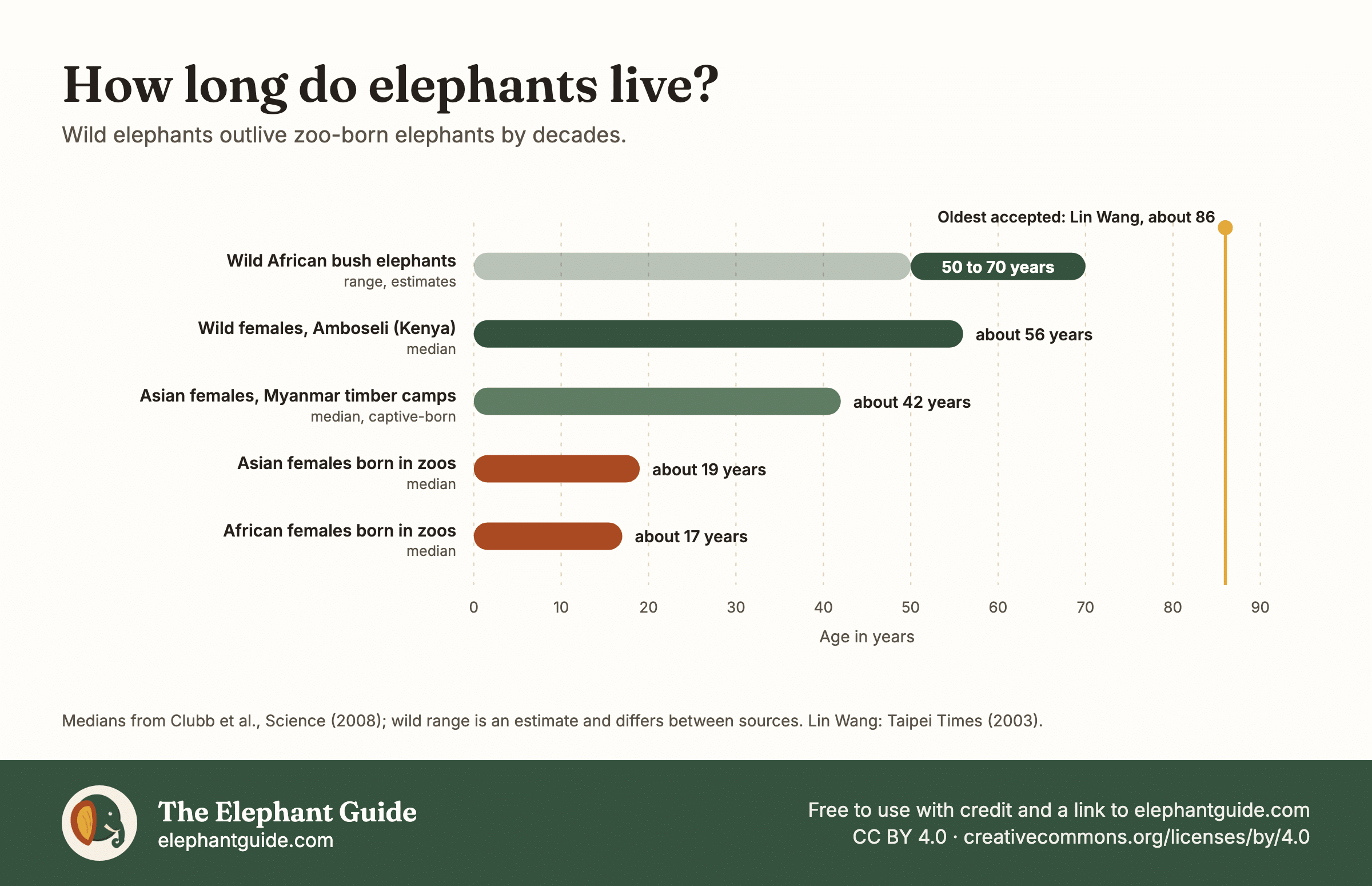
Wild elephants commonly live into their 50s and 60s, with some reaching about 70. A 2008 Science study found median lifespans of about 17 to 19 years for zoo-born female elephants, against 56 years for females in the wild in Amboseli, Kenya. The best-known long-lived elephant, Lin Wang, died at about 86 in Taipei Zoo.
This guide breaks down elephant lifespan by species, by environment (wild vs zoo vs sanctuary), by life stage, and by the threats and health issues that shorten their lives. It also covers how scientists actually measure an elephant’s age, the oldest elephants on record, and what elephant lifespan looks like compared to other animals.
Elephant Lifespan at a Glance
| Species / Environment | Typical lifespan | Maximum recorded |
|---|---|---|
| African bush elephant (wild) | About 50 to 70 years (estimates) | Up to about 70 years (estimates) |
| African forest elephant (wild) | Not well documented | Not well documented |
| Asian elephant (wild) | Often into the mid-50s (wild data are limited) | Not well documented in the wild |
| Asian elephant (zoo-born females) | Median about 19 years | Lin Wang, about 86 (Taipei Zoo) |
| African elephant (zoo-born females) | Median about 17 years | Varies widely |
| Asian elephant (captive-born females, Myanmar timber camps) | Median about 42 years | Varies widely |
Lifespan of Wild Elephants
In the wild, elephants are marathon lifers. A female African bush elephant that survives the vulnerable early years has a realistic chance of reaching her 50s and 60s. Bulls and cows face different risks: bulls roam farther, compete for mates during musth, and carry the largest tusks, which makes them prime targets for ivory poachers.
How long do African elephants live?
African bush elephants (Loxodonta africana) typically live about 50 to 70 years in the wild; Britannica gives about 60. A 2008 Science study of females in Amboseli National Park in Kenya put median lifespan at about 56 years when only natural deaths were counted, and about 36 years when human-caused deaths such as poaching were included.
African forest elephants (Loxodonta cyclotis) are less studied because their rainforest habitats make them harder to track, and their lifespan is not well documented. They breed more slowly, though: in a long-term study at Dzanga Bai in the Central African Republic, females typically had their first calf after age 23 and produced a calf once every five to six years, compared with every three to four years in savanna elephants.
Our guide to African bush elephants vs forest elephants covers the full species differences.
How long do Asian elephants live?
Asian elephants (Elephas maximus) typically live into their mid-50s, according to the Smithsonian National Zoo, which also notes that there is not enough consistent data on wild Asian elephants to give an exact figure. Like African elephants, they mature slowly, reproduce over many years, and have six sets of teeth, so very old elephants can be limited by worn molars.
The best long-term records for the species come from working elephants in Myanmar’s timber camps. Captive-born females there had a median lifespan of about 42 years in the 2008 Science study, more than twice the zoo figure.
Why elephants live so long
Three biological factors are often cited to explain elephant longevity:
- Large body size. Across mammals, larger species tend to live longer.
- Low cancer rates. Elephants carry about 20 copies of the TP53 tumor-suppressor gene (one original plus 19 retrogene copies; humans have 1), which researchers have suggested may help explain why such large, long-lived animals rarely die of cancer (Peto’s paradox). Whether the extra copies really protect against cancer is still debated.
- Slow reproduction. A pregnancy of about 22 months and a gap of several years between calves means elephants invest heavily in each offspring rather than reproducing fast.
Lifespan of Elephants in Captivity
Captive elephants live dramatically shorter lives than their wild counterparts. A landmark 2008 Science study by Ros Clubb and colleagues compiled data from more than 4,500 elephants. It compared 786 zoo females, drawn mainly from European zoo records from 1960 to 2005, with long-term records from Amboseli and from Myanmar’s timber industry. The median lifespans, leaving out premature deaths and stillbirths, were:
- Median lifespan of zoo-born African females: 16.9 years
- Median lifespan of Amboseli females (natural deaths only): 56 years
- Median lifespan of zoo-born Asian females: 18.9 years
- Median lifespan of captive-born Asian females in Myanmar timber camps: 41.7 years
In short, zoo-born African females lived roughly a third as long as the Amboseli females, and zoo-born Asian females less than half as long as the timber-camp females. The authors named stress and obesity as likely causes, and found that transfers between zoos raised mortality.
Why captive elephants face shorter lives
- Obesity. The 2008 study named obesity as a likely factor in early deaths, alongside stress. Zoo enclosures are far smaller than the ranges wild elephants cover.
- Stress. Stress is the other cause the 2008 study suggested. Infant mortality in zoos was high for Asian elephants compared with the Myanmar timber camps.
- Disrupted social groups. Wild females stay in the same family herd for life, which zoo groups often cannot reproduce. Moves between zoos were linked to higher mortality in the 2008 study.
- Foot and joint problems. A study of elephants in North American zoos found that more time spent on hard surfaces was associated with a higher risk of foot and joint problems. Earlier medical records from 69 North American zoos showed that an average of about half of elephants had foot problems.
- Tuberculosis. Tuberculosis has been documented in captive Asian elephants and their handlers. A mid-1990s outbreak on an Illinois exotic animal farm involved the same bacterial strain in four elephants and a handler, although in most cases the direction of infection is not known.
Sanctuaries do better
Accredited elephant sanctuaries are large-acreage facilities designed around elephants’ physical and social needs. Many elephants arrive there already old, so their lifespans cannot be compared directly with zoo-born medians. Shirley, an Asian elephant who retired to the Elephant Sanctuary in Tennessee in 1999, died there in 2021 at the age of 72. The Performing Animal Welfare Society (PAWS) in California and Elephant Refuge North America in Georgia are other US sanctuaries.
If you’re looking for where to see elephants responsibly in the US, our guide on where to see elephants in the US covers sanctuaries and zoos with elephants.
Elephant Life Stages
Elephant life follows clear stages, each with its own milestones, vulnerabilities, and roles in the herd. The ages below are approximate and differ between species and populations.
| Stage | Age range | What’s happening |
|---|---|---|
| Calf | Birth to about 4 or 5 years | Nursing; calves depend on milk for about 2 years, and full weaning in Amboseli comes at about 4.5 years |
| Juvenile | About 5 to 12 years | Learning feeding and navigation from the herd; savanna females are mature by about 12 |
| Young male leaving | About 12 to 14 years | Males typically leave the family herd in their early to mid-teens (sources give about 12 to 14); females stay with the herd |
| Adult female | From about 12 to 14 years | First calf at about 14 in savanna elephants (Amboseli, Addo), caring for calves, staying in the herd for life |
| Adult male | Into the 20s and beyond | Roaming alone or in bachelor groups; males generally cannot compete for mates until their 20s |
| Matriarch | Oldest experienced female | Leads African family herds and guides them to food and water |
| Very old elephant | Late in life | The last set of molars wears down, which can limit feeding |
How Scientists Measure an Elephant’s Age
Researchers use several methods to estimate elephant age in the wild, since you obviously can’t ask an elephant for its birth certificate.
- Tooth wear and replacement. Elephants have up to six sets of molars in their lifetime. Researchers estimate age from molar wear and which set is in place, and in Amboseli the method has been checked against elephants of known age. It stays approximate, because individuals wear their teeth at different rates.
- Shoulder height. Growth curves built from known-age elephants in Amboseli and Addo let researchers estimate age from shoulder height, accurately for females up to about 15 years and males up to about 36. Size also tracks body weight, but not age on its own.
- Back length. For aerial surveys, back length can be used instead: it gives fairly precise ages for females up to about 23 years and males up to about 17.
- Long-term field studies. In populations like Amboseli that have been studied for decades, many elephants have a recorded or estimated birth year.
Our guide on elephant tusks covers more on how tusks change with age.
What Affects Elephant Lifespan?
Natural threats
- Drought and food scarcity. Long dry spells can kill elephants. Kenya’s tourism ministry reported 205 elephant deaths between February and October 2022, during the worst drought in East Africa in 40 years, and warned the true toll may be higher.
- Predation on calves. Lions, spotted hyenas, and crocodiles can take calves, especially young ones separated from the herd. Healthy adults are rarely targeted.
- Tooth wear. The last set of molars appears around age 40 and is usually worn down by about 60. Because elephant teeth move forward on a conveyor belt rather than growing back, there is no further set, and worn teeth can lead to starvation.
- Disease. Elephant endotheliotropic herpesvirus (EEHV) has killed young Asian elephants in captivity and in the wild; of 22 lethal cases reported in India, 12 were wild, free-ranging calves.
Human-caused threats
- Poaching. IUCN names poaching for ivory and habitat loss as the main causes of declines in African elephants. Poaching shortens the lives of adults, and removes the experienced matriarchs who hold generational knowledge.
- Habitat loss. Deforestation and agricultural expansion squeeze elephants into smaller areas, which increases conflict with humans.
- Human-elephant conflict. Elephants killed in retaliation for crop raiding or infrastructure damage.
- Captivity. In the 2008 study, median lifespans in zoos were far shorter than in the Amboseli and Myanmar reference populations: about 39 years shorter for African females and about 23 years shorter for Asian females.
For the full picture on threats, see our guide on why elephants are endangered.
The Oldest Known Elephant
The best-known long-lived elephant is Lin Wang (林旺), an Asian bull who lived at the Taipei Zoo in Taiwan. The Chinese military acquired him in 1943 from Japanese prisoners of war in Burma, and he carried supplies during World War II. He moved to Kaohsiung in 1947 and to Taipei Zoo in 1954, and he died in February 2003 at an estimated age of 86.
Other notable long-lived elephants include:
- Vatsala (India), an Asian female at the Panna Tiger Reserve who died in July 2025. She was reported to be around 100, but no surviving documents confirm her age, so Guinness would not list her.
- Shirley (USA, Tennessee), an Asian elephant at the Elephant Sanctuary in Tennessee who died in February 2021 at the age of 72.
- Ahmed (Kenya), the famous Marsabit “Big Tusker”, who died in January 1974, probably of natural causes, at an estimated age of about 55 to 65, depending on the estimate.
- Tricia (Australia), an Asian elephant who died at Perth Zoo on 6 July 2022 aged 65 after age-related complications. The zoo described her as among the oldest elephants in the world.
Reported ages in the 80s and above rest on estimates or on records that cannot be confirmed, as Vatsala’s case shows. The AnAge longevity database notes that elephants are probably not as long-lived as often cited.
How Elephant Lifespan Compares to Other Animals
| Animal | Longest recorded or estimated lifespan |
|---|---|
| Human | About 122 years (Jeanne Calment, 1997) |
| Bowhead whale | Estimated up to about 211 years (one indirect estimate that may be too high) |
| African elephant | About 65 years in captivity (AnAge); wild estimates up to about 70 |
| Chimpanzee | About 68 years in captivity (an estimate); about 55 in the wild |
| Horse | 57 years (captive record) |
| Giraffe | About 39.5 years (captive record) |
How Can We Help Elephants Live Longer Lives?
- Support anti-poaching work. Donations to organizations like Save the Elephants, Big Life Foundation, and the African Wildlife Foundation fund rangers and monitoring on the ground.
- Avoid ivory products entirely. Demand drives poaching. A shrinking ivory market means fewer elephants killed for their tusks.
- Choose responsible wildlife tourism. Support safaris that fund conservation, not circuses or riding camps.
- Back sanctuary-based captive welfare. Accredited sanctuaries (Tennessee, PAWS, ERNA) are designed around elephants’ physical and social needs.
- Support habitat-connectivity projects. Wildlife corridors between protected areas can reduce human-elephant conflict.
For more on conservation, see our guides on how many elephants are left in the world and how to adopt an elephant.
Frequently Asked Questions about Elephant Lifespan
Wild elephants commonly live into their 50s and 60s, with some individuals reaching about 70. Wild data are limited for both African and Asian elephants. In a 2008 Science study, zoo-born females had median lifespans of about 17 to 19 years.
African bush elephants live about 50 to 70 years in the wild (Britannica gives about 60 for elephants in general). A 2008 Science study of Amboseli females found a median lifespan of about 56 years when only natural deaths were counted. African forest elephant lifespans are poorly documented.
Asian elephants typically live into their mid-50s, though the Smithsonian notes that wild data are limited. Captive-born females in Myanmar’s timber camps had a median lifespan of about 42 years. The best-known long-lived Asian elephant, Lin Wang, died at the Taipei Zoo in 2003 at an estimated age of about 86.
Lin Wang, an Asian bull at the Taipei Zoo in Taiwan, is the longest-lived elephant with a widely accepted age, an estimated 86 when he died in 2003. The Chinese military acquired him in Burma in 1943, and he carried supplies in World War II before moving to Taipei Zoo in 1954. Vatsala, a female in India who died in 2025, was reported to be around 100, but her age was never documented.
In the wild, by a large margin. A 2008 Science study found that zoo-born African females have a median lifespan of 17 years, versus 56 years for females in Amboseli (natural deaths only). Zoo-born Asian females live to 19, versus 42 for captive-born females in Myanmar timber camps. Sanctuary lifespans have not been compared with these medians, because many sanctuary elephants arrive already old.
In very old elephants, worn molars can lead to starvation. Elephants have up to six sets of molars in a lifetime, and when the last set wears down, usually by about 60, they can no longer chew their food effectively. Younger elephants die from causes such as drought, poaching, human-elephant conflict and disease (notably EEHV in young Asian elephants).
A 2017 study that tracked two wild matriarchs in Botswana for 35 days found they slept about 2 hours a day on average, mostly between 2 am and 6 am, and lay down only about every third or fourth day. Earlier reports put captive elephants at around 4 to 6 hours a day.
Researchers estimate elephant age from tooth wear (elephants have up to six sets of molars in a lifetime), shoulder height or back length (growth curves built from known-age elephants), and long-term population records where individual elephants are tracked from birth. Precise ages are usually only possible in long-studied populations like Amboseli.
Sources
Where the main facts in this article come from. Links open in a new tab.
- Clubb et al., Compromised survivorship in zoo elephants, Science, 2008
- Smithsonian National Zoo, Asian elephant
- San Diego Zoo Wildlife Alliance, Elephant species page
- IUCN, African elephant species now Endangered and Critically Endangered, 2021
- Lee et al., African elephant age determination from teeth, African Journal of Ecology, 2012
- Shrader et al., Growth and age determination of African savanna elephants, Journal of Zoology, 2006
- Trimble et al., Age determination by back length for African savanna elephants, PLOS ONE, 2011
- Miller et al., Foot and musculoskeletal health of elephants in North American zoos, PLOS ONE, 2016
- Nunney, Cancer suppression and multiple TP53 retrogene copies in elephants, Evolutionary Applications, 2022
- Sulak et al., TP53 retrogene copies and the evolution of cancer resistance in elephants, eLife, 2016
- Cornell University, Forest elephants need 100 years to rally from poaching, 2016
- San Diego Zoo Wildlife Alliance, African elephant fact sheet: reproduction
- Save the Elephants, Elephant facts
- AnAge, Loxodonta africana longevity record
- AnAge, Pan troglodytes longevity record
- AnAge, Balaena mysticetus longevity record
- AnAge, Homo sapiens longevity record
- AnAge, Equus caballus longevity record
- AnAge, Giraffa camelopardalis longevity record
- Taipei Times, Lin Wang obituary, 2003
- Mongabay, Vatsala, Asia’s oldest known elephant, 2025
- Perth Zoo, WA farewells Tricia the Asian elephant, 2022
- Elephant journal (Wayne State), Ahmed of Marsabit, 1987
- NewsChannel 5, Shirley dies at age 72, 2021
- Tsavo Trust, Do elephants have predators?
- Al Jazeera, Drought has killed 205 Kenyan elephants, 2022
- Gravett et al., Inactivity/sleep in two wild free-roaming African elephant matriarchs, PLOS ONE, 2017
- Michalak et al., Mycobacterium tuberculosis infection as a zoonotic disease: transmission between humans and elephants, Emerging Infectious Diseases, 1998
- Oo et al., EEHV hemorrhagic disease in Asian elephant calves in logging camps, Myanmar, Emerging Infectious Diseases, 2020
- Greene, Dierenfeld and Mikota, Elephant gastrointestinal anatomy, physiology and pharmacology, JZAR, 2019
- National Geographic, Satao, Ahmed and Kenya’s great tuskers
- Encyclopaedia Britannica, Elephant
Keep reading
How Do Elephants Breathe?
When you think of elephants, the first thing that probably comes to mind is their gigantic size. They’re definitely big creatures. In fact, they’re…

Why do Elephants have big ears? (hint: it goes beyond hearing)
For an elephant, their huge ears are crucial to their survival beyond only hearing. The large size of the elephant ears allows them to…

Do Elephants Have Hair? The Surprising Truth About Elephant Fur
Look closely at an elephant’s chin the next time you visit a zoo or encounter one on safari. You’ll see them: a scattering of…
Tricia the Perth zoo elephant deserves a spot on this this list! 💜
Hi Kylie, thank you for the suggestion. Tricia of Perth Zoo, who died in July 2022 aged 65, is now in the list of long-lived elephants in the article. https://elephantguide.com/elephant-lifespan-how-long-do-elephants-live/
I love ❣️ elephants and I’m glad that. They live as long as they do. Thanks to all those that care for them. God bless 🙏
Hi Richard, thank you for the kind words and the blessing, we really appreciate it. If you would like to do more for them, our guide to real ways to help elephants is here: https://elephantguide.com/how-to-help-save-elephants-6-real-ways-that-work/ , and the full story of how long they live is here: https://elephantguide.com/elephant-lifespan-how-long-do-elephants-live/
Weird question for you: if elephants could be fitted with dentures or the like, how much longer do you think they might be able to live?
Hi Melissa, it is not a weird question at all, and thank you for asking. An elephant’s lifespan really is limited by its teeth. It gets six sets of molars, and when the last set wears out, usually somewhere between 60 and 70 years old, it can no longer chew properly. Old elephants shift to soft swamp plants, which can buy them weeks or months, but as far as we know nobody has found a way to replace elephant teeth, so dentures are not a practical fix. Our teeth guide explains the whole process: https://elephantguide.com/elephant-teeth/