African Bush Elephant vs Forest Elephant: Complete Guide to Africa’s Two Species


Recent studies reveal a catastrophic decline of more than 86% in forest elephant populations over 31 years, highlighting the urgent need for species-specific conservation strategies.
For decades, scientists and wildlife enthusiasts viewed African elephants as a single species. However, groundbreaking genetic research has revealed that Africa is home to two distinct elephant species: the African bush elephant (Loxodonta africana) and the African forest elephant (Loxodonta cyclotis). This distinction, recognized on the IUCN Red List as two separate species in 2021, has revolutionized our understanding of elephant evolution, behavior, and conservation needs.
The differences between these two species extend far beyond their habitats. From the massive bush elephants roaming the savannas of East Africa to the smaller, more elusive forest elephants navigating the dense rainforests of Central and West Africa, each species has evolved unique characteristics that reflect millions of years of adaptation to their respective environments.
For wildlife enthusiasts planning African elephant viewing experiences, understanding these species differences is crucial for choosing destinations, timing visits, and appreciating the remarkable diversity within African elephant populations.
Quick answer
The African bush elephant is larger, lives on open savanna and has outward-curving tusks, while the forest elephant is smaller, lives in Central and West African rainforest and has straighter, downward-pointing tusks. The IUCN has listed them as two separate species since 2021: the bush elephant as Endangered and the forest elephant as Critically Endangered.
African bush elephant at a glance
| Feature | African bush elephant |
|---|---|
| Scientific name | Loxodonta africana |
| Also called | African savanna elephant |
| Shoulder height (bulls) | 3.2 to 4.0 m (11 to 13 ft) |
| Weight (bulls) | About 4,500 to 6,800 kg (9,900 to 15,000 lb) |
| Habitat | Savanna, grassland, woodland and semi-arid scrub |
| Range | Sub-Saharan Africa, strongest in East and Southern Africa |
| Conservation status | Endangered (IUCN, 2021) |
| Lifespan | About 50 to 70 years in the wild |
Species Recognition and Scientific Classification
The recognition of two distinct African elephant species represents one of the most significant developments in modern elephant research. This classification emerged from extensive genetic studies that revealed fundamental differences between bush and forest populations.
Genetic Evidence for Species Separation
DNA analysis has shown that African bush and forest elephants are at least as genetically divergent as Asian elephants and woolly mammoths (Rohland et al., PLoS Biology, 2010).
Genetic research (Roca et al., Science, 2001, and later studies) suggests that these species diverged roughly 2 to 7 million years ago, depending on the study (Rohland et al. 2010 estimate 1.9 to 7.1 million years), developing along separate evolutionary paths that resulted in distinct physical, behavioral, and ecological characteristics.
Key Genetic Findings:
- Genetic differences: DNA studies show the two are distinct species with separate evolutionary histories
- Nuclear genome: Deeply divergent, as much as or more than the Asian elephant and mammoth lineages
- Gene flow: The 2010 study could not rule out some more recent gene flow between the two, even though their nuclear genomes are deeply divergent
Taxonomic History and Recognition
The path to species recognition involved decades of research and scientific debate:
Historical Classification (1900-2000): Both populations considered subspecies of Loxodonta africana Genetic Revolution (2000-2010): DNA studies reveal species-level differences Official Recognition (2021): IUCN formally recognizes two distinct species Conservation Impact (2021-present): Species-specific conservation strategies developed.

African Bush Elephant: Giants of the Savanna
African bush elephants (Loxodonta africana) represent the world’s largest land mammals, perfectly adapted for life in Africa’s vast savannas, grasslands, and semi-arid regions.
These magnificent animals embody the classic image of African elephants, with their impressive size and iconic silhouettes against the African sunset.
Physical Characteristics and Adaptations
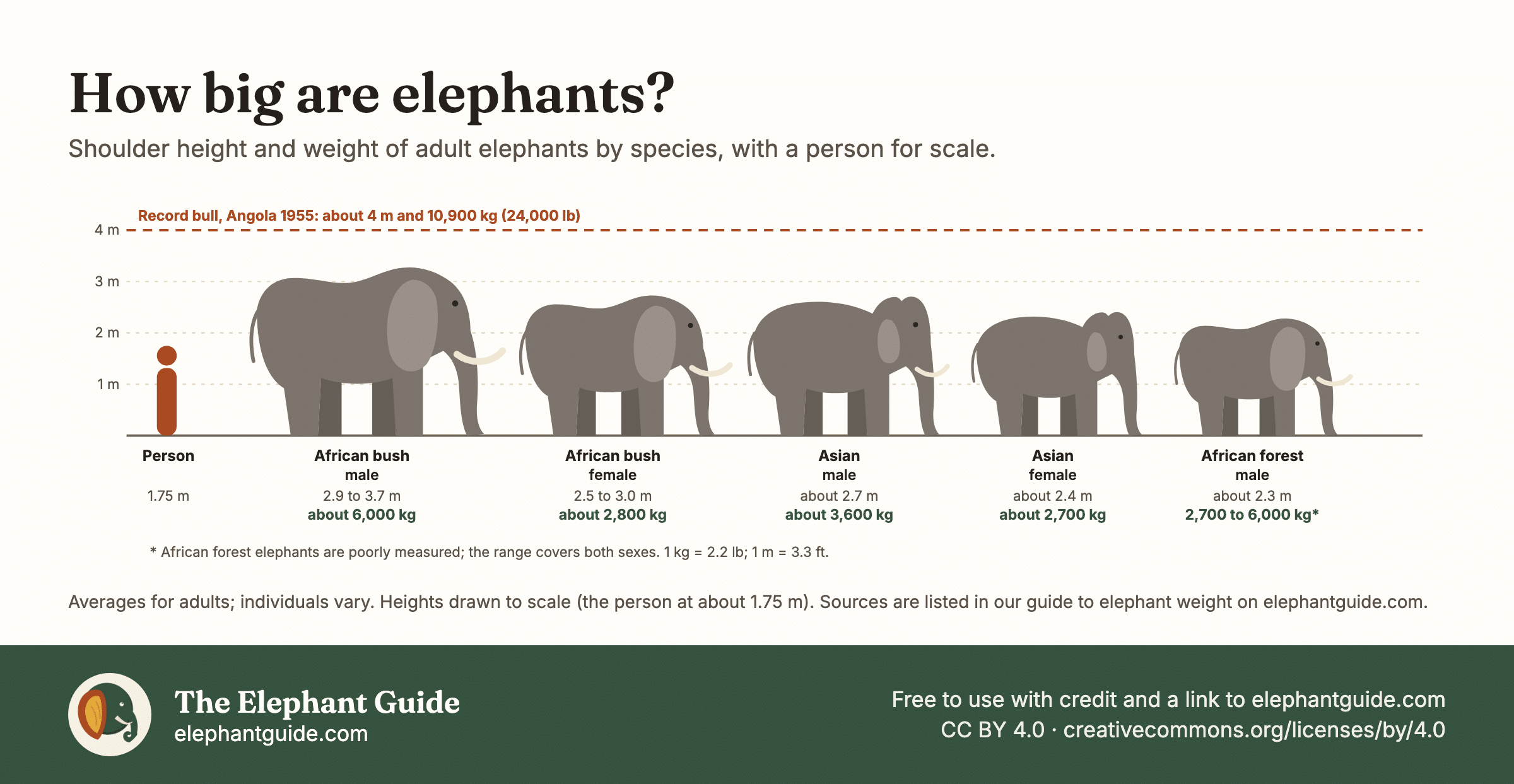
Adult male bush elephants typically measure 3.2 to 4.0 meters (11 to 13 feet) at the shoulder and weigh roughly 4,500 to 6,800 kilograms (9,900 to 15,000 pounds).
The largest recorded bush elephant, shot in Angola in 1955, weighed an estimated 10,900 kilograms (24,000 pounds) and stood about 4 meters (13 feet) at the shoulder.
Distinctive Features:
- Massive ears: Fan-shaped ears, often compared to the shape of the African continent, that can reach about 1.8 meters (6 feet) long
- Wrinkled skin: Skin folds that help dissipate heat
- Outward-curving tusks: Both males and females typically develop tusks
- Concave back: Distinctive dipped back profile
- Trunk characteristics: Two finger-like projections at the trunk tip
Savanna Adaptations
Bush elephants have evolved numerous adaptations for life in open savanna environments:
Thermoregulation: Large ears and skin folds help them shed heat in hot, open environments where shade is limited.
Feeding Strategies: A varied diet of grasses, leaves, bark, roots and fruit lets them use many plant resources.
Distribution and Habitat
Bush elephants inhabit a range of ecosystems across sub-Saharan Africa, with some of the largest populations in Southern and Eastern Africa.
Primary Habitats:
- Savannas and Grasslands: Open woodlands and grasslands of East Africa
- Semi-arid Regions: Kalahari Desert margins and similar environments
- Woodland Savannas: Mixed tree-grass ecosystems
- Floodplains: Seasonal wetlands and river systems
Current Range:
- Botswana: about 130,000 elephants (131,909 in the 2022 KAZA survey)
- Zimbabwe: more than 85,000 elephants (ZimParks, June 2026)
- Tanzania: about 66,700 elephants (2024/25 national census, down from more than 134,000 in 2005)
- Kenya: about 36,300 elephants (36,280 in the 2021 national wildlife census)
Conservation Status and Population Trends
African bush elephants are classified as Endangered by the IUCN, with populations declining due to multiple threats. However, their conservation status varies significantly across their range.
Population Trends:
- Overall decline: at least 60% over the last 50 years (IUCN)
- Regional variations: Some populations are stable or increasing (for example Botswana and South Africa)
- Poaching impact: an estimated 100,000 African elephants were killed for ivory in 2010 to 2012, roughly 33,000 a year on average (Wittemyer et al., 2014)
- Habitat loss: Agricultural expansion reduces available habitat
Kavango-Zambezi: The Kavango-Zambezi Transfrontier Conservation Area (KAZA) spans five countries (Angola, Botswana, Namibia, Zambia and Zimbabwe) and held an estimated 227,900 elephants in its 2022 survey, a population described as stable.
Tourism and Viewing Opportunities
Bush elephants offer spectacular viewing opportunities across numerous African destinations. Understanding seasonal elephant viewing patterns enhances the likelihood of memorable encounters while supporting conservation through responsible tourism.
Premier Destinations:
- Botswana: Chobe National Park and Okavango Delta
- Tanzania: Serengeti and Tarangire National Parks
- Kenya: Amboseli and Tsavo National Parks
- Zimbabwe: Hwange National Park
- South Africa: Kruger National Park

African Forest Elephant: The Rainforest Gardeners
African forest elephants (Loxodonta cyclotis) represent one of the world’s most endangered large mammals and play a crucial role as “ecosystem engineers” in Central and West African rainforests.
These smaller, more elusive elephants have evolved remarkable adaptations for life in dense forest environments.
Physical Characteristics and Forest Adaptations
Forest elephants typically measure 2.4 to 3.0 meters (7.9 to 9.8 feet) at the shoulder and weigh roughly 1,800 to 5,400 kilograms (4,000 to 12,000 pounds), though published estimates vary.
While smaller than their savanna relatives, forest elephants possess unique adaptations that make them perfectly suited for rainforest life.
Distinctive Features:
- Smaller, oval-shaped ears: Better suited for navigation through dense vegetation
- Straighter, downward-pointing tusks: Forest elephant tusks are straighter than the outward-curving tusks of bush elephants
Ecological Role as Forest Gardeners
Forest elephants serve as crucial ecosystem engineers, shaping rainforest structure and biodiversity through their feeding and movement patterns.
Seed Dispersal: Fruit dominates the forest elephant diet, and the seeds pass through the animal in its dung. A 2025 study in Science Advances found that ebony saplings dropped by 68% where elephants were absent, because elephant dung protects seeds from rodents and carries them far from the parent tree.
Carbon Storage: Forests with elephants have fewer but larger trees and store more carbon, because elephants thin out small trees (Berzaghi et al., Nature Geoscience, 2019). Without elephants, these forests could lose a large share of that carbon.
Critical Conservation Status
Forest elephants face an extinction crisis, with populations declining by more than 86% over 31 years. The IUCN classifies the species as Critically Endangered.
Catastrophic Decline Factors:
- Poaching Crisis: High-value ivory drives intensive poaching pressure
- Habitat Destruction: Logging and agricultural conversion destroy forest habitat
Recent Population Studies: A 2013 survey of the largest forest elephant dataset assembled found that:
- Population: Forest elephants in Central Africa fell by 62% between 2002 and 2011
- Range: The species lost 30% of its geographical range over the same period
- Today: The population is below 10% of its potential size and occupies less than 25% of its potential range
Remaining Strongholds
Despite the crisis, several areas maintain viable forest elephant populations:
Key Conservation Areas:
- Sangha Trinational (Cameroon/CAR/Congo): UNESCO World Heritage site since 2012, listed for its viable forest elephant populations
- Odzala-Kokoua National Park (Congo): Large intact forest ecosystem
- Lopé National Park (Gabon): Mixed forest-savanna habitat
- Dzanga-Sangha (Central African Republic): Famous for forest clearings
Conservation Efforts and International Response
The forest elephant crisis has prompted unprecedented international conservation efforts:
Anti-Poaching Initiatives: Wildlife Conservation Society runs conservation programs in Central Africa, including a forest elephant research camp at Langoué Baï in Gabon.
International Trade Controls: Most African elephant populations are in CITES Appendix I, and all international commercial trade in African elephant ivory is currently prohibited under CITES (four southern African populations sit in Appendix II, but their ivory is treated as Appendix I).
Limited Tourism Opportunities
Forest elephant viewing opportunities are limited but provide unique experiences for dedicated wildlife enthusiasts:
Recommended reading: The Best Destinations in the World to see Elephants in the wild
Viewing Locations:
- Dzanga Bai (CAR): Forest clearing where forest elephants gather, thought to be for the minerals in the soil
- Langoué Bai (Gabon): Remote forest clearing with a WCS research camp, where forest elephants gather
- Odzala (Congo): Guided forest walks and bai visits
Viewing Challenges:
- Dense vegetation: Limited visibility in forest environments
- Elusive behavior: Forest elephants are more wary of humans
- Access difficulties: Remote locations require specialized logistics
- Security concerns: Political instability affects some range areas
Species Comparison: Understanding the Differences
The differences between African bush and forest elephants extend across multiple biological and ecological dimensions, reflecting millions of years of separate evolution.
Physical Comparison Table
| Characteristic | Bush Elephant | Forest Elephant |
|---|---|---|
| Height (males) | 3.2-4.0m (11-13 ft) | 2.4-3.0m (7.9-9.8 ft) |
| Weight (males) | 4,500-6,800 kg | 1,800-5,400 kg |
| Ear Shape | Large, fan-shaped | Smaller, oval-shaped |
| Tusk Direction | Curved outward | Straight, downward |
| IUCN status (2021) | Endangered | Critically Endangered |
Behavioral and Ecological Differences
Social Structure:
- Bush elephants: Family groups led by a matriarch; elephant family units in general range from three to 25 animals (SeaWorld)
- Forest elephants: Smaller groups, usually two or three animals, often a mother and her dependent offspring (Gabon field study)
Feeding Behavior:
- Bush elephants: Grazers and browsers
- Forest elephants: A diet dominated by fruit, plus leaves and bark
Conservation Implications
The recognition of two distinct species has profound implications for conservation strategies:
Species-Specific Threats:
- Bush elephants: Poaching, habitat loss and human-wildlife conflict
- Forest elephants: Poaching and habitat loss, with a steeper recorded decline
Planning Your African Elephant Experience
Understanding species differences enhances wildlife viewing experiences and supports conservation through informed tourism choices.
Choosing Your Destination
For Bush Elephant Viewing:
- Botswana: Chobe and the Okavango Delta
- Tanzania: Tarangire and Serengeti
- Kenya: Amboseli
- South Africa: Kruger National Park
For Forest Elephant Viewing:
- Gabon: Lopé National Park and Langoué Baï
- Central African Republic: Dzanga Bai, subject to local security conditions
- Republic of Congo: Odzala-Kokoua National Park
Conservation Outlook and Future Challenges
The future of African elephants depends on addressing species-specific conservation challenges while maintaining the ecological integrity of their respective habitats.
Bush Elephant Conservation Priorities
Habitat Connectivity: Protecting migration corridors and seasonal ranges across international boundaries remains crucial for maintaining viable bush elephant populations.
Human-Wildlife Conflict: Developing sustainable coexistence strategies as human populations expand into traditional elephant ranges.
Tourism Balance: Managing tourism pressure while maximizing conservation benefits and community support.
Forest Elephant Emergency Response
Anti-Poaching Intensification: Poaching remains a leading threat to forest elephants, so enforcement in the remaining intact forest matters.
Habitat Protection: Preserving remaining intact forest ecosystems and creating protected corridors between fragmented populations.
International Cooperation: Coordinated efforts across range states to address transboundary conservation challenges.
Climate Change Implications
Drought and a changing climate add pressure on both species. Two documented examples:
Bush Elephants: Kenya recorded 205 elephant deaths between February and October 2022 during the worst drought in East Africa in 40 years, according to the tourism ministry; the true toll may be higher.
Forest Elephants: In Lopé National Park, Gabon, fruit production fell 81% between 1986 and 2018 and forest elephant body condition has fallen 11% since 2008; warming may be a factor, but this is not confirmed (Science, 2020).
Conclusion: Two Species, One Conservation Mission
The recognition of African bush and forest elephants as distinct species has revolutionized our understanding of elephant diversity and conservation needs.
While bush elephants face significant challenges, their populations remain relatively stable in some regions. Forest elephants, however, have declined by more than 86% over 31 years and are listed as Critically Endangered.
For wildlife enthusiasts, understanding these species differences enhances appreciation for elephant diversity and supports more informed conservation choices. Whether witnessing the spectacular gatherings of bush elephants in Botswana’s Chobe National Park or experiencing the rare privilege of observing forest elephants in Central African rainforests, each encounter contributes to the broader mission of elephant conservation.
The future of both species depends on our collective commitment to protecting their habitats, supporting local communities, and addressing the underlying drivers of elephant decline. Through responsible tourism, conservation support, and continued research, we can ensure that future generations will have the opportunity to witness the majesty of both African elephant species in their natural habitats.
As we continue to learn about these remarkable animals, one thing remains clear: the diversity of African elephants reflects the incredible adaptability and resilience of life on Earth. Protecting both species is not just about preserving individual populations. It’s about maintaining the ecological integrity of Africa’s most important ecosystems and honoring our responsibility as stewards of the natural world.
Frequently asked questions
The bush elephant is larger, lives on open savanna and carries outward-curving tusks, while the forest elephant is smaller, lives in the rainforests of Central and West Africa and carries straighter, downward-pointing tusks suited to moving through dense vegetation. They are separate species, not regional variants.
Yes. Genetic research established that they are two distinct species, Loxodonta africana and Loxodonta cyclotis, rather than subspecies of one. The IUCN Red List assessed them separately for the first time in 2021, listing the bush elephant as Endangered and the forest elephant as Critically Endangered.
Critically Endangered. Forest elephant populations have fallen by more than 86% over 31 years, driven by poaching and the loss of Central African rainforest.
Bush elephants are seen across the savanna parks of East and Southern Africa, which is where most elephant safaris operate. Forest elephants are far harder to see because they live in dense Central and West African rainforest.
Sources
Where the main facts in this article come from. Links open in a new tab.
- IUCN, African elephant species now Endangered and Critically Endangered, 2021
- Science News, Genes separate Africa’s elephant herds (on Rohland et al., PLoS Biology, 2010)
- Rohland et al., Genomic DNA sequences from mastodon and woolly mammoth reveal deep speciation of forest and savanna elephants, PLoS Biology, 2010
- San Diego Zoo Wildlife Alliance, Elephant species page
- IFAW, Differences between African and Asian elephants
- Mongabay, Analysis of the largest elephant surveys ever, 2024
- Euronews, Conflict between humans and Zimbabwe’s 100,000 elephants is growing, 2025
- KAZA TFCA, 2022 KAZA elephant survey results
- Colorado State University, Study verifies more than 100,000 African elephants killed in three years, 2014
- Wittemyer et al., Illegal killing for ivory drives global decline in African elephants, PNAS, 2014
- Maisels et al., Devastating decline of forest elephants in Central Africa, PLoS ONE, 2013
- LSCE, Collapse of forest elephant populations reduces aboveground carbon stocks (Berzaghi et al., Nature Geoscience, 2019)
- Mongabay, As forest elephants plummet, ebony trees decline in Central Africa, 2025
- University of Stirling, Gabon forest fruit production decline, 2020
- Al Jazeera (Reuters), Drought has killed 205 Kenyan elephants in 10 months, 2022
- SeaWorld, Elephant behavior
- IUCN World Heritage Outlook, Sangha Trinational
- WCS Gabon, Langoué Baï
- Abundance, density and social structure of African forest elephants in southwestern Gabon, 2020
- PBS Nature, Elephants and the poaching problem
- The Citizen (Tanzania), Why Tanzania’s elephant population has declined sharply (TAWIRI 2024/25 census)
- Phys.org (AFP), Kenya hails anti-poaching efforts in first wildlife census, 2021
- Conservation Action Trust, Current rules on commercial international trade in elephant ivory under CITES
- National Geographic, African forest elephant
- Smithsonian Institution Archives, Fénykövi elephant diagram (1955 measurements, unveiled 1959)
- Encyclopaedia Britannica, African bush elephant
- Encyclopaedia Britannica, African forest elephant
- IUCN Red List, African savanna elephant (Loxodonta africana)
- IUCN Red List, African forest elephant (Loxodonta cyclotis)
Keep reading
Elephant Evolution & Extinct Relatives: The Full Story
Today just three species of elephant survive, but they are the last twigs on a vast, 60-million-year family tree. Their ancestors began as small…

Is an Elephant a Mammal? Classification Explained
It’s a question that comes up more than you’d think, maybe because of their tough, wrinkled, almost reptilian-looking skin. But yes: the elephant is…

Borneo Pygmy Elephants: Where to See Them
The Borneo pygmy elephant is often treated as a genetically distinct subspecies of the Asian elephant and is one of the smallest elephants alive.…