
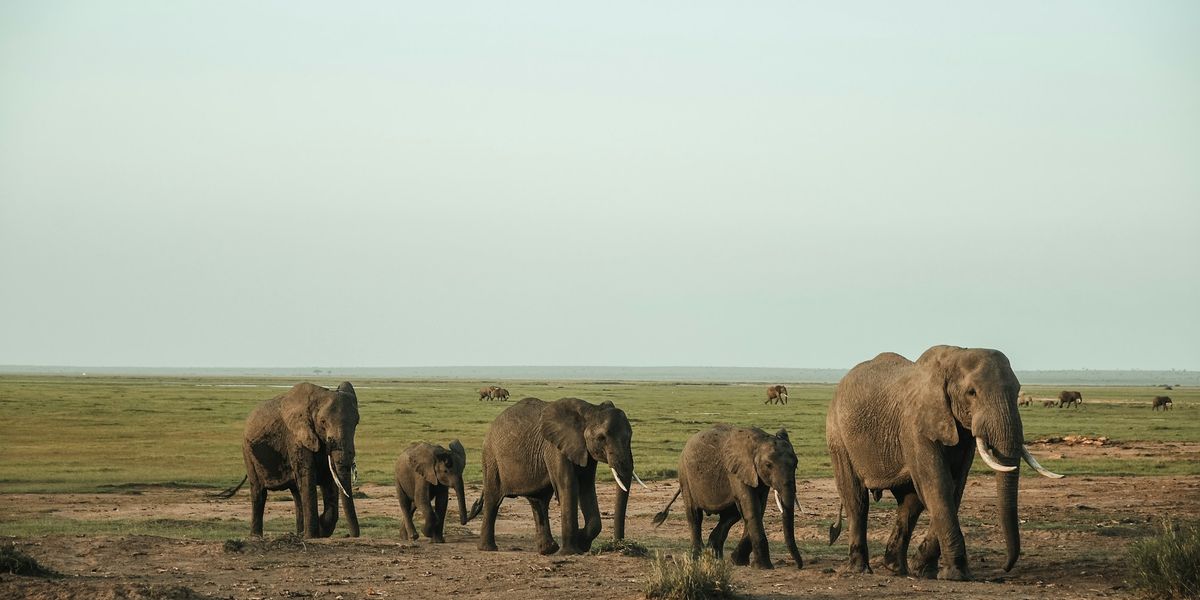
“An elephant never forgets.” It’s one of the most famous sayings about any animal — and unlike the myth that elephants are afraid of mice, this one is largely true. Elephants have some of the best long-term memories in the animal kingdom, and that memory is no party trick: it can mean the difference between life and death for the whole herd.
The short answer: yes — elephants have exceptional long-term memory. Matriarchs remember water sources, migration routes and individual elephants for decades, and that recall has been shown to help herds survive droughts.
Do elephants really never forget?
The saying is an exaggeration — no animal has a literally perfect memory — but elephants come remarkably close. They excel at long-term social, spatial and episodic memory: recalling places, routes, other elephants and even individual humans across many years. It’s one of the clearest signs of just how intelligent elephants are.
The matriarch’s memory can save the herd
The most striking proof comes from droughts. Elephant herds are led by a matriarch — the oldest female — and her memory of where to find water in a crisis can save lives. During a severe 1993 drought in Tanzania’s Tarangire National Park, herds led by older matriarchs (aged 38 and 45) left the parched park for remembered water sources and survived. A herd with a younger 33-year-old matriarch stayed put — and lost 20% of its calves, ten times the normal rate.
Matriarchs have led their families to water holes they last visited 35 to 45 years earlier — memory measured in decades.
It’s a powerful reminder of why the oldest elephants are so vital to a herd, and why losing them to poaching is so damaging (see why elephants are endangered).
How good is an elephant’s memory? The science
Elephant memory is built on serious brain hardware. The hippocampus — the brain region that turns experiences into long-term memories and handles spatial navigation — is exceptionally large in elephants, making up about 0.7% of the brain (compared with ~0.5% in humans). Combined with a huge temporal lobe, it lets elephants:
- recall water sources and routes they last used 35–45 years earlier;
- recognise dozens of individual elephants by sight, scent and voice;
- remember specific humans — both kind and cruel — for years;
- retain detailed mental maps of vast home ranges.
The four types of elephant memory
Spatial memory is the ability to map and recall locations across vast territories. African savanna elephants range over home ranges of up to 11,000 km². They navigate using remembered landmarks, dry-season water sources, and migration corridors that have been used by the same family for generations. GPS tracking studies have confirmed that elephants make purposeful, direct routes to specific water sources they have not visited in months or years — not wandering exploration, but deliberate recall-driven navigation.
Social memory underpins the whole structure of elephant society. Elephants live in complex, multigenerational groups and can recognise over 100 individual elephants by sight, smell and the characteristic low-frequency rumbles each elephant produces. Karen McComb’s Amboseli research found that matriarchs could correctly identify “friends” (familiar allied families) versus “strangers” from their rumbles alone — and respond defensively to the latter. This social recognition persists even after long separations, allowing reunions between elephants that have not shared a range for years.
Episodic memory — the recall of specific past events rather than just places or individuals — was once thought to be uniquely human. The most striking documented example involves Shirley and Jenny, two elephants at The Elephant Sanctuary in Tennessee, who showed extraordinary recognition behaviour when they met in 1999 despite having spent time together only briefly at a circus 23 years earlier. Sanctuary staff described an immediate, intense mutual recognition. Whether this constitutes true episodic memory in the strict cognitive science sense is debated, but the behavioural evidence is compelling.
Olfactory memory may be the deepest and most long-lasting of all. A 2023 study found that African elephants could distinguish the scent of Maasai (a group that has historically posed a threat to them) from Kamba (a non-threatening group) based on red cloth worn by each group, responding with elevated vigilance to Maasai-associated scents even when the source was not visible. This suggests that smell-linked memories are stored with high fidelity over years and can trigger complex threat-assessment responses — a form of memory with direct survival value.
Do elephants remember people?
Yes. There are well-documented accounts of elephants recognising individual people — keepers, researchers, even former handlers — after many years apart, greeting some warmly and remaining wary of others who once harmed them. Their memory is social as well as spatial.
Do elephants remember their dead?
One of the most moving signs of elephant memory is how they treat death. Elephants will pause at the bones and tusks of dead elephants, gently touching and turning them with their trunks, and have been seen returning to the remains of relatives. This apparent mourning is tied to the same deep social memory — and it raises a compelling question: do elephants actually cry? The evidence for real emotional grief is surprisingly strong. More on their bonds in our guide to elephant herds and social behaviour.
Where does “an elephant never forgets” come from?
The saying predates modern science by centuries. Roman and Greek writers noted elephants for their intelligence and long-lived nature, and the Roman author Pliny the Elder described elephants as animals with exceptional memory and the capacity to harbour grudges across years. The observation was practical — handlers and traders had seen it first-hand.
In English, the phrase “an elephant never forgets” became widespread in the 19th century, driven largely by circus culture. That reputation is also the root of the animal’s symbolic meaning, where memory sits alongside strength and wisdom — see what an elephant symbolizes. Circus elephants regularly demonstrated recall of specific trainers and handlers after years of separation, and the saying spread as a shorthand for that extraordinary fact.
The modern scientific validation came later: what elephant handlers had observed over centuries turned out to be grounded in real neuroanatomy — an unusually large hippocampus and temporal lobe. The anecdotes were largely accurate; researchers just lacked the mechanism. Studies from the 1990s onwards (Tarangire drought data, McComb’s Amboseli rumble experiments, sanctuary reunion records) provided the rigorous evidence the saying always lacked.
A note on searches: “elephant trick for memory” is a popular search that refers to a human mnemonic technique or supplement brand — not anything to do with elephant biology. This article covers only the biology of elephant memory itself.
The bottom line
“Elephants never forget” is more fact than fiction: elephants have outstanding long-term memory, powered by an unusually large hippocampus, and a matriarch’s decades-deep recall can save her whole family in a drought. Keep exploring elephant intelligence: herds and family life, how elephants communicate, and what elephants are afraid of.
Frequently asked questions
Not literally — no animal has a perfect memory — but elephants have exceptional long-term memory, particularly for spatial routes, social relationships and threatening individuals. The saying is grounded in real biology.
Decades. Matriarchs have navigated to water sources not visited for 35–45 years. Sanctuary elephants have recognised companions after 23-year separations. There is no known upper limit to elephant long-term memory.
Elephants have an unusually large hippocampus (around 0.7% of brain volume, versus ~0.5% in humans) and a large temporal lobe. These regions handle long-term memory formation, spatial navigation and social recognition — the exact memory types where elephants excel.
Yes. Elephants have been documented recognising individual keepers, researchers and handlers after years apart, responding differently to those who were kind versus those who harmed them. Both positive and negative memories of humans persist long-term.
Elephants show strong behavioural signs of recognising and mourning their dead, pausing at and touching the bones and tusks of deceased elephants — including relatives — sometimes years after death. This is tied to deep social memory and is one of the most compelling signs of elephant emotional intelligence.
This is a human memory technique or supplement brand, not related to elephant biology. This article covers actual elephant memory — how elephants themselves remember. If you’re looking for human memory tips, this is not the right article.
Elephants are widely regarded as having the best long-term memory of any land animal, particularly for social and spatial information over decades. Dolphins and chimpanzees also have strong long-term memory, but neither shows the decades-long spatial recall documented in elephant matriarchs.
Elephants have a larger hippocampus relative to brain size than humans (~0.7% vs ~0.5%) and show superior long-term recall for spatial routes and social relationships. Humans surpass elephants on working memory and abstract reasoning. The comparison is not straightforward — each species excels at the memory tasks most relevant to its survival.
The saying traces back to ancient Roman and Greek observations of elephant intelligence. It entered modern English in the 19th century through circus culture and wildlife writing. Modern science has confirmed the core claim — especially for matriarchs’ decades-long spatial and social recall.