
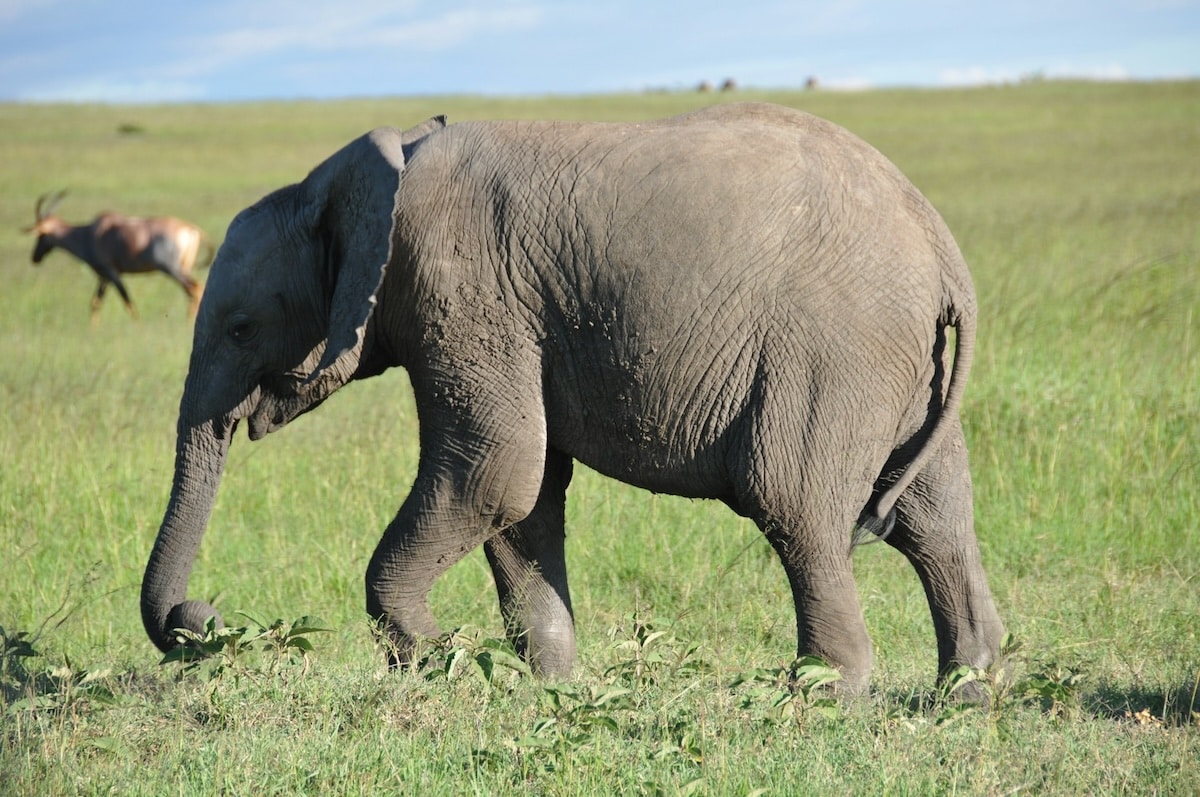
The Borneo pygmy elephant is the smallest – and most genetically distinct – subspecies of Asian elephant on earth. Found only on the island of Borneo, and almost entirely within the Malaysian state of Sabah, it’s one of the rarest elephants in the world. Roughly 1,000 to 1,500 of them are left in the wild.
Borneo pygmy elephants (Elephas maximus borneensis) are a subspecies of the Asian elephant found only on the island of Borneo, mostly in the Malaysian state of Sabah. They stand around 2.5 metres (8 feet) tall at the shoulder – roughly 30 to 60 cm shorter than mainland Asian elephants – with rounder faces, larger ears, longer tails, and straighter tusks. Only 1,000 to 1,500 remain in the wild, mostly along the Kinabatangan River and in Tabin, Deramakot, and Danum Valley forest reserves. They’re classified as Endangered by the IUCN and are threatened primarily by palm-oil-driven deforestation.
This guide covers what makes Borneo pygmy elephants a distinct subspecies, how big they actually are, where to see them in Borneo, the palm-oil conflict threatening their habitat, and what responsible tourism for this species looks like.
Borneo Pygmy Elephants at a Glance
| Scientific name | Elephas maximus borneensis |
| Range | Island of Borneo – mostly Sabah (Malaysian Borneo), small population in Kalimantan (Indonesian Borneo) |
| Wild population | Approximately 1,000 to 1,500 |
| Conservation status | Endangered (IUCN) |
| Shoulder height | Around 2.5 metres (8 feet) for adult males |
| Weight | Around 2,500 to 3,000 kg (5,500 to 6,600 lb) |
| Distinguishing features | Smaller size, rounder face, larger ears, longer tail (often touching the ground), straighter tusks |
| Best places to see them | Kinabatangan River (Sukau, Sabah); Tabin, Deramakot, and Danum Valley forest reserves |
What Are Borneo Pygmy Elephants?
Borneo pygmy elephants are the smallest and most isolated population of Asian elephants. For a long time, scientists weren’t sure whether they were genuinely native to Borneo or descended from a small group of captive elephants introduced by the Sultan of Sulu in the 17th or 18th century.
A 2003 genetic study by Prithiviraj Fernando and colleagues settled the debate. DNA analysis showed that Borneo’s elephants diverged from mainland Asian elephants around 300,000 years ago, which is far too long ago for an 18th-century introduction. They’re a genuine native subspecies, isolated on Borneo since the last Ice Age.
That genetic distinctness is why the Borneo pygmy elephant is now classified as its own subspecies (Elephas maximus borneensis) – separate from the Indian (indicus) and Sri Lankan (maximus) subspecies. In 2024, the IUCN further upgraded their threat status to Endangered.
How Big Are Borneo Pygmy Elephants?
Borneo pygmy elephants are noticeably smaller than other Asian elephants. The difference is consistent enough that researchers use body dimensions alongside DNA to identify the subspecies.
| Measure | Borneo pygmy | Mainland Asian elephant |
|---|---|---|
| Shoulder height (adult male) | 2.3 to 2.5 m (~8 ft) | 2.7 to 3.0 m (~9 to 10 ft) |
| Shoulder height (adult female) | 1.9 to 2.2 m | 2.4 to 2.6 m |
| Weight | 2,500 to 3,000 kg | 3,000 to 5,000 kg |
| Face shape | Rounder, babyish | Longer, more angular |
| Ears | Proportionally larger | Smaller |
| Tail | Longer, often touches ground | Shorter |
| Tusks (males) | Straighter | More curved |
Despite the name, “pygmy” is a slightly misleading label. The size difference is real but relatively modest – a Borneo pygmy is still a large animal, weighing as much as a mid-sized car. They’re also called Bornean elephants, which is the more scientifically preferred name.
For a full species comparison, see our guide on African vs Asian elephants.
How Many Borneo Pygmy Elephants Are Left?
The most commonly cited estimate is 1,000 to 1,500 individuals, almost all of them in the Malaysian state of Sabah. A smaller population of around 50 to 100 lives across the border in Indonesian Kalimantan.
Sabah’s Wildlife Department periodically conducts dung-based population surveys because the elephants are too hard to count directly in dense rainforest. The numbers have trended downward over the past two decades as palm oil expansion has fragmented their habitat.
For global elephant population context, see our guide on how many elephants are left in the world.
Best Places to See Borneo Pygmy Elephants
Sightings are not guaranteed. These elephants roam across hundreds of square kilometres of rainforest, and most of the year they’re deep in the forest interior. The best viewing opportunities are in areas where rivers or logging roads funnel herds close to accessible viewing points.
1. Kinabatangan River (Sabah, Malaysia)
The Lower Kinabatangan Wildlife Sanctuary is the single best place to see Borneo pygmy elephants. The sanctuary protects a 26,000-hectare forest corridor along the Kinabatangan River, and elephants regularly come to the riverbank to drink and cross.
- Base town: Sukau, around 2.5 hours by road from Sandakan airport
- How to see them: Guided boat cruises at dawn and dusk along the river. Most lodges run 2 to 3 cruises a day.
- When to go: March to October is drier and has better visibility. Wildlife is present year-round.
- Hit rate: Multi-day stays usually produce at least one sighting, but no trip can guarantee it.
2. Tabin Wildlife Reserve (Sabah, Malaysia)
Tabin is a 1,200 sq km lowland rainforest reserve east of Lahad Datu. It holds a resident elephant population along with orangutans, Bornean pygmy orangutans, and proboscis monkeys. Sightings are less frequent than on the Kinabatangan, but Tabin tends to be quieter and the forest is more intact.
- Base town: Lahad Datu (2 hour road transfer to Tabin Wildlife Resort)
- How to see them: Night drives on reserve roads, jungle walks with rangers, salt lick visits.
3. Deramakot Forest Reserve (Sabah, Malaysia)
Deramakot is a sustainably-managed logging concession that doubles as one of the best mammal-watching areas in Borneo. It’s a favourite among serious wildlife photographers for clouded leopards and elephants. Access is by permit only and typically requires a specialist operator.
- Access: Permit-only. Usually booked through Sabah-based wildlife tour operators.
- How to see them: Night drives on logging roads, often in custom 4WD vehicles.
- Hit rate: Low but high quality when it happens – relatively undisturbed populations behaving naturally.
4. Danum Valley Conservation Area (Sabah, Malaysia)
Danum Valley is a 438 sq km block of primary lowland rainforest south of Lahad Datu, widely considered one of the best-preserved rainforests in Southeast Asia. Elephants pass through but sightings are rare – the forest is dense and the herds move over large distances.
- Base lodge: Borneo Rainforest Lodge (premium) or the Danum Valley Field Centre (budget)
- Primary draw: Orangutans, hornbills, gibbons; elephants are a bonus rather than a target
5. Borneo Elephant Sanctuary (Lok Kawi, Sabah)
The Borneo Elephant Sanctuary at the Lok Kawi Wildlife Park near Kota Kinabalu is a government rehabilitation centre for orphaned and injured elephants that cannot be released. It’s worth visiting for education value, but it’s a captive facility – not a wild-elephant experience.
- Base: Lok Kawi (30 minutes from Kota Kinabalu)
- What to expect: Viewing platforms, feeding sessions, keeper talks. No rides.
When Is the Best Time to See Pygmy Elephants in Borneo?
Borneo has a tropical climate with no strict dry season, but there’s a useful window. The months of March to October tend to be drier, with better boat conditions and clearer trails. November to February is the monsoon – heavier rain, higher river levels, and trickier logistics.
Elephants are present year-round. The difference is your comfort, not their presence. For a multi-region viewing calendar, see our seasonal elephant viewing guide, or browse our full elephant destinations hub for country-by-country coverage.
Threats: Palm Oil and the Borneo Pygmy Elephant
The biggest threat to the Borneo pygmy elephant isn’t poaching – it’s palm oil. Sabah has lost more than 40 percent of its original lowland rainforest to oil palm plantations over the past four decades. The Kinabatangan floodplain, historically the elephants’ core habitat, is now a fragmented mosaic of small forest patches surrounded by plantation monoculture.
This fragmentation causes three escalating problems:
- Loss of natural food. Elephants push into plantations to feed, where they’re seen as pests.
- Human-elephant conflict. Elephants that raid plantations are sometimes killed by plantation workers or poisoned.
- Isolated populations. Small forest fragments can’t support viable elephant groups long-term.
The most serious recent incident was in early 2013, when 14 Borneo pygmy elephants were found dead near the Gunung Rara Forest Reserve. Investigations concluded the elephants had been deliberately poisoned, though no conviction followed. The case drew international attention to the plight of the subspecies and helped spur additional conservation funding.
Our guide on why elephants are endangered covers the broader conservation picture.
Responsible Tourism for Borneo Pygmy Elephants
Unlike mainland Asian destinations, Borneo doesn’t have a heavy captive-elephant tourism industry. There are no commercial riding operations, no significant temple-elephant issue, and no “walking with elephants” camps. The main ethical questions are more subtle.
- Choose accredited lodges. The better Kinabatangan lodges follow strict guidelines: keeping distance, turning off engines, no flash photography.
- Don’t push for a “guaranteed sighting”. Pressure on operators creates incentives to harass elephants into predictable behaviour. Accept that sightings are uncertain.
- Support certified sustainable palm oil. RSPO (Roundtable on Sustainable Palm Oil) certification has real flaws, but it’s the main market mechanism pushing back against deforestation.
- Donate to Sabah-based conservation groups. The Borneo Conservation Trust, HUTAN (Kinabatangan Orangutan Conservation Programme, which also monitors elephants), and Seratu Aatai are reputable and on-the-ground.
- Visit in small groups. Kinabatangan river boats are better when they’re not crowded. Ask your operator about group sizes.
For the broader responsible-tourism checklist, see our guide on visiting elephant sanctuaries and orphanages.
How to Plan a Trip to See Borneo Pygmy Elephants
A typical elephant-focused Borneo itinerary looks like this:
- Fly into Sandakan or Kota Kinabalu, Sabah. Sandakan is closest to the Kinabatangan and Tabin. Kota Kinabalu is the main Sabah hub.
- Spend 3 to 4 nights in the Kinabatangan. Sukau is the classic base. Include morning and evening river cruises.
- Add 2 to 3 nights at Tabin Wildlife Reserve for a quieter forest experience.
- Optional: Extend to Danum Valley for primary rainforest, or combine with Sepilok for the orangutan rehabilitation centre.
Most Borneo elephant-viewing trips also include orangutans (Sepilok or Danum), proboscis monkeys (Kinabatangan), and hornbills. The same lodges and operators cover all of it.
FAQ about Borneo Pygmy Elephants
The Borneo pygmy elephant (Elephas maximus borneensis) is a subspecies of the Asian elephant, found only on the island of Borneo. A 2003 DNA study confirmed they’re genetically distinct from mainland Asian elephants, having been isolated on Borneo for around 300,000 years. They are smaller, rounder-faced, and have longer tails than their mainland cousins.
Adult male Borneo pygmy elephants stand around 2.3 to 2.5 metres (about 8 feet) at the shoulder and weigh 2,500 to 3,000 kg. They’re 30 to 60 cm shorter than mainland Asian elephants on average. Despite the name ‘pygmy’, they’re still large animals – roughly the weight of a mid-sized car.
Around 1,000 to 1,500 Borneo pygmy elephants remain in the wild, almost all of them in the Malaysian state of Sabah. A smaller population of 50 to 100 individuals lives across the border in Indonesian Kalimantan. The IUCN classifies them as Endangered.
Borneo pygmy elephants are smaller than other Asian elephants (about 30 to 60 cm shorter at the shoulder), have rounder faces, larger ears, longer tails that often touch the ground, and straighter tusks in males. They’re also restricted to a single island, whereas other Asian elephant subspecies are spread across mainland Asia.
The Lower Kinabatangan Wildlife Sanctuary in Sabah is the most reliable place, viewed from morning and evening river cruises out of Sukau. Tabin Wildlife Reserve and Deramakot Forest Reserve offer quieter viewing but lower hit rates. Danum Valley is a possibility but elephants are secondary to orangutans there.
Habitat loss from palm oil plantations is the primary threat. Sabah has lost more than 40 percent of its original lowland rainforest in recent decades, fragmenting elephant habitat and driving human-elephant conflict. A notorious 2013 poisoning event killed 14 elephants and brought international attention to the crisis.
They’re a subspecies, not a separate species. Genetic analysis shows they branched off from mainland Asian elephants around 300,000 years ago but are still classified within Elephas maximus. Their full scientific name is Elephas maximus borneensis.
No, and this is a good thing. Sabah does not have a commercial elephant-riding industry. Wild elephants are viewed from boats and jeeps on carefully managed safari operations, and the only captive facility (the Borneo Elephant Sanctuary at Lok Kawi) is a rehabilitation centre that doesn’t offer rides.