Elephants don’t just have big babies — they have the longest pregnancy of any land animal on Earth. A mother elephant carries her calf for roughly 22 months, almost two full years, before giving birth to a 200-pound newborn that can stand and walk within an hour. Here is exactly how long elephants are pregnant, why the gestation period is so extraordinarily long, and what happens when the calf finally arrives.
The short answer: an elephant’s gestation period is about 22 months (640–660 days) — the longest of any mammal on land. African elephants average ~640–673 days; Asian elephants are similar, up to around 22 months.
How long are elephants pregnant?
An elephant’s gestation period lasts about 22 months — close to two years. That is more than double a human pregnancy and the longest of any land mammal. The exact length varies a little between the two species:
| Species | Gestation period | Newborn calf weight |
|---|---|---|
| African elephant | ~640–673 days (~22 months) | 220–265 lb (100–120 kg) |
| Asian elephant | ~620–680 days (~18–22 months) | 200–250 lb (90–115 kg) |
Females (cows) usually carry a single calf — twins are rare. Because the pregnancy is so long, elephants reproduce slowly, which is one reason populations recover so slowly from poaching and habitat loss (see why elephants are endangered).
Why is an elephant’s pregnancy so long?
Such a long gestation comes down to one thing: building a big, brainy, ready-to-walk baby. A few key reasons:
- Brain development. Elephants are highly intelligent, social animals. The calf’s large brain needs extra time to develop in the womb, so it is born ready to learn from the herd.
- Born ready to move. Elephant calves are precocial — they can stand within about 20 minutes and walk within an hour, essential for keeping up with a moving herd and escaping predators.
- Sheer size. Growing a 200-pound newborn simply takes time.
At nearly two years, the elephant’s pregnancy is the longest of any land mammal — longer than a giraffe, a rhino, or a whale.
The biology: what makes elephant pregnancy so unusual
Most mammals sustain pregnancy through a single corpus luteum — a temporary hormonal gland that forms on the ovary after ovulation, produces progesterone for a few weeks, and then degrades once the placenta takes over. Elephants do something found in no other land mammal: they maintain four to five simultaneous corpora lutea throughout the entire 22-month pregnancy. This unusual arrangement keeps progesterone levels elevated far longer than any standard mammalian blueprint would predict, effectively running a hormonal relay for nearly two years.
For decades, this hormonal quirk created a genuine scientific puzzle. Until the 1970s and 1980s, researchers could not reliably detect elephant pregnancy biochemically because the hormone signatures looked nothing like those of other mammals. Progesterone levels in pregnant elephants were lower than expected and followed patterns that did not map onto existing models. Zoo keepers managing captive herds sometimes had no idea a cow was pregnant until she was only weeks from giving birth — the belly drop arrived late, and early-stage hormonal tests returned ambiguous results. It was not until researchers developed elephant-specific assays and applied systematic ultrasound monitoring that reliable early detection became possible.
Brain development is the core driver of that extraordinary duration. An elephant calf’s brain is roughly 35% of its adult size at birth — a higher proportion than in humans (around 25% at birth) and far more developed than most newborn mammals. That level of neurological readiness does not come quickly. The calf must be born socially aware: able to recognise its mother’s voice and scent, begin processing complex herd vocalisations, and start forming the social bonds that will define its entire life. There is simply no shortcut to building a brain capable of all that.
Key fact: Elephants maintain 4–5 active corpora lutea throughout the entire pregnancy — a hormonal arrangement found in no other land mammal.
How big is a newborn elephant calf?
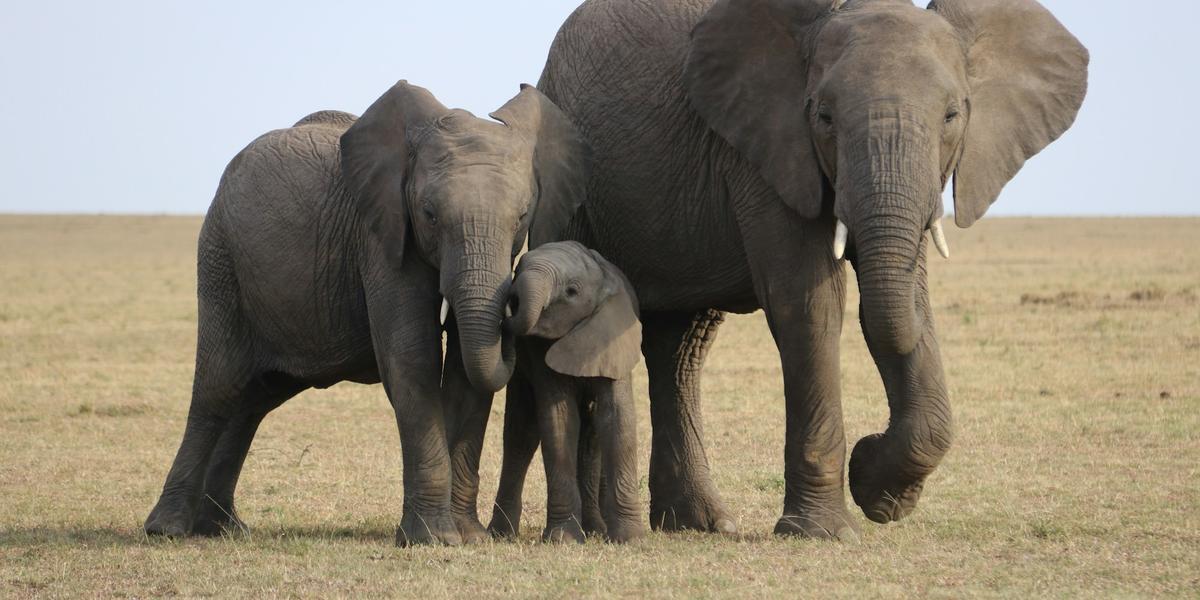
A newborn elephant is already enormous by animal standards: about 200–265 pounds (90–120 kg) and roughly 3 feet (1 m) tall at the shoulder. Within 20 minutes it can stand, and within an hour or two it can walk with the herd. Calves nurse for 2–4 years — though they start experimenting with plants early (here’s what elephants eat). Learn more in our guide to baby elephants.
What happens during the 22 months
Twenty-two months is a long time. Here is what is actually happening inside the womb — and in the herd — across the three broad stages of elephant gestation.
First seven months (early gestation). Fertilisation occurs within a narrow window: a cow is in oestrus for only two to three days, and conception must happen within that time. The embryo implants within two to three weeks, and the calf’s heart begins beating around day 22. Sex is determined early, though external differentiation takes considerably longer. From the outside, the cow shows no visible signs at all — experienced matriarchs in the herd may pick up on subtle behavioural shifts before any physical change is apparent, but a human observer would see nothing out of the ordinary.
Months seven to fourteen (middle gestation). The calf’s trunk forms during this period and begins practising suction and grasping movements — the muscular coordination that will be essential for feeding and social interaction after birth. The characteristic deeply wrinkled skin starts developing. The growing calf becomes detectable by abdominal ultrasound, which is now the standard tool for pregnancy monitoring in captive herds. Bulls in musth may show heightened interest in the cow during this stage.
Months fourteen to twenty-two (final stretch). This is the period of most rapid growth. The calf gains roughly 1 kg per day in the final trimester, and the cow’s belly drops noticeably in the final weeks. The herd begins to respond: a close female — often a sister, a daughter from a previous birth, or another trusted herd member — takes on the role of allomother, staying within a few metres of the labouring cow as birth approaches. Labour typically lasts between 30 and 60 minutes.
The birth itself is unlike most large mammals: elephant calves are born hind-legs first. What would be a dangerous breech presentation in many species is the normal, expected delivery position for elephants. The amniotic sac breaks as the calf emerges. The allomother and other herd females are typically present, and the herd vocalises loudly — low rumbles, trumpets and contact calls — as the newborn arrives. The calf can stand within 15 to 20 minutes and begins nursing within the first hour.
How often do elephants give birth?
Because each pregnancy lasts so long and calves nurse for years, elephants breed slowly. A healthy cow gives birth roughly once every 4–5 years (the calving interval can stretch to 4–8 years depending on conditions), and may raise around 7–12 calves over a lifetime that can reach 60–70 years. See how long elephants live for the full lifecycle.
Which animal has the longest pregnancy?
The elephant holds the record among all land mammals — but the full picture across the animal kingdom is more surprising than you might expect.
| Animal | Average gestation | Notes |
|---|---|---|
| African elephant | ~22 months | Longest of any land mammal |
| Asian elephant | ~18–22 months | Slight variation by subspecies |
| Orca (killer whale) | ~17 months | Longest of any dolphin or whale species |
| White rhinoceros | ~16 months | Second longest land mammal |
| Walrus | ~15–16 months | Includes ~4-month delayed implantation |
| Giraffe | ~15 months | Calf drops 6 ft at birth |
| Camel | ~13 months | Both Bactrian and dromedary |
| Blue whale | ~11–12 months | Shorter than elephant despite being far larger |
| Horse | ~11 months | Single foal, also precocial |
| Human | ~9 months | |
| Hippo | ~8 months | |
| Dog | ~2 months |
Surprisingly, the blue whale — the largest animal on Earth — has a shorter pregnancy than the elephant. Size alone doesn’t determine gestation length; brain complexity does.
Outside mammals, the frilled shark holds the overall animal kingdom record at an estimated 3.5 years — but sharks are not mammals. Among all mammals including marine species, the elephant is rivalled only by the orca at around 17 months, and it still wins comfortably. The elephant’s 22-month gestation stands as the longest confirmed pregnancy of any mammal on land or sea.
The bottom line
Elephants are pregnant for about 22 months — the longest gestation of any land animal — producing a single ~200-pound calf that walks within the hour. That slow reproductive pace makes every calf precious. Keep exploring: baby elephant facts, elephant herds and family life, and the three species of elephant.
Frequently asked questions
About 22 months — roughly 640–660 days, or close to two years. It is the longest gestation period of any land mammal.
The elephant has the longest gestation of any land animal at about 22 months. (Some sharks and whales can rival or exceed it in the ocean.)
Around 200–265 pounds (90–120 kg) and about 3 feet tall — and it can stand within 20 minutes and walk within an hour of birth.
Roughly once every 4–5 years. The long pregnancy plus years of nursing means elephants reproduce slowly, raising about 7–12 calves in a lifetime.
Yes, but it is rare — elephants almost always give birth to a single calf.
About 22 months, or 640–680 days. African savanna elephants average around 640–673 days; African forest elephants are slightly longer at up to ~24 months (roughly 720 days); Asian elephants range from about 620–680 days.
Among land mammals, yes — the elephant’s ~22-month gestation is unmatched. In the ocean, the orca comes close at ~17 months. Outside mammals, the frilled shark holds the record at an estimated 3.5 years, but it is not a mammal.
Externally, elephant pregnancy is remarkably hard to detect until the final few months, when the belly visibly drops. The hormonal signatures are so different from other mammals that scientists were unable to reliably detect elephant pregnancy biochemically until the 1970s–80s. Experienced zookeepers and researchers now use ultrasound from around 4–5 months in.
About 11–12 months — shorter than an elephant’s. Despite being the largest animal on Earth, blue whales have a significantly shorter pregnancy. This is because gestation length is driven more by brain and neurological development complexity than by body size.