
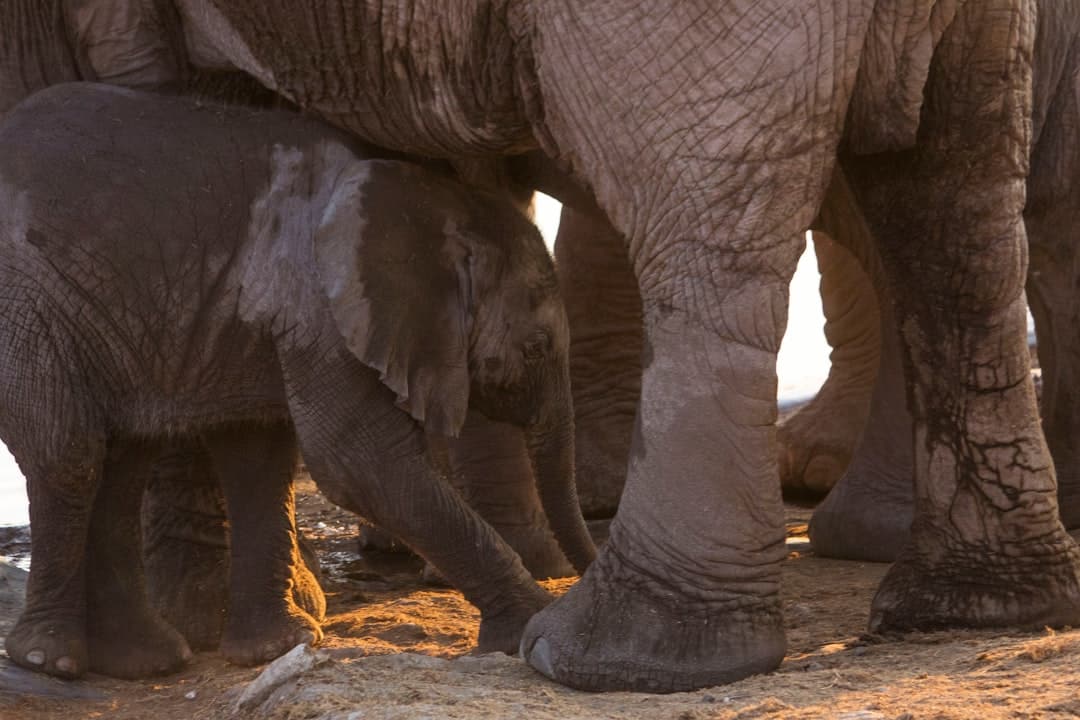
Elephants live among the longest lives of any land mammal, with wild individuals regularly reaching 60 to 70 years of age. That lifespan is not simply a number — it is a journey through five richly distinct life stages, each shaped by one of the most complex social structures in the animal kingdom. From the moment a calf takes its first unsteady steps, surrounded by a herd of protective aunts and cousins, to the final years when a matriarch’s accumulated wisdom guides her family across vast, drought-stricken landscapes, the elephant life cycle is a masterclass in slow, deliberate, deeply social development.
At a glance: Elephants live 60–70 years in the wild, passing through five major life stages: infancy, childhood, adolescence, adulthood, and old age. Their reproductive and social development mirrors many aspects of human aging.
The elephant life cycle at a glance
Before diving into each stage in detail, it helps to see the full arc at once. Elephant development is remarkably slow compared to most mammals — a reflection of the species’ large brain, complex social needs, and extended period of learning. Where a horse is sexually mature at two years and fully grown at five, an elephant is still considered a juvenile at ten and may not reproduce until its mid-teens. This slow pace is both a biological strategy and, increasingly, a conservation vulnerability.
African savanna elephants (Loxodonta africana), African forest elephants (Loxodonta cyclotis), and Asian elephants (Elephas maximus) follow broadly the same life-stage timeline, though Asian elephants tend to be slightly smaller and may reach certain milestones a year or two earlier. The five-stage framework below applies across all three species.
| Stage | Age Range | Key Events |
|---|---|---|
| Infancy | 0–2 years | Birth, nursing, learning to use the trunk |
| Childhood | 2–10 years | Social learning, play, weaning complete by year 5 |
| Adolescence | 10–17 years | Males begin leaving natal herd; females remain |
| Adulthood | 17–45 years | Peak reproduction, musth in males, matriarch years |
| Old age | 45–70+ years | Tooth wear limits lifespan, final molars, reduced reproduction |
Understanding this timeline is not merely academic. Conservation programmes must account for the elephant’s slow reproductive rate: a female produces perhaps eight to ten calves in a full lifetime, with roughly four-to-five-year gaps between births. When poaching, habitat loss, or human–wildlife conflict removes mature adults — especially matriarchs — the impact on a herd’s survival knowledge and social cohesion is catastrophic and takes decades to recover from.
Stage 1: Infancy (birth to 2 years)
The arrival of an elephant calf is a herd event. Females surround the birthing mother, using their bodies as a protective screen while vocalising in low rumbles that researchers describe as “birth rumbles” — a distinctive call that can travel several kilometres. The calf itself enters the world after a gestation of approximately 22 months, the longest pregnancy of any land mammal on Earth. At birth, a healthy African elephant calf weighs between 200 and 320 pounds (90–145 kg) and stands roughly three feet tall — already large enough to be a significant physical presence. You can read more about exactly how much a baby elephant weighs and how it compares across species.
The first hour of life is a race against time and gravity. The calf must stand unaided within approximately one hour of birth — vital both to begin nursing and to be mobile enough to stay with the moving herd. Allomothers, sometimes called “aunties,” are adult or adolescent females who assist the mother, using their trunks and feet to help the calf upright and to position it beneath its mother’s belly to nurse. This cooperative birthing and early care is one of the defining features of elephant society.
Elephant milk is extraordinarily rich in fat — around 15 percent lipid content compared to around 3–4 percent in cow’s milk — and calves nurse voraciously, consuming up to three gallons per day. Nursing continues for four to five years, though solid food is sampled from around three months of age. During the first weeks, calves are almost entirely dependent on milk and physical contact with their mothers; they are rarely more than a trunk’s reach away.
The trunk presents perhaps the most remarkable developmental challenge of infancy. Unlike many mammalian limbs, the trunk contains approximately 40,000 individual muscles but no bone — it is pure muscular hydrostat, comparable in complexity to a human hand multiplied many times over. Newborn calves have almost no voluntary control over their trunks and can be observed flopping them around, even tripping over them in the first weeks of life. By six to eight months, calves begin experimenting in earnest: grasping grass, splashing in water, and investigating objects with the sensitive tip. Full dextrous control develops gradually over the first two years.
Some behaviours are hardwired from birth: the instinct to follow and stay close to large, moving shapes (which in normal circumstances means following their mother), the ability to suckle, and basic vocalisations. Far more, however, requires social learning — watching older herd members, copying behaviours, and practising. This is why the presence of experienced older females in a calf’s early life is so critical to its long-term survival.
Stage 2: Childhood (2–10 years)
If infancy is about survival, childhood is about education. Between the ages of two and ten, young elephants spend the majority of their waking hours in one of two activities: play and observation. Play — chasing, mock-charging, wrestling, and water play — develops muscle, coordination, and crucially, social skills. Young calves learn how hard they can push another individual and what the consequences are; these interactions lay the foundation for the hierarchical social relationships that will define their adult lives.
Observation is equally important. Studies of wild elephants in Amboseli National Park have shown that young calves spend up to 90 percent of their time within five metres of their mother for much of their first three years. Through this proximity, they absorb an enormous amount of information: which plants are safe to eat, where the best water sources are across seasonal ranges spanning hundreds of kilometres, and how to read the alarm calls and body language of other species. Elephants’ legendary memory begins forming during these childhood years, as calves start building the long-term spatial and social maps they will rely on throughout their lives.
Weaning is a gradual process in elephants. While calves begin sampling solid food at around three months, nursing typically decreases significantly after year three and is usually complete by year five — though calves in some populations have been observed nursing opportunistically for longer if the mother does not fall pregnant again. The transition to a fully herbivorous diet is enormous in terms of quantity: adult elephants consume up to 300 pounds of vegetation per day, and learning to efficiently locate, process, and digest this volume of food requires years of practice and guidance.
By mid-childhood, young elephants are being introduced to the full social structure of the matriarchal herd. They observe how the oldest female — the matriarch — makes decisions about group movement, responds to threats, and mediates conflicts within the family. Research has demonstrated that herds led by older, more experienced matriarchs show better survival outcomes during droughts and conflicts with humans, underlining how much ecological knowledge is passed down through direct observation rather than instinct.
Trunk dexterity continues to develop throughout childhood. By around age three, most calves can reliably use their trunks to drink (drawing water up and squirting it into the mouth), to grip and strip vegetation, and to engage in social touching — a behaviour that remains central to elephant communication throughout life. The development of fine motor control for tasks like picking small fruits or investigating crevices for minerals continues well into adolescence.
A female elephant may produce only eight to ten calves across her entire 60-year lifespan — making every individual life, and every matriarch’s decades of accumulated knowledge, irreplaceable.
Stage 3: Adolescence (10–17 years)
Adolescence marks the most dramatic divergence between male and female elephants. The two sexes, which have grown up side by side in the same family herd, begin to follow radically different social trajectories from around age ten — trajectories that will define the rest of their lives.
Females remain within their natal herd throughout adolescence and into adulthood. Under the matriarch’s guidance, they progressively take on more responsibility within the group — helping to care for younger calves, learning migration routes across large home ranges, and beginning to establish their own place in the adult female hierarchy. A female’s first estrus cycle typically occurs between ages eleven and thirteen. However, first calves are usually born at thirteen to fourteen years of age, after she has had an opportunity to observe and participate in the care of other calves. This apprenticeship model of motherhood is thought to significantly improve first-calf survival rates.
Males undergo a very different transition. From around age ten, adolescent bulls are gradually pushed to the periphery of the family herd. This is not aggressive expulsion but a slow social drift — the adult females begin interacting less with the young males, who in turn spend more time exploring on their own. By fourteen to sixteen, most young males have left their natal herd entirely and joined all-male bachelor groups. These loosely affiliated male associations provide an important social structure: older bulls model behaviour, younger males learn through sparring and play-fighting, and the hierarchy established in these bachelor groups will influence mating success decades later.
The first signs of musth — the periodic state of elevated testosterone that drives male mating behaviour — can appear in adolescent males as early as seventeen to twenty years of age, though at this stage it is typically mild and short-lived compared to the full musth cycles of prime adult bulls. The temporal glands, located on each side of the head between the eye and ear, may begin secreting a dark, musky fluid, and young males may show increased restlessness and aggression. Full musth, however, is a phenomenon of adulthood.
Adolescence is statistically the most dangerous period in a male elephant’s life, for reasons beyond natural predation. Young males dispersing from family groups are most likely to venture into agricultural areas in search of food and water, bringing them into direct conflict with farmers. They are also the most commonly targeted demographic in illegal ivory poaching in some regions. Conservation organisations working in conflict zones note that the loss of adolescent males disproportionately disrupts the social learning pipeline within bachelor herds.
Stage 4: Adulthood and reproduction (17–45 years)
The adult years — roughly seventeen to forty-five — represent the reproductive and social peak of the elephant life cycle. For females, this period encompasses the majority of their calving years, a deepening role in the herd’s social structure, and, for the most experienced individuals, the eventual ascent to matriarch status. For males, adulthood brings the full expression of musth, peak competitive ability, and the prime years of mating success.
Musth — derived from the Persian word for “intoxicated” — is a recurring physiological state in adult male elephants characterised by a dramatic surge in testosterone (up to 60 times normal baseline levels in some studies), continuous secretion from the temporal glands, and urine dribbling caused by swollen temporal gland pressure. During musth, which typically lasts two to three months per year in prime bulls, males become significantly more aggressive, more active, and more attractive to oestrous females. Females actively seek out musth males for mating, appearing to prefer their heightened state as a signal of genetic quality and physical dominance. Outside of musth, adult males are generally calm and even relatively social with humans and other animals.
Female reproductive cycles are among the most complex in the animal kingdom. A female elephant’s estrus lasts only about three to five days, and this window occurs only once every four to six years (constrained by the long gestation and extended nursing period). The synchronisation of a musth male’s presence with a specific female’s brief fertile window is partly a matter of chance and partly the result of both sexes actively seeking each other out using infrasonic calls — low-frequency rumbles below 20 Hz that travel through both air and ground over distances of several kilometres.
Female elephants reach their peak reproductive output between approximately twenty-five and forty years of age. Calving intervals average four to five years, meaning a female who reproduces consistently from age fourteen to age fifty-five might produce a maximum of eight to ten calves — though infant mortality, injury, and drought can reduce this significantly. The structure of elephant herds means that each calf benefits from the care not just of its mother but of the entire extended family, dramatically improving its survival odds compared to species where mothers raise young alone.
Long-term research at Amboseli has provided compelling evidence for the value of matriarch experience. Herds led by the oldest females — those over fifty — respond faster and more appropriately to predator calls, make better decisions about when to flee versus stand their ground, and navigate successfully to water sources during extreme droughts. This accumulated knowledge, built over decades of experience, represents an irreplaceable form of ecological memory that cannot be quickly replaced when a matriarch is lost.
Stage 5: Old age (45–70+ years)
Old age in elephants is defined less by arbitrary chronology than by a specific biological fact: the progressive failure of the teeth. Elephants are polyphyodonts — they replace their teeth horizontally across the jaw rather than vertically (as humans do). Over a lifetime, an elephant cycles through six sets of molars. Each set moves forward in the jaw as the previous one wears down and falls out in fragments. The sixth and final set typically emerges around age forty to forty-five and gradually wears through to the gumline between ages sixty and seventy. Elephant teeth are uniquely adapted to process hundreds of pounds of tough vegetation daily, but they are not inexhaustible.
When the sixth molars are gone, the elephant can no longer effectively chew its food. Vegetation passes through insufficiently processed, nutrients cannot be absorbed, and the animal gradually weakens and dies — not from predation or disease in the conventional sense, but from an inability to sustain its own metabolic needs. This biological clock, written into the tooth structure, places an upper limit on natural lifespan that is remarkably consistent across elephant populations worldwide.
Elephants appear to respond to the degradation of their final molars by instinctively seeking out softer vegetation. Field researchers have observed that very old individuals increasingly gravitate toward riverbanks, floodplains, and wetlands where softer aquatic plants, sedges, and softer grasses are available. Some populations in Zimbabwe and Kenya’s Amboseli ecosystem have been documented spending dramatically more time in marshland as they age — a behavioural adaptation that extends functional lifespan by reducing the mechanical demand on failing teeth.
The social role of elderly elephants shifts significantly in this final stage. Older females who are past their prime reproductive years do not simply become dependent burdens on the herd — they become its most valuable knowledge repositories. Studies have shown that the mere presence of a post-reproductive matriarch significantly improves herd cohesion and decision-making under stress. In this sense, elephants follow a pattern — rare in nature — of extended post-reproductive lifespan that has clear adaptive value for the group, analogous in some respects to theories of the human grandmother effect.
Very old males become increasingly solitary as their musth periods shorten and their competitive ability wanes. Rather than becoming outcasts, however, many older bulls are tolerated and even socially sought out by younger males in bachelor groups — their presence appearing to have a calming effect on younger, more disruptive individuals. Research in South Africa’s Pilanesberg National Park found that herds with no older bulls present showed significantly higher rates of aggressive behaviour in adolescent males, pointing to the social regulation role that older males provide.
How long do elephants live? Wild vs. captivity
The question of elephant longevity is straightforward in wild populations but becomes complicated — and often contentious — when captivity is introduced. In the wild, both African savanna elephants and Asian elephants regularly reach their mid-60s, with some confirmed individuals living into their early 70s. The teeth, as discussed, provide a hard biological cap in natural conditions.
Captive elephants present a far more mixed picture. Zoo elephants in Western countries have historically shown significantly reduced lifespans — many dying in their 30s and 40s from conditions almost unheard of in the wild: obesity and associated cardiovascular disease from insufficient movement, chronic foot problems from standing on hard concrete substrates, stereotypic behaviours (repetitive swaying and head-bobbing) indicating severe psychological distress, and reproductive complications partly attributed to compressed social environments without the extended family structures elephants evolved within.
Sanctuaries — large, naturalistic environments designed to provide elephants with social groups, extensive ranging space, and appropriate substrates — show considerably better outcomes. Sanctuary elephants in Tennessee (The Elephant Sanctuary in Tennessee) and Thailand (Elephant Nature Park) have lived well into their 70s and even 80s under conditions of lower physical stress and richer social lives than traditional zoos can provide.
| Population | Typical Lifespan | Notes |
|---|---|---|
| African savanna (wild) | 60–70 years | Upper limit set by molar wear |
| African savanna (zoo captivity) | 40–55 years | Foot disease and obesity are key factors |
| Asian elephant (wild) | 60–70 years | Some protected populations reach low 70s |
| Asian elephant (zoo captivity) | 40–50 years | Herpesvirus (EEHV) a major cause of early death in calves |
| Elephant (sanctuary) | 65–80+ years | Natural social groups, space, soft substrate |
The three species of elephant share broadly similar life-history parameters, but conservation pressures differ markedly. African forest elephants — the least studied species — are now classified as Critically Endangered, with their slow reproductive rate making population recovery from poaching extremely difficult. Losing a single mature female from a small forest elephant group can depress recruitment for a decade or more.
How do elephants reproduce?
Elephant reproduction is characterised by two features that set it apart from almost every other land mammal: an exceptionally long gestation period and an unusually low reproductive rate. Together, these make elephant populations uniquely vulnerable to disturbance and uniquely slow to recover. Understanding how long elephants are pregnant is central to understanding the entire life cycle.
The 22-month gestation of the African elephant — and the 18–22-month gestation of the Asian elephant — is the longest of any terrestrial mammal. The reason lies in the complexity of what is being grown. Elephants possess the largest brains of any land animal in absolute terms (African elephant brains average around 10–12 pounds), and brain development requires time that cannot be accelerated without cost. The calf’s musculoskeletal system, too, must be sufficiently developed at birth to allow it to stand and walk within the first hour — a survival necessity in a species that must be mobile to stay with the herd. A foal or calf that cannot stand and run within hours of birth is a dead calf in the African bush.
Mating itself is a complex negotiation. During musth, adult male elephants call extensively using infrasonic rumbles (below the range of human hearing) that females can detect over distances of several kilometres through both air and ground vibration. Females in estrus produce their own distinctive calls — the “estrus call” — that attract multiple males. Mating access is broadly determined by male dominance, with musth males taking precedence over non-musth males regardless of relative size, but female choice plays a more active role than early research suggested. Females have been observed running from males they appear to disfavour and actively approaching musth males whose calls they have tracked over long distances.
After the birth, the inter-birth interval — the time between successive calves from the same mother — averages four to five years under good ecological conditions and can extend to seven or more years during drought or periods of high social stress. This means a female who begins reproducing at thirteen and lives to fifty-five is producing, at most, roughly one calf every four to five years — a stark contrast to the reproductive rates of most other large mammals. The implication for conservation is profound: even with zero poaching and ideal habitat, an elephant population cannot quickly bounce back from a significant reduction in adult female numbers.
Elephant calves are altricial in terms of cognitive and social development but precocial in terms of physical mobility — a rare combination. They enter the world physically capable of moving with the herd, but they require years of intensive social learning to develop the full complement of behaviours they need to survive independently. This extended developmental dependency is the engine that drives the matriarchal social structure: the herd exists, in part, to provide the educational environment that each generation needs to thrive.
The bottom line
The elephant life cycle is one of the most compelling examples in nature of a species whose survival strategy is built on time, patience, and accumulated wisdom rather than rapid reproduction. Every stage of development feeds into the next: a well-nurtured infant becomes a socially capable juvenile; a socially capable juvenile becomes an effective parent; an effective parent, over decades, becomes the irreplaceable matriarch whose knowledge can mean the difference between a herd finding water during a crisis or losing calves to drought.
This strategy works magnificently under natural conditions — elephants have been ecologically dominant on two continents for millions of years. But it creates acute fragility in the face of human pressure. When poaching removes adults faster than the slow reproductive cycle can replace them, when habitat loss forces herds into fragmented islands with no matriarchal memory of alternative corridors, or when the social fabric is disrupted through culling or capture, the damage runs far deeper than the number of individual animals lost. Conservation of elephants is, ultimately, conservation of the knowledge that flows through their extraordinary multigenerational social structure.
There are five major stages in the elephant life cycle: infancy (0–2 years), childhood (2–10 years), adolescence (10–17 years), adulthood (17–45 years), and old age (45–70+ years). Each stage is characterised by distinct physical, social, and behavioural development.
African elephants have a gestation period of approximately 22 months — the longest of any land mammal. Asian elephants have a slightly shorter gestation of around 18–22 months. This extended pregnancy allows the calf’s large brain and body to develop sufficiently for it to stand and walk within hours of birth.
Female elephants reach their first estrus cycle between ages eleven and thirteen, with first calves typically born at thirteen to fourteen years of age. Males begin showing early signs of musth around age seventeen to twenty, but do not compete effectively for mating until their mid-twenties when they reach full musth cycles.
Elephants’ lifespan is biologically capped by their teeth. They cycle through six sets of molars over a lifetime, and when the final (sixth) set wears out — typically between ages 60 and 70 — they can no longer effectively chew vegetation, leading to malnutrition. Unlike most mammals, elephants cannot grow additional teeth, making tooth wear the primary biological limit on longevity.