How Many Elephants Are Left in the World?


While some African elephant populations are growing primarily in southern Africa, other areas are seeing decreasing populations. A lot of work has been done trying to determine the elephant population in the world, but it’s incredibly difficult to get accurate numbers. Experts can only guess at the total number of African elephants remaining.
Quick answer
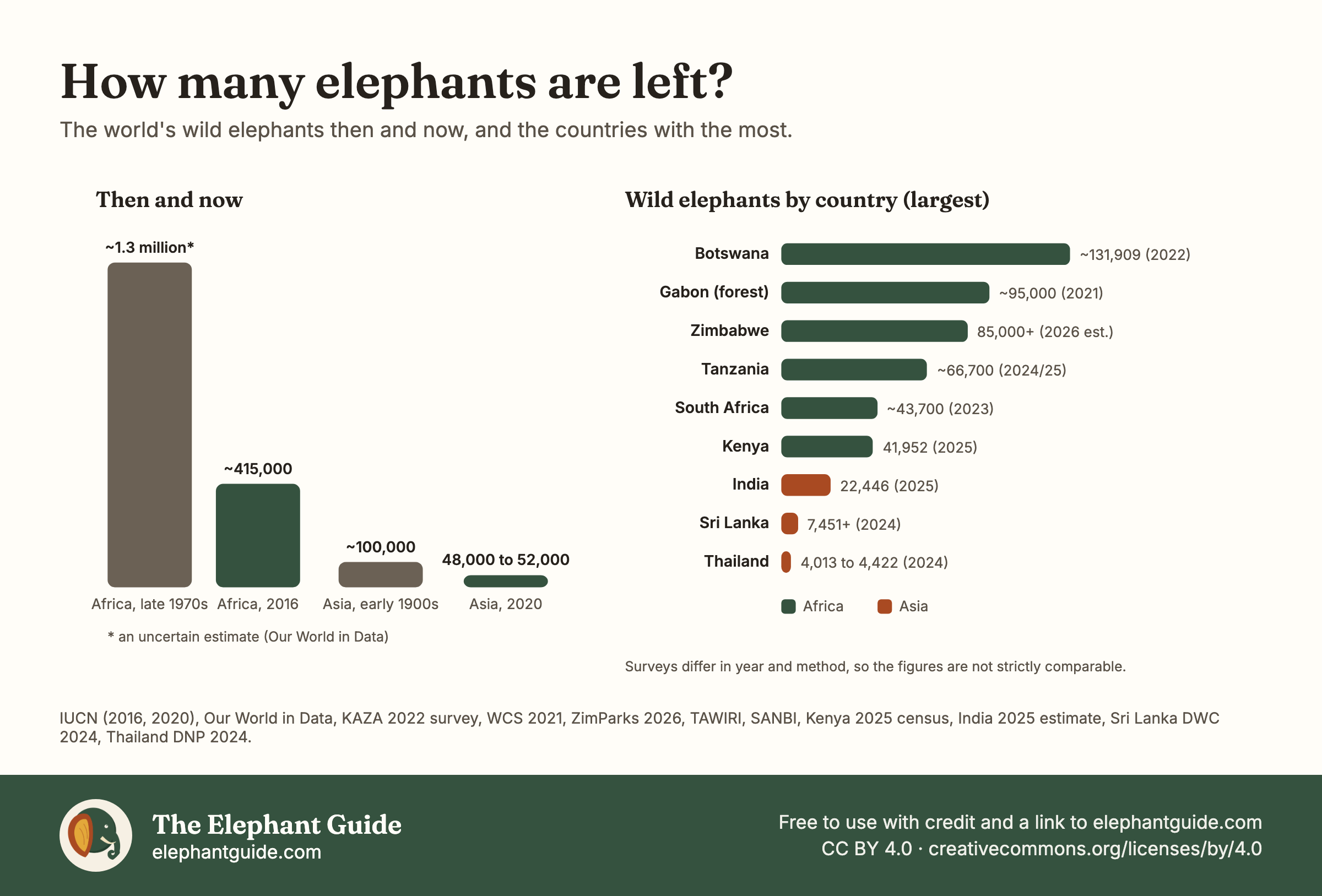
Roughly 460,000 elephants are left in the wild. That is about 415,000 African elephants (IUCN, 2016 estimate) plus about 48,000 to 52,000 Asian elephants (IUCN, 2020). The African figure is the older one, so treat the total as approximate.
The IUCN Red List assessed the two African species separately in March 2021. It found that African forest elephants fell by more than 86% over 31 years and African savanna elephants by at least 60% over 50 years. Poaching peaked around 2011 and still threatens both.
The savanna (bush) elephant is now listed as Endangered and the forest elephant as Critically Endangered, and the Asian elephant is Endangered too. Charities such as WWF and many others run various conservation efforts to help stop the killing of these threatened species. The picture is more mixed than those labels suggest, as we explain further down.
The Elephant population as of 2026
As mentioned, a commonly accepted estimate says that there are roughly 460,000 elephants left in the wild: about 415,000 African elephants (the IUCN’s 2016 estimate) plus 48,000 to 52,000 Asian elephants. However, some experts say the African figure could be off, since the Great Elephant Census counted about 352,000 savanna elephants in 18 countries in 2014 and 2015 and forest elephants are far harder to count.
Note: National population estimates are drawn from the most recent available surveys, which vary by country (2015 to 2025). Elephant census data is updated irregularly due to the logistical complexity of surveying wild populations.
Why do the numbers differ so much on how many elephants are there in the world? Surveys use different methods in different years, and forest elephants are hard to count. The numbers also keep changing because of ivory poaching and habitat loss.
African elephants left in the world
There are an estimated 415,000 African elephants left in the world. Among the countries with the largest populations are Botswana, with around 130,000 elephants (131,909 in its 2022 survey), and Zimbabwe, where the 2015 Great Elephant Census counted 82,304 (a 2022 survey of the Zimbabwean part of the KAZA area counted 65,028).
Tanzania’s 2024/25 national census counted 66,714 elephants, against 46,408 reported in news coverage for 2014 (the 2014 TAWIRI report gives 43,521) and about 134,000 reported before 2005. It’s estimated that the savanna elephant make up the large majority of Africa’s elephants; the Great Elephant Census counted 352,271 of them in 18 countries.
Table Overview of Elephant Population remaining in Africa by Country
If you’re wondering how many African elephants are left in the world; Below you’ll find an overview of the elephant populations per country in Africa. The table is sorted from largest to smallest.
The year is the year of the survey or report. Only countries where we could confirm a recent published count are listed, so the rows do not add up to the continental estimates.
| Country | Estimated Number of Elephants | Year of Estimation |
|---|---|---|
| Botswana | 131,909 | 2022 (KAZA survey) |
| Gabon | about 95,000 | 2021 |
| Zimbabwe | 82,304 | 2015 (Great Elephant Census) |
| Tanzania | 66,714 | 2024/25 |
| South Africa | 43,681 | 2023 |
| Kenya | about 42,000 | 2025 |
| Namibia | about 24,000 | 2019 |
| Zambia | 21,758 | 2015 (Great Elephant Census) |
| Mozambique | 9,605 | 2015 (Great Elephant Census) |
| Uganda | 7,975 | 2023 (report) |
Asian elephants left in the world
There are an estimated 48,000 to 52,000 wild Asian elephants left in the world, with India holding the largest share (about half according to the Smithsonian National Zoo, and India’s 2025 DNA-based survey counted 22,446).
The IUCN’s 2020 assessment gives 48,323 to 51,680 Asian elephants as of 2018 and notes that reliable counts are missing across most of the range, so the figure is rough. The 2025 count was India’s first DNA-based survey, and its report says the figures are not comparable with earlier counts, so it works as a new baseline rather than proof of a fall.
Other countries with large Asian elephant populations include Sri Lanka (a minimum estimate of 7,451 for 2024, from the Ministry of Environment) and Thailand (4,013 to 4,422 in a fiscal year 2024 report by the Wild Animal Assistance Centre).
The Asian elephant is listed as endangered with extinction by the IUCN.
Table Overview of Elephant Population remaining in Asia by Country
If you’re wondering how many Asian elephants are left in the world; Below you’ll find an overview of the elephant populations per country in Asia.
We’ve also added the four Indian states with the most elephants in the 2025 survey, as populations vary.
The table is sorted from largest to smallest. The year is the year of the survey or report. Only countries where we could confirm a recent published count are listed, so the rows do not add up to the continental estimates.
| Country | Estimated Number of Elephants | Year of Estimation |
|---|---|---|
| India | 22,446 | 2025 |
| – Karnataka State | 6,013 | 2025 |
| – Assam | 4,159 | 2025 |
| – Tamil Nadu | 3,136 | 2025 |
| – Kerala | 2,785 | 2025 |
| Sri Lanka | 7,451 (minimum) | 2024 |
| Thailand | 4,013 to 4,422 | 2024 |
Male elephants left in the world
No reliable continental count of male elephants exists, but males with large tusks have been targeted for ivory.
African bulls have been killed for their ivory throughout history, and poaching rose sharply after 2008 and peaked in 2011 (IUCN).
Among Asian elephants, only some males have large tusks and a significant number of adult males have none, while most females have small tusks called tushes.
Are elephants really endangered? Why the answer depends on where you look
Readers sometimes ask how a species with hundreds of thousands of animals can be endangered, especially when some governments are culling elephants. It is a fair question, and both things are true.
- The global verdict: in March 2021 the IUCN assessed the two African species separately for the first time. The savanna elephant is Endangered (down by at least 60% over 50 years) and the forest elephant Critically Endangered (down by more than 86% over 31 years). The IUCN’s most recent reliable continental estimate is around 415,000 elephants, from 2016.
- The local picture: the IUCN notes that savanna elephant numbers have been stable or growing for decades in the Kavango-Zambezi region, which holds the largest subpopulation, and that some forest elephants have stabilised in well-managed areas of Gabon and the Republic of the Congo.
- Where it goes wrong: forest elephants, now Critically Endangered, fell by more than 86% over 31 years (IUCN), even though Gabon holds roughly 95,000 of those that remain (a 2021 DNA-based survey).
- Culling: in September 2024 Zimbabwe said it would cull 200 elephants, its first cull since 1988, and Namibia planned to kill 83, to provide food during a drought (as reported at the time). Officials argued that numbers exceed what the land can support, and conservation groups opposed the plans.
The Red List does not ask whether one country has too many elephants. It measures the decline across a species’ whole range over several generations. Healthy populations in parts of southern Africa and steep losses elsewhere can both be real, which is why the global status and the local headlines look so different. Asian elephants are Endangered too. For the causes, see why elephants are endangered.
Are Elephants Going Extinct?
Both African and Asian elephants are officially classified as threatened species by the IUCN Red List. Since 2021 the African savanna (bush) elephant has been listed as Endangered and the African forest elephant as Critically Endangered, and the Asian elephant is Endangered too. These designations reflect long-term declines measured across each species’ whole range. They do not mean that every population is shrinking, as the section above explains.
Nobody ran a real census a century ago. The first continent-wide estimate for Africa and Asia that we can cite, made for Africa in the late 1970s, was about 1.3 million, a figure Our World in Data calls uncertain, and the IUCN estimated about 100,000 Asian elephants in the early 1900s. Today the combined population sits at roughly 460,000. The primary drivers of that decline remain poaching for ivory and the steady erosion of habitat as human populations expand into elephant ranges.
The international ivory trade ban that took effect in 1990 was a major step, but poaching surged again after 2008 and peaked in 2011. China ended its legal domestic ivory trade on 31 December 2017, and wholesale raw ivory prices there fell by about two thirds in the three years to early 2017, but reporting at the time still named Vietnam as one of the largest illegal ivory markets.
There is, however, genuine reason for hope. Conservation corridors and anti-poaching units have helped in several places. Kenya’s national census counted 36,280 elephants in 2021 and more than 40,000 in 2025, and the 2022 KAZA survey found the elephant population of the Kavango-Zambezi region roughly stable since 2015. The fight to protect elephants is far from over, but it is far from lost.

Table Overview of Elephants Remaining in the World, by Country and Region
The below table is simply a combined version of the African and Asian overview tables above.
| Country | Estimated Number of Elephants | Year of Estimation |
|---|---|---|
| Botswana | 131,909 | 2022 (KAZA survey) |
| Gabon | about 95,000 | 2021 |
| Zimbabwe | 82,304 | 2015 (Great Elephant Census) |
| Tanzania | 66,714 | 2024/25 |
| South Africa | 43,681 | 2023 |
| Kenya | about 42,000 | 2025 |
| Namibia | about 24,000 | 2019 |
| India | 22,446 | 2025 |
| Zambia | 21,758 | 2015 (Great Elephant Census) |
| Mozambique | 9,605 | 2015 (Great Elephant Census) |
| Uganda | 7,975 | 2023 (report) |
| Sri Lanka | 7,451 (minimum) | 2024 |
| Thailand | 4,013 to 4,422 | 2024 |
Great Elephant Census (GEC)
The late Paul Allen, co-founder of Microsoft, sponsored a project to count Africa’s savanna elephants from the air. The surveys ran in 2014 and 2015 and the results were published in 2016.
It was called the Great Elephant Census: Counting Africa’s Elephants. It counted 352,271 savanna elephants in 18 countries and found a 30 percent fall (about 144,000 animals) between 2007 and 2014 in the 15 countries where earlier counts allowed a comparison.
See results from the Great Elephant Census.
Biggest reasons the elephant population is decreasing
There are a lot of different reasons by the elephant population is decreasing. The primary reasons are poaching for the illegal trade of ivory, growing human populations in rural areas and therefore the loss of habitat for the elephants. But there are also other dangers to the elephant.
Elephant poaching
African elephants are being poached at an alarming rate for their tusks. Illegal killing peaked around 2011, and an estimated 100,000 African elephants were killed for ivory between 2010 and 2012, roughly 33,000 a year.
One of the most significant milestones in the battle against illegal elephant poaching was China’s decision to end its legal domestic ivory trade, which took effect on 31 December 2017.
Human wildlife conflict
As populations grow, humans are encroaching on some elephant habitats. This often leads to conflict between the two species as elephants destroy crops or harm people.
In India, human-elephant conflict kills roughly 470 to 630 people a year according to government data (2,853 deaths from 2019 to 2023).
Illegal trade of ivory tusks
Ivory is trafficked across borders, and in 2017 reporting Vietnam was named as one of the largest illegal ivory markets, supplied mostly with tusks from Africa.
The annual value of the illegal ivory trade is hard to measure. In Hanoi, raw ivory averaged about $1,322 per kg in 2015 and about $660 per kg by February 2017 (Eco-Business, citing traders surveyed).
Habitat loss
The elephant has been rapidly decreasing as a result of humans cutting down forests for development or farming purposes, generally leading to fragmentation of the once large home range that elephants need to live.
In addition to deforestation, man-made barriers have been blocking important migration routes and access to water sources for elephants.
According to the IUCN, nearly two thirds of Africa still has suitable elephant habitat, but only 17 percent of that suitable habitat is currently available to elephants.
FAQ on the Elephant populations
There are about 415,000 African elephants (the IUCN’s 2016 estimate) and roughly 48,000 to 52,000 Asian elephants (IUCN, 2020) remaining in the wild. These numbers continue to change with poaching, habitat loss and new survey data.
Roughly 48,000 to 52,000 (IUCN, 2020), with India holding the largest share. India’s 2025 DNA-based survey counted 22,446, but its report says the figures are not comparable with earlier counts.
It depends on the year. Poaching peaked around 2011, when roughly 100,000 African elephants were killed between 2010 and 2012, about 90 a day. The IUCN says poaching peaked in 2011 and still threatens populations.
Botswana, with about 130,000 elephants (131,909 in its 2022 survey). Gabon holds about 95,000 forest elephants (2021 DNA-based survey), and Zimbabwe counted 82,304 in the 2015 Great Elephant Census.
Nobody can put a date on it. African forest elephants are Critically Endangered and savanna elephants Endangered (IUCN, 2021), but savanna populations in places such as the Kavango-Zambezi region have been stable or growing for decades, so the outlook depends heavily on where you look.
No single continental percentage is published. The 2014 PNAS study estimated that illegal killing took about 6.8 percent of Africa’s elephants a year on average in 2010 to 2012, peaking at around 8 percent in 2011.
Nobody counted a century ago. The first continent-wide estimate for Africa, from the late 1970s, was about 1.3 million (an uncertain figure), and the IUCN estimated about 100,000 Asian elephants in the early 1900s, against roughly 460,000 across both continents today.
A 2014 study in PNAS by Wittemyer and colleagues estimated that about 100,000 African elephants were killed for their ivory between 2010 and 2012, roughly 33,000 a year.
Bottom Line
There are about 415,000 African elephants (the IUCN’s 2016 estimate) and 48,000 to 52,000 Asian elephants left in the world, well below the roughly 1.3 million African elephants estimated in the late 1970s.
The primary threats (ivory poaching, habitat loss, and human-elephant conflict) continue to put pressure on elephant populations globally. African forest elephants are now Critically Endangered, while Asian elephants remain listed as Endangered.
The good news: conservation efforts are working in some regions. Kenya and parts of southern Africa have seen growth or stability. The fight to save elephants is far from over, but it is far from lost.
Sources
Where the main facts in this article come from. Links open in a new tab.
- Williams et al., Elephas maximus, IUCN Red List assessment, 2020
- IUCN, African elephant species now Endangered and Critically Endangered, 2021
- IUCN, Shrinking spaces for the world’s largest land animal, 2021
- Chase et al., Continent-wide survey reveals massive decline in African savannah elephants, PeerJ, 2016
- Elephants Without Borders, Great Elephant Census results
- Wittemyer et al., Illegal killing for ivory drives global decline in African elephants, PNAS, 2014
- Our World in Data, Elephant populations
- Mongabay, Analysis of largest elephant surveys ever shows stable population, 2024
- The Herald (Zimbabwe), 65,028 elephants estimated in Zimbabwe’s KAZA region, 2023
- Eyewitness News (AFP), Zimbabwe to cull 200 elephants, 2024
- The Peninsula, Tanzania’s elephant population rises to 66,714, 2026
- EurekAlert, Gabon forest elephant DNA survey, 2021
- Mongabay, Kenyan wildlife census reveals conservation wins and losses, 2025
- African Elephant Journal, Namibia’s elephant population reaches 24,000, 2019
- AFP via Phys.org, Uganda wildlife numbers soar, 2023
- SANBI, Loxodonta africana non-detriment findings supporting document (South Africa, end 2023)
- Down To Earth, India has 22,446 elephants as per new census, 2025
- Newswire.lk, How many elephants in Sri Lanka, 2025
- The Nation Thailand, Wild elephants caused 227 deaths in 12 years, 2024
- Onmanorama, elephant deaths and attacks, central government data, 2024
- Eco-Business, China’s ivory ban sparks dramatic drop in prices across Asia, 2017
- National Geographic, China shuts down its legal ivory trade, 2017
- Smithsonian National Zoo, Asian elephant
- IUCN Red List, Asian elephant (Elephas maximus)
- IUCN Red List, African savanna elephant (Loxodonta africana)
- IUCN Red List, African forest elephant (Loxodonta cyclotis)
- WWF, African elephants
Keep reading

Do Elephants Migrate? Movement, Routes & Home Ranges
Most elephants don't follow a fixed seasonal migration, but some populations move between wet-season and dry-season ranges. Here is what tracking studies show about…

Reasons Why Elephants Are Endangered
The elephant is the largest known mammal to live on land. This creature’s large tusks, enormous ears, and muscular but sensitive legs make it…

Elephant Sanctuary Guide: What They Are and How to Visit Ethically
Elephants are one of the most fascinating animals on earth. They’re intelligent, sensitive, and social creatures that deserve to be treated with dignity. Thankfully…
Eine Großwild-Spezies mit vielen 100.000 Exemplaren kann kaum als gefährdet betrachtet werden. Und tatsächlich werden inzwischen Elefanten im südlichen Afrika zum Abschuss freigegeben, weil sie sich in den letzten Jahren stark vermehrt haben. Natürlich ist mit Untergangsszenarien mehr Spendengeld einzusammeln, trotzdem sollte man bei den Fakten bleiben.
Hi Martin, thank you for the push to stick to the facts. You were right that parts of the article were overstated. We removed an outdated claim about a 62% drop and a forecast that never materialised, stopped attributing the Critically Endangered label to WWF, replaced the extinction-timeline warnings, and corrected the Asian elephant numbers (roughly 40,000 to 50,000). Every IUCN figure is now sourced (savanna elephants down by at least 60% over 50 years, forest elephants by more than 86% over 31 years). We also added a section explaining why the global status and local reality differ: savanna populations in the Kavango-Zambezi region have been stable or growing, and Zimbabwe and Namibia moved to cull elephants in 2024. https://elephantguide.com/how-many-elephants-are-left-in-the-world/