The Elephant Life Cycle: From Birth to Old Age


Elephants live among the longest lives of any land mammal, with wild individuals living up to about 70 years. That lifespan is not simply a number. It is a journey through five richly distinct life stages, each shaped by one of the most complex social structures in the animal kingdom.
From the moment a calf takes its first unsteady steps, surrounded by a herd of protective aunts and cousins, to the final years when a matriarch’s accumulated wisdom guides her family across vast, drought-stricken landscapes, the elephant life cycle is a masterclass in slow, deliberate, deeply social development.
At a glance
Elephants can live up to about 70 years in the wild and pass through five rough life stages: infancy, childhood, adolescence, adulthood and old age. Pregnancy lasts about 22 months, a first calf usually arrives in the mid-teens or later, and males leave the family herd as they reach puberty.
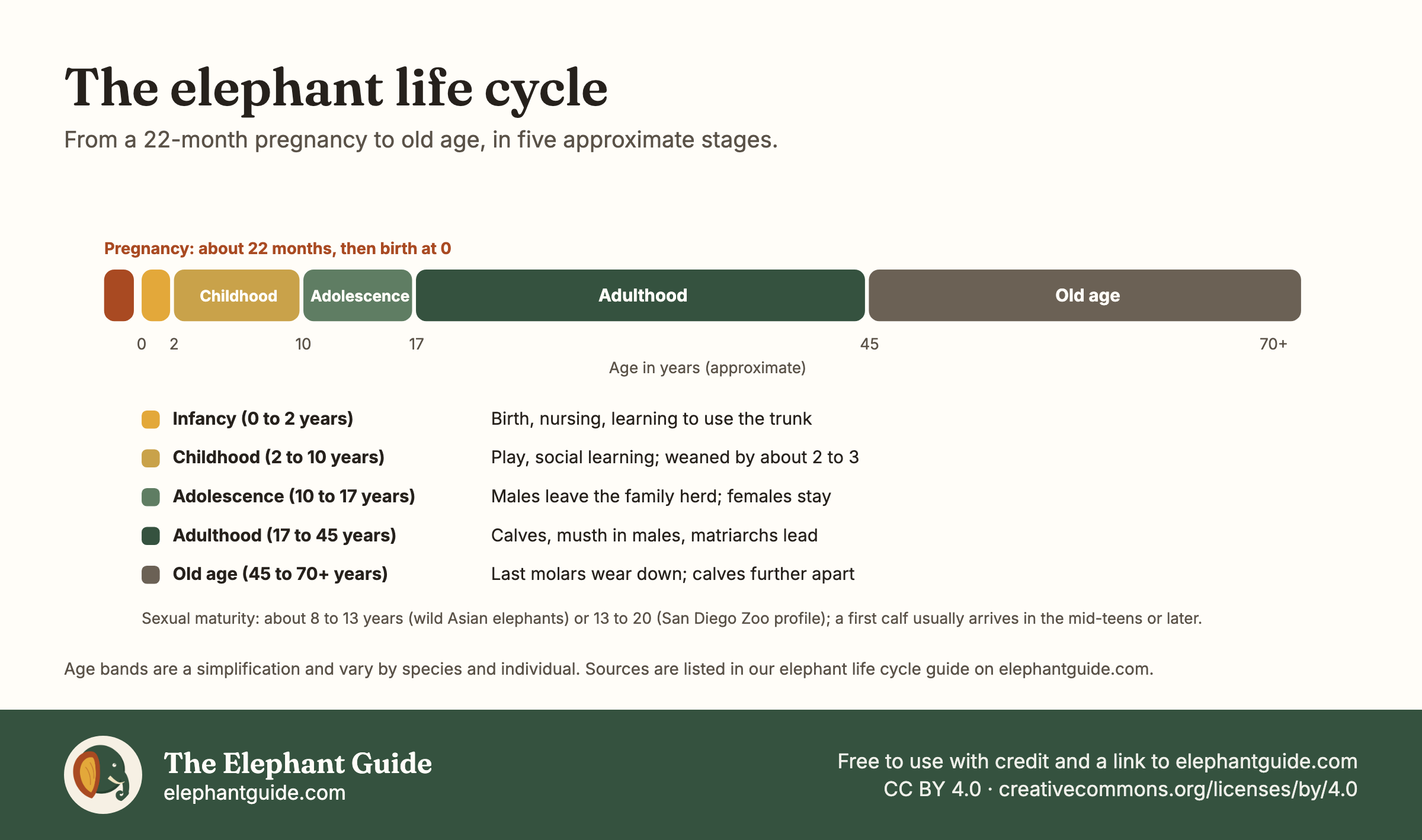
The elephant life cycle at a glance
Before diving into each stage in detail, it helps to see the full arc at once. Elephant development is slow compared with many mammals: sexual maturity comes at about 8 to 13 years in wild Asian elephants (Smithsonian) and 13 to 20 years in the San Diego Zoo’s elephant profile, and a first calf usually arrives in the mid-teens or later. This slow pace is both a biological strategy and, increasingly, a conservation vulnerability.
African savanna elephants (Loxodonta africana), African forest elephants (Loxodonta cyclotis), and Asian elephants (Elephas maximus) follow broadly similar life histories, with differences in detail: Asian males leave the herd at about 8 to 13 years and African males at about 12 to 15. The five stages below are a simplification, not a fixed scientific scale, and the age bands are approximate.
| Stage | Age Range | Key Events |
|---|---|---|
| Infancy | 0 to 2 years | Birth, nursing, learning to use the trunk |
| Childhood | 2 to 10 years | Social learning, play, weaning (gradual; most calves no longer need to nurse by about 2 to 3 years) |
| Adolescence | 10 to 17 years | Males begin leaving natal herd; females remain |
| Adulthood | 17 to 45 years | Peak reproduction, musth in males, matriarch years |
| Old age | 45 to 70+ years | Last set of molars wears down; calves arrive further apart |
Understanding this timeline is not merely academic. Conservation programs must account for the elephant’s slow reproductive rate: calves arrive three to eight years apart, depending on conditions (Smithsonian National Zoo, for Asian elephants). When poaching, habitat loss, or human-wildlife conflict removes mature adults, especially matriarchs, the herd can lose social knowledge, and recovery is slow because births are so far apart.
Stage 1: Infancy (birth to about 2 years)
The arrival of an elephant calf is a herd event. Other females, called allomothers or “aunties”, often help with the newborn. The calf itself enters the world after a gestation of about 22 months, the longest pregnancy of any land mammal.
A newborn calf weighs roughly 150 to 350 pounds (68 to 160 kg), depending on species and source (Smithsonian National Zoo), and stands about 26 to 42 inches (66 to 107 cm) tall (San Diego Zoo Wildlife Alliance). You can read more about exactly how much a baby elephant weighs and how it compares across species.
The first hours of life matter: calves stand and nurse soon after birth (Smithsonian), which lets them keep up with the moving herd. SeaWorld reports that mothers, aunts, sisters and the matriarch help the newborn stand and guide it to nurse. This cooperative early care is one of the defining features of elephant society.
Calves typically no longer need to nurse by about two to three years (San Diego Zoo Wildlife Alliance), although weaning is gradual and may continue until the mother has another calf (Smithsonian). Calves begin eating vegetation at about six months.
The trunk presents perhaps the most remarkable developmental challenge of infancy. Unlike many mammalian limbs, the trunk contains no bone. It is a muscular hydrostat: a structure made almost entirely of muscle.
Calves have to learn to use their trunks, and the skill develops gradually. By about six months they begin eating vegetation, which takes practice with the sensitive tip of the trunk.
Much of what a calf needs to know is learned by watching older herd members. SeaWorld notes that calves learn which plants are edible by watching their elders.
Stage 2: Childhood (about 2 to 10 years)
If infancy is about survival, childhood is about education. Between the ages of two and ten, young elephants spend much of their time playing and watching older herd members. Play such as chasing, mock-charging, wrestling and splashing in water is thought to build muscle, coordination and social skills.
Observation matters too. Calves stay close to their mothers and learn from them and from other herd members, for example which plants to eat.
Calves also learn the places and relationships their herd depends on. For more on how elephants remember, see do elephants have a good memory.
Weaning is a gradual process in elephants. Calves begin eating vegetation at about six months, and most no longer need to nurse by about two to three years (San Diego Zoo Wildlife Alliance), although nursing may continue until the mother has another calf.
The transition to a fully herbivorous diet is enormous in terms of quantity: adult elephants eat about 165 to 330 pounds (75 to 150 kg) of vegetation a day (San Diego Zoo Wildlife Alliance), and learning to find that much food takes years of practice and guidance.
In African elephants, young animals grow up in a herd led by the oldest and largest female, the matriarch. Playback experiments at Amboseli found that groups led by older matriarchs responded more appropriately to the calls of unfamiliar elephants than groups led by younger ones (McComb et al., Science, 2001), and the authors suggested that this may raise reproductive success.
Trunk skills keep developing through childhood, from drinking and gripping vegetation to social touching, which stays central to elephant communication throughout life.
Because calves are born so far apart, every individual life, and every matriarch’s decades of accumulated knowledge, is hard to replace.
Stage 3: Adolescence (about 10 to 17 years)
Adolescence marks the biggest divergence between male and female elephants. The two sexes, which have grown up side by side in the same family herd, begin to follow different social paths.
Females stay in the family herd, where they help to care for younger calves.
Females reach sexual maturity at about 8 to 13 years in wild Asian elephants (Smithsonian) and at 13 to 20 years according to the San Diego Zoo’s elephant profile, and a first calf usually arrives in the mid-teens or later. Sources differ because maturity varies between species, populations and conditions.
Males go through a very different transition. They typically leave the family herd at puberty, and the departure is gradual (Smithsonian National Zoo).
In African elephants this happens at about 12 to 15 years of age (Ganswindt et al., 2005), and in Asian elephants at about 8 to 13 (Smithsonian). Adult males usually roam alone, although they sometimes form loose all-male groups (National Geographic).
Musth is a periodic state of elevated androgen hormones, with aggression, continuous urine discharge and swollen temporal glands, in males. In the wild it is mostly seen in older bulls, not adolescents.
The temporal glands, located on each side of the head between the eye and ear, secrete heavily during musth.
Stage 4: Adulthood and reproduction (about 17 to 45 years)
The adult years (roughly seventeen to forty-five) cover most of an elephant’s breeding life. For females, this period includes most of their calving years and, for the most experienced individuals, the eventual role of matriarch in African herds. For males, adulthood brings full musth and the main years of mating.
Musth is a recurring physiological state in adult male elephants, marked by increased aggression, copious secretion from the temporal glands, continuous urine discharge and elevated androgen levels. In free-ranging African bulls, fecal hormone measurements showed androgen levels about 5 to 10 times higher during these periods (Ganswindt et al., 2005).
Musth periods last from weeks to months: in that study two bulls were sexually active for periods of 3 to 14 weeks. During musth, bulls actively seek out and are preferred by females in estrus, although sexual activity is not restricted to musth (Ganswindt et al., 2005).
A female that is neither pregnant nor nursing comes into estrus about every 115 days (Smithsonian, Asian elephants), but each fertile window is brief, and pregnancy and nursing mean that a female conceives only once every few years. Elephants communicate over distance with low-frequency rumbles, which ElephantVoices says may be detected at distances of roughly 2 to 4 kilometers.
Calving intervals range from about three to eight years depending on conditions (Smithsonian), so a female produces relatively few calves in her lifetime, and drought or high infant mortality can reduce that further.
The structure of elephant herds means that each calf benefits from the care not just of its mother but of the entire extended family, as SeaWorld notes: mothers, aunts, sisters and the matriarch all help with calf development.
Long-term research at Amboseli supports the value of matriarch experience. In playback experiments, families led by matriarchs aged 55 were far more likely to bunch together defensively in response to calls from unfamiliar elephants than families with matriarchs aged 35 or younger (McComb et al., Science, 2001). That experience is hard to replace when a matriarch is lost.
Stage 5: Old age (about 45 to 70+ years)
Old age in elephants is often described in terms of the teeth. Elephants have four molars in the mouth at a time and can go through up to six sets in a lifetime (San Diego Zoo Wildlife Alliance), each set moving forward in the jaw as the one before wears down.
The Hoedspruit Endangered Species Centre (HERD) says the final set arrives at about 30 to 40 years of age and has to last the rest of the elephant’s life, which can reach about 70 years in protected conditions. Elephant teeth are uniquely adapted to process hundreds of pounds of tough vegetation daily, but they are not inexhaustible.
HERD describes tooth loss as a leading cause of death in mature elephants: without working molars they struggle to chew and digest food, and many die of starvation or malnutrition. Tooth wear is therefore one limit on how long an elephant can live, but it is not the only cause of death.
The social role of older females matters. In the McComb et al. playback study, the oldest female’s superior ability to tell familiar from unfamiliar callers shaped how the whole group responded, which is why the loss of older matriarchs to poaching can harm a family.
Older males can matter too. In South Africa’s Pilanesberg National Park, orphaned young bulls killed more than 40 white rhinos in the five years from 1992. After six full-grown bulls were introduced in 1998, the young males showed signs of musth only briefly and none killed a rhino, suggesting that older males help to regulate young ones (Slotow et al., Nature, 2000).
Key numbers in the elephant life cycle
Here are the main figures from the sources we checked. Where sources differ, we give both.
| Milestone | Figure | Source |
|---|---|---|
| Gestation | About 22 months (20 to 22; 21.5 to 22 for Asian elephants) | San Diego Zoo Wildlife Alliance; Smithsonian |
| Newborn weight | Roughly 150 to 350 lb (68 to 160 kg) | Smithsonian National Zoo |
| Newborn height | 26 to 42 inches (66 to 107 cm) | San Diego Zoo Wildlife Alliance |
| First eats vegetation | About 6 months | Smithsonian |
| No longer needs to nurse | By about 2 to 3 years; weaning may continue until the mother has another calf | San Diego Zoo Wildlife Alliance; Smithsonian |
| Sexual maturity | 8 to 13 years (wild Asian elephants); 13 to 20 years (San Diego Zoo profile) | Smithsonian; San Diego Zoo Wildlife Alliance |
| Males leave the herd | About 12 to 15 years (African); 8 to 13 years (Asian) | Ganswindt et al., 2005; Smithsonian |
| Time between calves | 3 to 8 years, depending on conditions | Smithsonian |
| Estrus cycle (not pregnant or nursing) | About every 115 days (Asian elephants) | Smithsonian |
| Daily food | 165 to 330 lb (75 to 150 kg) | San Diego Zoo Wildlife Alliance |
| Median life expectancy | 38 to 47 years; 47 years for Asian females | San Diego Zoo Wildlife Alliance; Smithsonian |
How long do elephants live?
Elephant longevity is not well understood. National Geographic gives up to 70 years for wild African elephants, although the Smithsonian National Zoo notes that recent data suggest they rarely reach 50, and it says Asian elephants typically live into their mid-50s, with too little wild data for an exact figure. Tooth wear, as discussed, is one limit on natural lifespan.
Published median life expectancies are lower. The San Diego Zoo Wildlife Alliance gives a median life expectancy of 38 to 47 years, and the Smithsonian National Zoo gives 47 years for female Asian elephants. Neither page says whether the figure describes zoo or wild animals.
| Population | Typical Lifespan | Notes |
|---|---|---|
| African elephants (wild) | Up to about 70 years | National Geographic; the Smithsonian says recent data suggest they rarely reach 50 |
| Elephants (median life expectancy) | 38 to 47 years | San Diego Zoo Wildlife Alliance (does not say whether zoo or wild) |
| Asian elephant (wild) | Typically into the mid-50s | Wild data are insufficient for an exact estimate (Smithsonian) |
| Asian elephant (female median life expectancy) | 47 years | Smithsonian National Zoo |
The three species of elephant share broadly similar life-history parameters, but conservation pressures differ markedly. African forest elephants are now classified as Critically Endangered, and their slow reproductive rate makes recovery from poaching difficult.
How do elephants reproduce?
Elephant reproduction is characterised by two features: a very long gestation period and a low reproductive rate. Together, these make elephant populations vulnerable to disturbance and slow to recover. Understanding how long elephants are pregnant is central to understanding the entire life cycle.
Gestation lasts about 22 months in both species (20 to 22 months according to the San Diego Zoo Wildlife Alliance, 21.5 to 22 for Asian elephants according to the Smithsonian), the longest of any land mammal.
The calf is large and well developed at birth: it stands and nurses soon after birth, which helps it keep up with the herd.
Elephants communicate over distance with low-frequency rumbles (adult rumbles typically fall between 12 and 20 Hz, according to ElephantVoices), which may be detected at distances of roughly 2 to 4 kilometers.
Musth bulls are actively sought out and preferred by females in estrus, although sexual activity is not restricted to musth (Ganswindt et al., 2005).
After a birth, the interval to the next calf ranges from about three to eight years depending on environmental conditions (Smithsonian), and it lengthens when conditions are poor.
The implication for conservation is that elephant populations recover slowly after a significant loss of adult females, because births are so far apart.
The bottom line
The elephant life cycle is one of the most compelling examples in nature of a species whose survival strategy is built on time, patience, and accumulated wisdom rather than rapid reproduction. Every stage of development feeds into the next: a calf that is well looked after learns from the herd, grows up, and may eventually become a matriarch whose experience helps her family.
This strategy works well under natural conditions, but it makes elephants vulnerable to human pressure. When poaching removes adults faster than the slow reproductive cycle can replace them, the damage can run deeper than the number of animals lost, because older females carry social knowledge that the herd relies on.
We describe five approximate stages in the elephant life cycle: infancy (0 to 2 years), childhood (2 to 10 years), adolescence (10 to 17 years), adulthood (17 to 45 years), and old age (45 to 70+ years). The age bands are our simplification, not a fixed scientific scale.
Elephants have a gestation period of about 22 months in both species (20 to 22 months according to the San Diego Zoo Wildlife Alliance, 21.5 to 22 for Asian elephants according to the Smithsonian), the longest of any land mammal.
Females reach sexual maturity at about 8 to 13 years in wild Asian elephants (Smithsonian) and at 13 to 20 years according to the San Diego Zoo’s elephant profile, and a first calf usually arrives in the mid-teens or later. Males leave the herd at puberty and are mostly seen in musth when older.
Tooth wear is one limit on how long an elephant can live. They go through up to six sets of molars over a lifetime, and HERD describes tooth loss as a leading cause of death in mature elephants.
Sources
Where the main facts in this article come from. Links open in a new tab.
- Smithsonian National Zoo, Asian elephant
- San Diego Zoo Wildlife Alliance, Elephant species page
- SeaWorld, Elephants: care of young
- ElephantVoices, Elephant acoustic communication
- National Geographic, African elephant
- Ganswindt et al., The sexually active states of free-ranging male African elephants, Hormones and Behavior, 2005
- University of Sussex, press release on McComb et al., Science, 2001 (matriarchs as repositories of social knowledge)
- Science News, Really big guys restrain youth violence (Slotow et al., Nature, 2000)
- Hoedspruit Endangered Species Centre (HERD), Elephant teeth
- Encyclopaedia Britannica, Elephant
Keep reading

Why Do Elephants Destroy Trees?
Elephants snap, push over and strip trees, mostly while feeding. Here is what the research says about why, and how much it matters.

Can Elephants Swim? Yes, and Surprisingly Well
Watch a multi-ton elephant wade into a river and you’d be forgiven for expecting it to sink. It doesn’t. Joyce Poole of ElephantVoices has…

Leadership Lessons From Elephants: What Herds Teach About Leading
We investigate the natural world for ideas about what it takes to run a business effectively. For example, we can learn from wolves how…