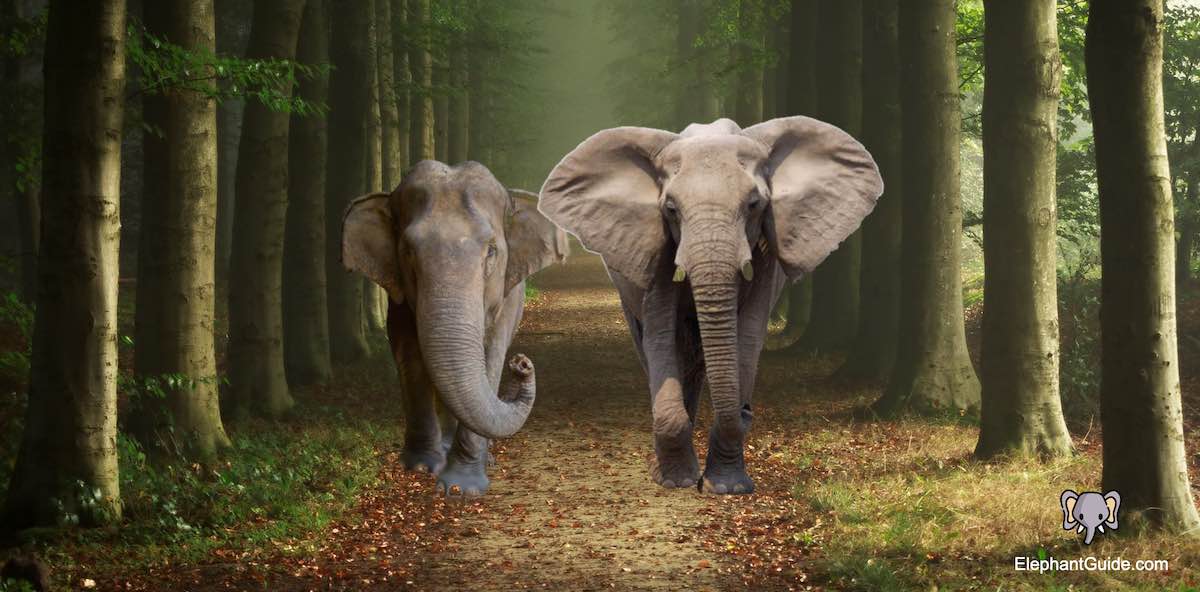
The Asian and African elephants are both types of the same elephant species. Yet, they belong to different genera because there are so many variances between the two types of Elephants.
Africa and Asia are home to their respective species of elephants, known as Asian and African elephants.
Both types of animals are friendly and congregate in huge groups called herds.
African and Asian elephants are easiest to tell apart by their ears, the shape of their heads, and their tusks.
Ethan of ElephantGuide.com
The simplest way to tell African and Asian elephants apart is by their ears. African elephants have enormous ears that are shaped like the continent of Africa. On the other hand, Asian elephants have much smaller, round ears.
There are two living species within this genus: the larger African savanna elephant, known scientifically as L. Africana, and the smaller African forest elephant, known scientifically as L. cyclotis.
The only living species of the genus Elephas, the Asian elephant (Elephas maximus), is also known as the Asiatic elephant.
The three subspecies of the Asian elephant are E. m. indicus, which lives in mainland Asia; E. m. Maximus, which is from Sri Lanka; and finally, E. m. sumatranus native to Sumatra Island.
Physical Differences Between African Elephant and Asian Elephant
African elephants are larger and have larger ears and a long, curved tusk, while Asian elephants are smaller and have smaller ears, a shorter and straighter tusk, and a more wrinkled forehead.
African elephants also have a more rounded forehead and two “fingers” at the end of their trunk, while Asian elephants have a more flexible trunk with a single “finger”.
Table Overview of the Physical Differences Between African Elephant and Asian Elephant
Below is a table showing the main differences between the two different species:
| Physical Differences | African Elephant | Asian Elephant |
|---|---|---|
| Size & Weight | An African savanna elephant typically weighs around 11,000-16,000 lbs (5-7 tons) and is between 10-13 feet tall at the shoulder, while an African forest elephant is a bit smaller and weighs less. | The largest Asian elephants weigh around 6,000-9,000 lbs (3-4 tons) and are 8-9 feet tall at the shoulder. |
| Ears | African elephants have much larger ears than other kinds of elephants. Their ears are shaped a little like the continent of Africa. | Asian elephants have smaller, more semi-circular ears than other elephant species. |
| Head | The heads of African elephants are more round and full, resembling a dome shape. | Asian elephants have two domes on their head, with an indent running up the center. |
| Tusks | Both male and female African elephants grow tusks; however, there are some cases where neither sex exhibits tusks. | Although only male Asian elephants typically grow tusks, it’s important to remember that not every male elephant of this species will develop them. However, female Asian elephants and some male Asian elephant species have rudimentary tusks, more commonly known as “tushes.” |
| Trunk | The African elephant’s trunk has two prehensile digits that they use for picking up and handling objects. | The Asian elephant has an opposable “thumb” at the end of its trunk, which they use to hold objects against the underside of its trunk. |
| Lips Shade | African elephants have plump, round lower lips. | Asian elephants have long and tapered lower lips. |
| Skin | African elephants skin is more wrinkled, as it was recently discovered that cracks and wrinkles help the animal retain moisture, keeping it cool and preventing dehydration in dry habitats. | The skin of Asian elephants is smoother than that of African elephants. |
| Ribs | African elephants usually have more ribs than Asian species, up to 21 pairs of ribs. | Asian elephants have an average of 19-20 pairs of ribs. The number of ribs in a species can vary slightly, and some individuals may have more or fewer ribs than the average for their species. |
| Lifespan | The lifespan of an African elephant can extend up to 60-70 years. | The lifespan of an Asian elephant can be up to 60 years. Generation length of the Asian elephant is 22 years. |
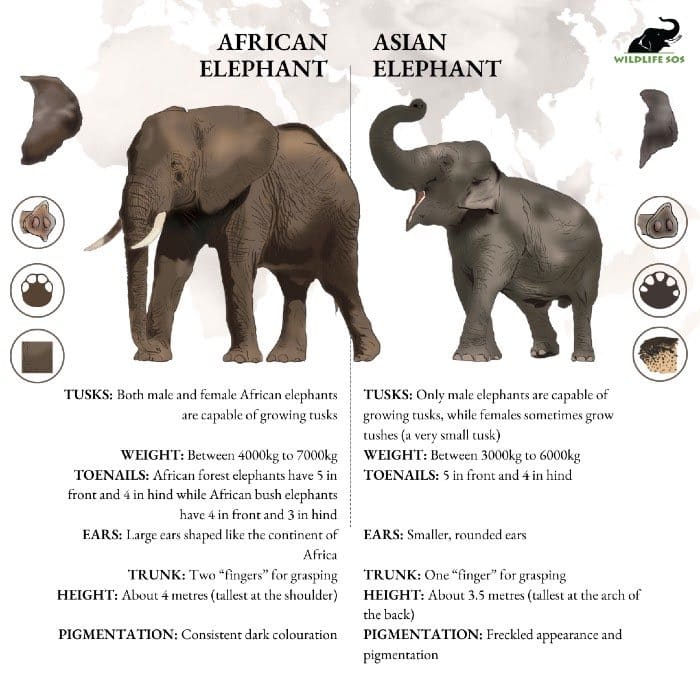
Illustration from WildlifeSOS Outlining the Main Differences
Video Showcasing the Main Differences
Geographical Differences Between African Elephant And Asian Elephant
Here are some of the geographical differences between an African elephant and an Asian elephant;
1. Habitat
These two elephant species live in Africa and Asia and don’t share the same space. You would never see them living together if they were both in their natural habitats.
African elephants can be found across the African continent, from tropical rainforests to arid deserts.
Meanwhile, Asian elephants have a more limited habitat and are largely confined to southern Asia.
They tend to prefer forested regions and can be found in countries such as Nepal, India, Sri Lanka, Myanmar, Thailand, Malaysia, Laos, and Cambodia.
2. Diet
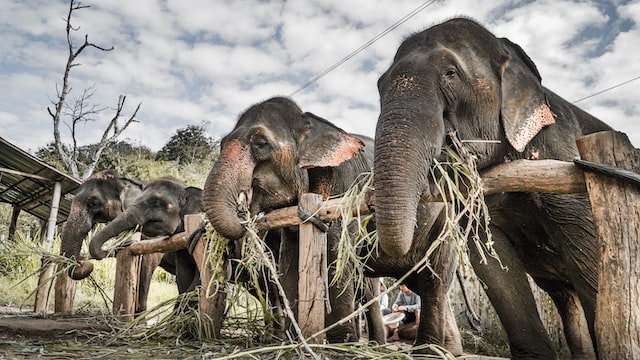
The primary difference in the diets of Asian and African elephants is that Asian elephants prefer monocot plants – palms, bamboo, grasses, and tree saplings native to their ecosystem.
Meanwhile, African elephants typically choose to eat tree saplings by breaking them apart and then stripping off their foliage.
African elephants’ diets vary depending on their location and proximity to other elephants. Their primary food sources include roots, grasses, fruit, and bark.
3. Lifespan
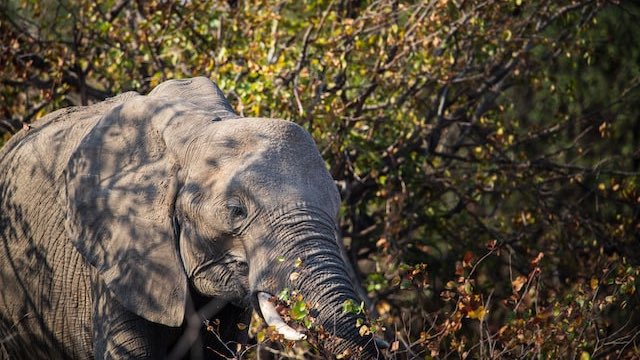
African elephants average living in the wild have had recorded lifespans of up to seventy years, whereas Asian elephants average is if sixty years.
Elephants have some of the longest life expectancies of any mammal, second only to humans. Read more about the expected lifespan of Elephants.
Historical Difference Between African Elephant And Asian Elephant
1. Human Interaction
African elephants have historically been used for labor and transportation by indigenous cultures and as a source of ivory.
The demand for ivory in Western countries has led to the decimation of African elephant populations through poaching.
Asian elephants have also been used for labor and transportation, but not to the same extent as African elephants. They have been poached for their skin and tusks, but not to the same degree as African elephants.
2. Conservation Status
The IUCN lists the African bush elephant as Vulnerable and the African forest elephant as Critically Endangered — a status updated in 2021. Asian elephants are classified as Endangered. All three species face ongoing threats from habitat loss, human-wildlife conflict, and poaching for ivory.
More information:
More information:
Asian elephants are since long endangered, with an estimated 40,000-50,000 individuals left in the wild.
3. Captivity
African elephants are more commonly found in zoos and other captive facilities due to their larger size and historical use for labor and entertainment.
Asian elephants are not as widely seen in captivity, with only a few thousand individuals living in captivity compared to the thousands of African elephants kept in captivity.
Behavioural Differences Between African and Asian Elephants
Social Structure
Both species live in matriarchal herds led by the oldest and largest female, but the structure differs. African elephant herds tend to be larger — sometimes numbering 20–30 individuals — and are often made up of several family units that merge into larger aggregations called clans. Asian elephant herds are generally smaller, typically 6–10 individuals, and tend to be more fragmented in their forest habitats.
Temperament and Human Interaction
Asian elephants have a longer history of domestication and working alongside humans — they have been used in forestry, religious ceremonies, and transport for thousands of years across India, Thailand, Sri Lanka, and beyond. As a result, they are generally considered more trainable and accustomed to human presence.
African elephants have historically been less domesticated, though they can be trained. Wild African elephants tend to be warier of humans, partly due to generations of pressure from ivory poaching. Bull African elephants in musth are considered especially dangerous.
Musth
Both African and Asian bull elephants experience musth — a periodic hormonal state characterised by a surge in testosterone, swollen temporal glands, and increased aggression. However, musth is more intensely studied in Asian elephants due to their closer historical relationship with humans. In both species, bulls in musth can be highly unpredictable and should be approached with extreme caution.
Intelligence and Communication
Both species are highly intelligent and communicate through a rich combination of vocalisations, body language, and infrasound — low-frequency rumbles below the range of human hearing that can travel several kilometres through the ground. Studies suggest African elephants have a slightly larger brain relative to body size, but both species demonstrate complex problem-solving, empathy, and long-term memory.
In Summary
African and Asian elephants are two species of elephants that differ in size. African elephants grow to be larger, with males averaging 12,000 pounds while females weigh 9,000 pounds. For Asian elephants, the genders are reversed where females tower over their male counterparts; however, both sexes rarely exceed 11,000 or 7,000 pounds respectively.
African and Asian elephants can be distinguished by their ears, tusks, and head shape. African elephants have larger ears, a long curved tusk, and a more rounded forehead. They also have two “fingers” at the end of their trunk. Asian elephants have smaller ears, a shorter straighter tusk, and wrinkles on their forehead. They only have one flexible “finger” at the end of their trunk.
Both African and Asian elephants are intelligent and social animals, but they have different behaviors and habitat preferences.
Frequently Asked Questions – Differences Between African Elephant and Asian Elephants?
Yes. Elephants found in Africa are the largest terrestrial creatures on Earth. The African Elephant is both taller at the shoulder and weigh more than their Asian cousin. See our table in this post for a complete overview.
Apart from their difference in size, the simplest way to tell African and Asian elephants apart is by their ears. African elephants have enormous ears that are shaped like the continent of Africa. On the other hand, Asian elephants have much smaller, round ears.
There is no definitive answer to this question, as strength is measured in various ways. However, African elephants have been known to lift heavier objects with their trunks and have thicker bones than Asian elephants.
Asian elephants are Endangered with around 40,000–50,000 remaining in the wild. Of the African species, the African forest elephant is Critically Endangered and the African bush elephant is Vulnerable. All three face serious threats from habitat loss and poaching.
No. African and Asian elephants are separate genera — Loxodonta and Elephas respectively — and cannot interbreed. They diverged from a common ancestor roughly 6–7 million years ago, making them more distantly related than lions and tigers, which also cannot produce viable offspring in the wild.