
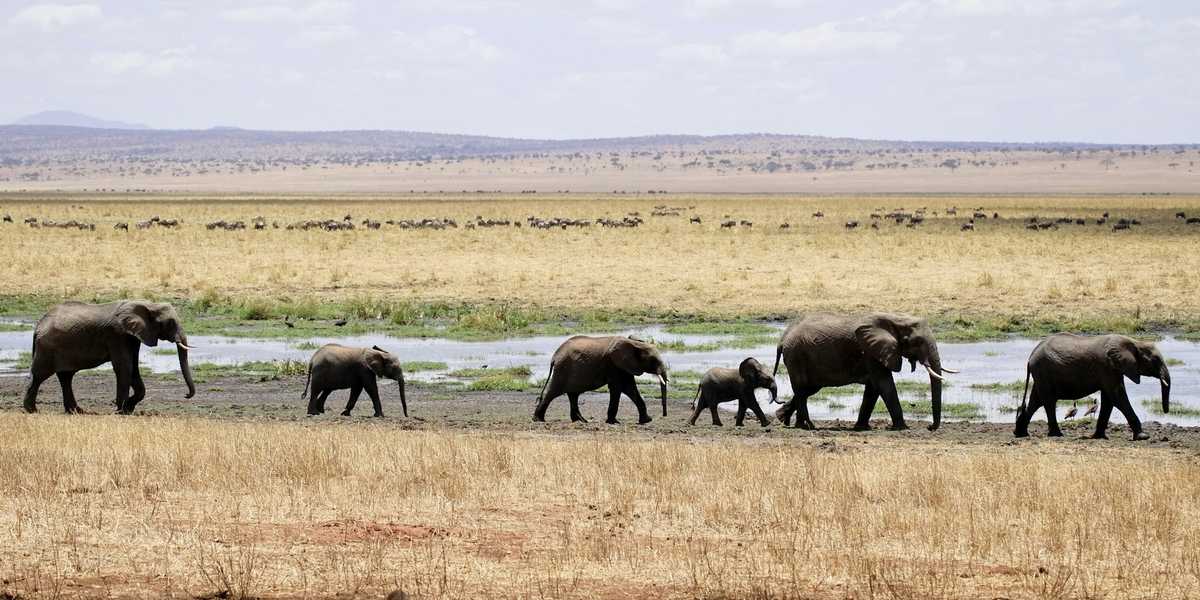
Elephants have their own set of names — for the group, the babies and the sexes — and they’re some of the most-asked questions about the species. The quick version: a group of elephants is a herd, a baby is a calf, a female is a cow and a male is a bull. Here’s the full breakdown, including the origins of those collective nouns, how herd structure differs between species, and how elephant naming compares to other animals.
The short answer: a group of elephants is a herd; a baby is a calf; a female is a cow; a male is a bull.
What is a group of elephants called?
A group of elephants is called a herd. Herds are family units led by the oldest female, the matriarch, and usually made up of related cows and their calves. You may also see the poetic collective nouns a “parade” or a “memory” of elephants — the latter a nod to their famous recall. Adult bulls often roam alone or in loose bachelor groups. More on this in our guide to elephant herds and social behaviour.
Where do the names come from? (Herd, parade, and memory explained)
English has three accepted collective nouns for elephants, and each tells a slightly different story about how people have perceived these animals across history.
Herd is the everyday term and the one used in zoology and wildlife research. It comes from Old English heord, meaning a domesticated or driven group of animals — the same root as a herd of cattle. The word emphasises the group’s collective movement and the social bonds that hold it together. It’s the term you’ll see in field reports, documentaries, and conservation data.
Parade is the formal literary collective noun, recorded in medieval English books of heraldry and natural history. It refers to the stately, processional way elephants move in single file when travelling between water sources or foraging grounds — the long column of animals walking trunk-to-tail has a ceremonial quality that “parade” captures well. It is rarely used in scientific writing but appears often in wildlife journalism and nature writing.
Memory is the most evocative of the three, coined as a poetic nod to the elephant’s legendary recall. Elephants have demonstrated the ability to remember individuals, locations, and events over decades. The term gained wider use in the late 20th century and appears frequently in popular writing, though scientists tend to stick with “herd.”
“Herd” is used in the field; “parade” appears in nature writing; “memory” celebrates their legendary recall. All three are correct.
How many elephants are in a herd?
Herd size varies considerably between species and habitat. African savanna elephant herds are typically larger because the open landscape supports bigger family groups; Asian elephant herds tend to be smaller, partly due to denser forest habitat. Here is the typical range:
| Species | Typical herd size | Notes |
|---|---|---|
| African savanna elephant | 10–20+ individuals | Can merge into “bond groups” of 50–100+ when resources allow |
| African forest elephant | 2–8 individuals | Smaller herds suit dense rainforest terrain |
| Asian elephant | 4–10 individuals | Core family units; may gather in larger groups at seasonal feeding sites |
| Bull bachelor group | 2–6 males | Loose associations; not a true matriarchal herd |
African savanna herds can temporarily merge into “bond groups” — aggregations of two or more related family units that come together at shared water sources or during the dry season. During the rainy season, when food and water are abundant, researchers have recorded temporary assemblies of over a hundred elephants on the Amboseli plains.
African vs Asian elephant herd structure
Both African and Asian elephants live in matriarchal herds, but the details differ in ways that reflect their environments.
African savanna elephants live on open grasslands and shrublands where resources can be spread over hundreds of kilometres. Their herds are large and mobile, often covering 50–80 km in a single day. The matriarch’s memory is critical — she navigates her family to water sources remembered from droughts decades earlier. When conditions are good, related herds (“bond groups”) reunite with elaborate greeting ceremonies of trumpeting, touching, and spinning in circles.
African forest elephants live in dense Central African rainforest where visibility is limited and food patches are smaller and more dispersed. Their herds are correspondingly smaller — typically just a mother and two or three offspring — and they communicate more through infrasound vibrations that carry through the forest floor, where loud vocalisations would be muffled by vegetation.
Asian elephants fall somewhere between the two. Their core family unit is a matriarch, her daughters, and their young. Bulls leave the herd earlier than in African species — typically around age 8–12 — and maintain looser ties with their natal group. In areas like Sri Lanka and Borneo, seasonal flooding and forest patchwork push groups together at certain times of year, creating temporary mega-herds that resemble African bond groups.
What is a baby elephant called?
A baby elephant is called a calf (plural: calves). Calves weigh 200–265 lb at birth and stay close to their mothers for years — see our guide to baby elephants and how long elephants are pregnant.
What is a female elephant called?
A female elephant is called a cow. Cows are the heart of the herd — the matriarch who leads is always a cow, and females typically stay with their family group for life. The term follows the same pattern as cattle, bison, and other large mammals.
What is a male elephant called?
A male elephant is called a bull. Young bulls leave the herd as they mature and live alone or in loose bachelor groups, rejoining females mainly to breed. The occasional aggressive state known as musth — characterised by elevated testosterone and temporal gland secretions — occurs in bulls and signals reproductive readiness.
Elephant names at a glance
| Elephant | What it’s called |
|---|---|
| Group | Herd (also “parade” or “memory”) |
| Baby | Calf (plural: calves) |
| Female | Cow |
| Male | Bull |
| Leader of the herd | Matriarch (the oldest cow) |
How do elephant collective nouns compare to other animals?
English has a long tradition of fanciful collective nouns for animals, many dating back to 15th-century hunting manuals. Elephants got three of the better ones. Here is how the elephant’s terms compare to some other notable examples:
| Animal | Collective noun(s) |
|---|---|
| Elephant | Herd, parade, memory |
| Lion | Pride |
| Wolf | Pack |
| Rhinoceros | Crash |
| Flamingo | Flamboyance |
| Crow | Murder |
| Owl | Parliament |
| Jellyfish | Smack |
| Whale | Pod, gam, school |
| Giraffe | Tower |
Bonus: what are an elephant’s body parts called?
A couple of common follow-ups: an elephant’s “nose” is properly called its trunk (a fusion of nose and upper lip — see what the trunk does), its long ivory teeth are tusks, and its broad, cushioned feet help it move almost silently despite its size.
The bottom line
A group of elephants is a herd, a baby is a calf, a female is a cow and a male is a bull — with the wise old matriarch leading the way. “Parade” and “memory” are the poetic alternatives, each carrying its own piece of elephant lore. Keep exploring: how elephant herds work, baby elephants, and the three species of elephant.
Frequently asked questions
A herd — a family group led by the oldest female (the matriarch). It can also be called a “parade” or a “memory” of elephants.
A calf (plural: calves). Calves weigh 200–265 lb at birth and stay close to their mothers for years.
A cow. The matriarch who leads the herd is always a cow, and females typically remain with their family group for life.
A bull. Mature bulls usually live alone or in loose bachelor groups, rejoining females mainly during breeding.
The trunk — a fused nose and upper lip. It is not simply a “nose,” though people often call it that.
Because elephants travel in single file in a stately, processional manner — especially when moving between water sources. The word “parade” captures that ceremonial quality and appears in formal English collective noun lists dating back to medieval heraldry.
It varies by species. African savanna elephant herds typically have 10–20+ members and can temporarily merge into groups of 50–100. African forest elephant herds are smaller (2–8), and Asian elephant herds are typically 4–10 individuals.
A bachelor group or bachelor herd. Young bulls leave the family herd as they mature and form loose associations with other males. These are not matriarchal herds — they lack a permanent leader and members come and go freely.
The most common is “herd.” Two poetic alternatives are also accepted: “parade” (from their stately single-file movement) and “memory” (a nod to their legendary recall). All three are correct English collective nouns.