Elephant herd and social behavior


African and Asian elephants both live in social groups built around related females. Calves can stand and nurse soon after birth.
Family units are commonly cited at 3 to 25 elephants, usually adult females and their baby calves; adult bulls normally live apart. The elephant herd can split into several smaller herds (or “elephant units”) if the group is too big.
Quick answer
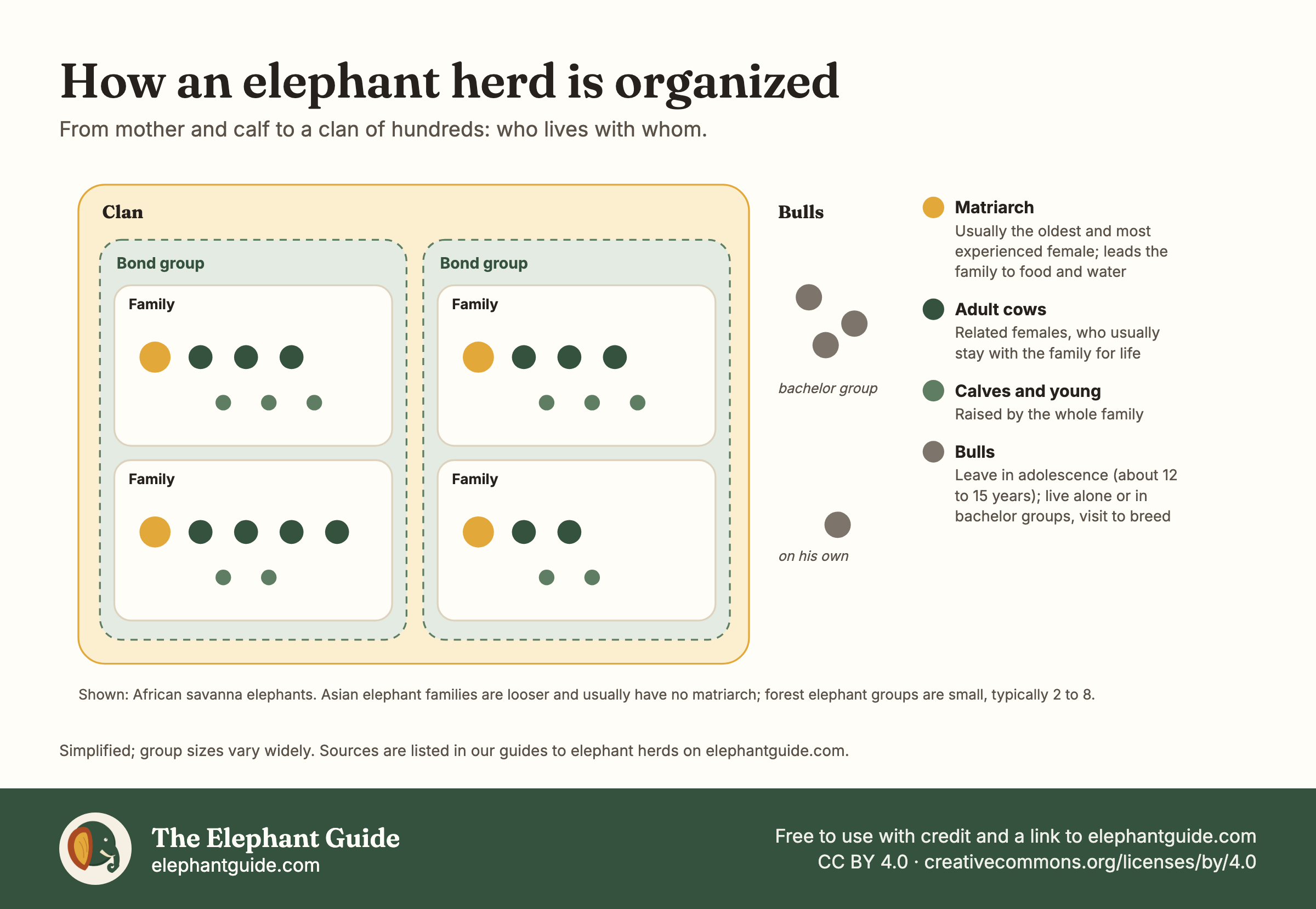
Elephants live in family herds, and in African elephants each herd is led by a matriarch, usually the oldest and most experienced female. Asian elephants usually do not have a matriarch, according to the Smithsonian National Zoo. Herds are made up of related females and their young. Males leave in adolescence, at roughly 12 to 15 years in African elephants, and live alone or in bachelor groups.
Every elephant needs a herd
Living in a family group helps elephants with protection and with raising their young. As a family grows, it can split into smaller groups of related females.
Elephant families are close-knit. For what elephants have meant in different cultures, see elephant symbolism.
What is the social structure of an elephant herd?
An elephant family usually consists of:
- An older matriarch in African elephants, usually the oldest and most respected female, who leads the family.
- Several related females and their offspring.
- Young males, until they leave the family in adolescence.
- Adult bulls, which usually live apart from family herds.
The importance of the herd’s matriarch
In African elephants, each family is led by a matriarch, usually the oldest and most respected female (ElephantVoices). Day-to-day decisions involve broad participation, including consensus building, rather than orders from one animal.
Experience may matter in hard times. A 2008 study of the severe 1993 drought in Tanzania’s Tarangire National Park found that calves of younger mothers were less likely to survive, and that calves in family groups that left the park had lower mortality than those in groups that stayed. The authors suggested that older matriarchs may have led groups to refuges using experience of earlier droughts, but said they could not tell which differences caused the result.
The matriarch is usually described as leading the family to food and water.

Raising calves together
Elephants are pregnant for about 22 months, the longest pregnancy of any land mammal.
Calves are raised within the family, and other females help look after them.
Allomothers are females that help care for calves that are not their own. Most are young females under 15 that have never given birth, though older relatives such as grandmothers and aunts sometimes help too (National Geographic).
Females with their calves
When it comes to baby elephants, many people tend to only see the mothers and young. However, they don’t always know that other female elephants will also play a very important role when it comes to the young’s upbringing.
Allomothers comfort calves, play with them, and help in stressful moments such as when a calf falls, gets stuck in mud or is separated from its mother. The extra help also lets mothers watch their young while the group spreads out to forage.
Elephant bull dynamics
Adult male elephants live apart from the family herds. According to the San Diego Zoo, bulls visit female herds briefly to breed and do not help care for the young.
Males leave the family herd in adolescence, at roughly 12 to 15 years old in African elephants (about 8 to 13 in Asian elephants), and then live alone or in bachelor groups.
Bulls often associate with other males in loose bachelor groups, but they can also be quite aggressive with other elephants.
Is there a difference between elephant population structures in Africa and Asia?
Researchers who study the elephants of Amboseli National Park, Kenya, describe several levels of social life. Related females and their young form a family; families that spend much of their time together form a bond group; and families that share the same dry-season home range form a clan, which can include several bond groups and sometimes several hundred elephants (ElephantVoices).
Asian elephants also live in groups of related females and their young, but the Smithsonian’s National Zoo notes that, unlike African elephants, they do not have a matriarch. Females stay in the family for life, and males leave at puberty, typically at about 8 to 13 years old.

Summary
Elephant herds are close-knit units that share a strong family bond. Female elephants, both young and old, take care of calves together and play an important role in their upbringing.
Male elephants leave their family herd in adolescence and live alone or in bachelor groups, visiting herds mainly to breed.
FAQ about Elephant herds
The role of the matriarch
In African elephants, each family herd is led by a matriarch, usually the oldest and most respected female. The Smithsonian’s National Zoo says Asian elephants do not have a matriarch, although an individual female may sometimes take a more dominant role.
How elephants communicate within the herd
Elephants communicate with sound, touch, scent and body language. Our guide to how elephants communicate and the page on the sounds elephants make go into detail.
It’s called a “herd”. Researchers also use “family” for a group of related females and their young, and “clan” for families that share the same dry-season home range.
Yes, elephants live in herds.
Family units are commonly cited at 3 to 25 elephants; sources give ranges from 2 to 50 or more.
Females live in family herds. Males leave in adolescence and then live alone or in bachelor groups, visiting herds briefly to breed.
In African elephants, yes: family herds are led by a matriarch, usually the oldest and most respected female. Asian elephants usually do not have a matriarch, according to the Smithsonian’s National Zoo.
Elephants live in a herd for protection and to make it easier to care for the young.
African elephant family herds are led by a matriarch, usually the oldest and most respected female. Asian elephants usually do not have a matriarch.
In African elephants the matriarch usually leads the family. Asian elephants usually do not have a matriarch.
An elephant family herd is a group of related females and their young. Adult males mostly live apart.
Sources
Where the main facts in this article come from. Links open in a new tab.
- ElephantVoices, An Elephant's Social Network
- Britannica, Elephant: Reproduction and life cycle
- Smithsonian National Zoo, Asian elephant
- Cornell Elephant Listening Project, Elephant sound
- Amboseli Trust for Elephants, Annual Report 2022
- SeaWorld, Elephant behavior
- San Diego Zoo Wildlife Alliance, Elephant
- Save the Elephants, Elephant facts
- Foley, Pettorelli and Foley, Severe drought events and population declines of African elephants, Biology Letters, 2008 (Tarangire, 1993)
- National Geographic, When elephant moms need help, nannies step in
Keep reading
Baby Elephant Facts: Birth, Growth & Life in the Herd
It’s a question that has puzzled scientists, zookeepers and animal lovers alike: Why is it that humans are so fascinated by the calves of…

Why Do Elephants Destroy Trees?
Elephants snap, push over and strip trees, mostly while feeding. Here is what the research says about why, and how much it matters.

The Elephant Life Cycle: From Birth to Old Age
Elephants live among the longest lives of any land mammal, with wild individuals living up to about 70 years. That lifespan is not simply…
Enjoyed reading this and amazing pictures ! I plan to read this article to my students .
Thank you for your kind words Preetha. Have a great day!
Gracias por el artículo. Vi hace un tiempo un documental en el que una cría perdía a su madre y la matriarca obligaba a una tía a darle de mamar. La tía no quería ya que tenía su propia cría. Al final, salían las dos adelante. Pero no recuerdo cómo se llamaba el documental.