
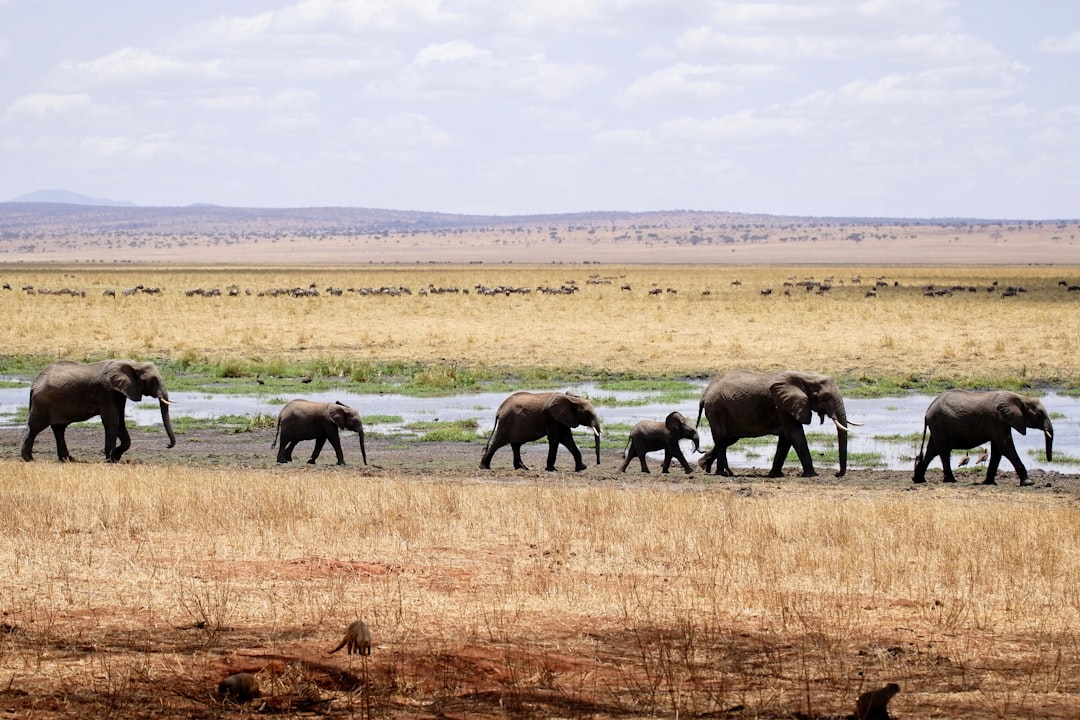
Unlike birds that vanish south every October or wildebeest that circle the Serengeti on a near-clockwork schedule, elephants don’t follow a predictable seasonal migration. But don’t let that fool you — elephants move. A lot. Across thousands of square miles, guided by ancient knowledge passed through generations, driven by the most fundamental forces in nature: water, food, and survival.
The short answer: Elephants don’t “migrate” in the traditional seasonal sense, but they are nomadic animals that may travel 50–100 miles in a single day during dry seasons, following ancient routes across landscapes that can span thousands of square miles.
Do Elephants Migrate?
The short answer is: not in the way most people picture migration. Classic seasonal migrants — monarch butterflies, Arctic terns, wildebeest — follow predictable, directional routes tied to the calendar. They leave, they arrive, they return. Elephants don’t do this. What elephants do is better described as nomadic movement: large-scale, seasonal wandering across a defined home range, driven by resources rather than the calendar.
That said, elephant movement absolutely has seasonal patterns. In East Africa, the wet season disperses herds across broad landscapes where temporary water pools and fresh grasses appear. When the dry season arrives and those resources disappear, elephants converge on permanent water sources — rivers, springs, and swamps — sometimes from dozens of miles away. This is resource-driven movement at a massive scale, and it resembles migration in all the ways that matter ecologically.
A note on terminology: you may have encountered the phrase “The Great Elephant Migration” in a US context. This refers to a public art installation — a travelling exhibit of over 100 life-size wooden elephant sculptures created by artist Vijay Kamath and the Coexistence collective. It has toured dozens of American cities to raise awareness about wild elephant conservation. This article is about something different: the biology of how real elephants move across real landscapes, and what drives those journeys.
So while the label “migration” is technically imprecise for elephants, the scale of their movement is anything but small. Some populations cover home ranges larger than entire countries. Understanding how and why they move is essential to protecting them — and to managing the human-elephant conflict that erupts when ancient routes collide with modern development.
What Drives Elephant Movement?
Water is the single most important driver of elephant movement. An adult elephant needs to drink 30–50 gallons of water every day — more during hot weather, more for lactating females. During the dry season, permanent water sources can be separated by tens of miles. Elephants will walk through the night, cover astonishing distances, and follow routes remembered across decades to reach those sources. Where the water is, the elephants will follow.
Food availability is a close second. Elephants are bulk feeders: an adult consumes 300–400 pounds of vegetation daily, stripping bark, uprooting grasses, pulling down branches. No single area can sustain a herd indefinitely. Elephants must keep moving to prevent exhausting the food supply in any one location — and their nomadic lifestyle is partly a strategy to allow vegetation to recover in their wake. During wet seasons, when food is abundant across the landscape, herds spread out. During dry seasons, they concentrate where resources remain.
Mineral licks are another draw. Specific locations — exposed rock faces, riverbanks, termite mounds — are rich in sodium, calcium, and other minerals that vegetation alone can’t provide. Elephants visit these sites repeatedly, sometimes travelling significant distances specifically to reach them. Calving females and young elephants are particularly drawn to mineral-rich sites, which support bone development and milk production.
Social factors also shape movement, especially for bulls. Males in musth — a state of heightened testosterone and reproductive drive — roam far beyond their normal range in search of receptive females. A bull in musth may cover terrain that a family herd would never visit, sometimes traversing hundreds of miles across unfamiliar territory.
Perhaps the most remarkable driver of elephant movement is learned knowledge, carried by matriarchs. Older female elephants remember water sources, mineral licks, and safe routes that they haven’t visited in years or even decades. Studies in Amboseli, Kenya, led by researcher Ian Douglas-Hamilton and later expanded by Cynthia Moss, have documented herds led by older matriarchs successfully navigating to water during severe droughts — to locations the younger animals had never visited. This cultural transmission of geographic knowledge is unique among land animals and makes the loss of older elephants particularly devastating. You can read more about this extraordinary spatial memory in our article on whether elephants have good memory.
How Far Do Elephants Travel?
The distances elephants cover vary enormously by population, habitat quality, and season. In resource-rich environments with permanent water, home ranges can be relatively compact. In arid environments where water is scarce and scattered, elephants may maintain the largest home ranges of any land mammal.
| Population | Typical daily movement | Seasonal home range | Max recorded movement |
|---|---|---|---|
| African bush (Amboseli, Kenya) | 5–15 miles | ~1,000 sq miles | 50+ miles/day during drought |
| African bush (Botswana, Chobe) | 10–30 miles | ~2,000–6,000 sq miles | — |
| African bush (Namibia, Kunene) | Up to 50 miles/day in dry season | Largest known ranges in Africa | 50+ miles/day |
| African forest (Congo Basin) | 3–10 miles | ~150–300 sq miles | — |
| Asian elephant (India) | 5–20 miles | ~100–600 sq miles | — |
The extremes are striking. Desert-adapted elephants in Namibia’s Kunene region have been GPS-tracked with home ranges exceeding 11,000 square miles — larger than Belgium. These animals navigate vast stretches of hyper-arid terrain between scattered water points, relying on ancient routes and exceptional geographic memory.
In Namibia’s desert-adapted elephant population, GPS tracking recorded individuals traveling more than 50 miles in a single day to reach water — across terrain with no visible landmarks and no permanent rivers.
At the other end of the scale, forest elephants in the Congo Basin maintain relatively compact ranges by elephant standards. Dense forest limits visibility and movement, and food resources — fruits, seeds, bark — are distributed more evenly through the forest year-round. These elephants are also far less studied than their savanna counterparts; their secretive nature and the difficulty of GPS-collaring animals in dense forest has left significant gaps in our understanding of their movement ecology.
Asian elephants generally maintain smaller home ranges than African bush elephants, though this varies considerably. In fragmented Indian landscapes, some populations are effectively restricted to small patches of forest surrounded by agriculture, a situation that creates serious conflict. In intact habitats like Sri Lanka’s dry-zone national parks, movement patterns are more expansive and seasonal.
African Elephant Movement and Migration Patterns
Africa’s elephant populations show the full spectrum of movement strategies, from the well-documented rhythms of East African savanna herds to the extraordinary odysseys of southern African desert elephants.
The Amboseli ecosystem in Kenya is one of the most intensively studied elephant populations on Earth, thanks to over 50 years of continuous research by Cynthia Moss and the Amboseli Elephant Research Project. Amboseli’s elephants use a wet-season range of roughly 30,000 square kilometres, dispersing into the surrounding Kilimanjaro foothills and Tanzanian border zones when rains create temporary water and fresh grass. As the dry season intensifies, herds converge on Amboseli’s spring-fed swamps — fed by snowmelt from Kilimanjaro — which remain permanent year-round. This seasonal pulse is predictable enough that it resembles true migration, though the animals never leave the broader ecosystem entirely.
In Botswana, the Chobe-Okavango-Linyanti triangle hosts the largest concentration of African elephants on Earth — over 130,000 animals. These elephants move seasonally between the Chobe River floodplains in the north and the Okavango Delta and Linyanti wetlands to the west and south. During the wet season, they spread across the Kalahari hinterland as temporary pans fill with water. In the dry season, they return to the permanent water of the main river systems. The scale of this congregation — tens of thousands of elephants gathered along the Chobe riverfront — is one of Africa’s great wildlife spectacles.
The desert-adapted elephants of Namibia’s Kunene region represent perhaps the most extreme movement strategy of any elephant population. GPS tracking studies have documented individuals navigating more than 50 miles per day across waterless terrain, crossing mountain ranges and dry riverbeds to reach distant water sources. These animals have developed physiological adaptations — reduced metabolic water requirements, modified foot structure for navigating sandy terrain — alongside behavioural adaptations that include memorising the locations of water points separated by days of travel.
African forest elephants (now recognised as a separate species, Loxodonta cyclotis) inhabit the dense rainforests of the Congo Basin and West Africa. Their movement ecology differs fundamentally from savanna elephants. Forest elephants are fruit specialists and seed dispersers, and their ranging patterns are influenced by fruiting cycles across the forest. They make extensive use of forest clearings called bais — mineral-rich openings where hundreds of forest elephants may congregate — but their daily ranging is generally less dramatic than their savanna counterparts. Research using GPS collars in Gabon and Cameroon has documented home ranges of roughly 150–300 square miles, though much remains unknown about long-distance movement in this species. Learn more about the three species of elephant and how they differ.
Asian Elephant Movement and Home Ranges
Asian elephants (Elephas maximus) occupy a different ecological world from their African relatives — forest-grassland mosaics, river valleys, and mountain slopes across South and Southeast Asia. Their movement patterns are shaped by monsoon rainfall, forest fruiting cycles, and increasingly, by the patchwork of human settlements and agricultural land that interrupts their traditional ranges.
In India, the largest Asian elephant population inhabits the forests of the Western Ghats, Eastern Ghats, and northeastern states. The Nilgiris-Eastern Ghats landscape in southern India is one of the most important elephant habitats on the continent, supporting roughly 6,000 animals. These elephants move seasonally through a mosaic of forest, grassland, and plantation, following the distribution of water and browse. As agricultural expansion has intensified, elephants increasingly encounter crops during their seasonal movements — a major source of human-elephant conflict, with elephants raiding sugarcane, rice, and millet fields. Annual crop-raiding events affect thousands of farmers and result in dozens of human deaths and elephant deaths each year.
In Sri Lanka, the dry-zone national parks host one of the island’s most remarkable seasonal gatherings. Minneriya National Park, in Sri Lanka’s north-central province, hosts what is marketed as “The Gathering” — a seasonal aggregation of up to 300 or more elephants around the Minneriya reservoir as surrounding areas dry out. This is the largest known gathering of Asian elephants in the world, occurring between June and September. Like the Amboseli dry-season convergence in Kenya, it is driven by elephants concentrating on a permanent water source as seasonal resources disappear.
Southeast Asian elephants in Borneo, Sumatra, and mainland Southeast Asia face among the most severe habitat fragmentation of any elephant population. In Sabah, Malaysian Borneo, the pygmy elephant — a distinct subspecies — has been GPS-tracked navigating a landscape of oil palm plantations, logging concessions, and forest reserves. These animals attempt to follow traditional movement corridors that have been partially severed by development, resulting in elephants regularly entering plantations and coming into fatal conflict with farmers.
The movement ecology of Asian elephants is intimately connected to their herd social structure. As with African elephants, matriarchs carry the accumulated knowledge of the landscape, guiding family groups to water sources and foraging areas that younger animals don’t yet know. The disruption caused by the historical ivory trade — which preferentially targeted large-tusked older animals — has removed many of these experienced leaders from populations, with consequences for navigation and movement that researchers are still trying to understand.
Elephant Corridors: What They Are and Why They Matter
An elephant corridor is a strip of habitat — often relatively narrow — that connects two larger protected areas and allows elephants to move between them. Corridors exist because elephants require far more land than any single protected area can provide. Without the ability to move across landscapes, elephant populations become isolated, genetically bottlenecked, and unable to respond to resource fluctuations that drive their movement. Corridors are, in a very literal sense, what makes elephant survival possible at a landscape scale.
In India and Nepal, the Terai Arc Landscape connects 14 protected areas across the foothills of the Himalayas, providing movement corridors for Asian elephants (as well as tigers and rhinoceroses) across a heavily populated agricultural region. The corridors here are narrow — sometimes only a few kilometres wide — and their maintenance requires constant negotiation with local communities whose land intersects the route. The Nilgiris Elephant Corridor in Tamil Nadu, India, is a particularly famous case: a 1.2-kilometre-wide strip of land in the Sigur Plateau that provides the only viable movement connection between elephant populations in the Nilgiris and Mysore plateaus. After years of legal battles, the Wildlife Trust of India purchased key private landholdings within the corridor to secure its future.
In southern Africa, the Kavango-Zambezi Transfrontier Conservation Area (KAZA TFCA) represents the world’s largest transboundary conservation area — roughly 200,000 square miles spanning Botswana, Zimbabwe, Zambia, Namibia, and Angola. KAZA was explicitly designed to allow elephants to move across international borders through a network of wildlife management areas and community conservancies that buffer the core national parks. With Botswana’s Chobe elephant population regularly crossing into Zimbabwe, Namibia, and Zambia, the transboundary approach acknowledges the reality that elephant conservation cannot stop at political borders.
Why does all of this matter? When corridors are severed — by roads, fences, farms, or settlements — elephants attempt to move anyway. The difference is that instead of moving through forest or bush, they move through human-occupied land. The result is property destruction, crop loss, human injury, and elephant death. Corridors are not just a conservation nicety: they are a practical tool for reducing human-elephant conflict by giving elephants viable routes that don’t require them to cross farms and villages. For more on the conservation challenges facing elephants, see our overview of whether elephants are endangered, and explore the work being done on the conservation efforts page.
Human Impact on Elephant Movement Routes
Every year, ancient elephant routes that have been used for thousands of years are interrupted by new infrastructure. Roads, railways, fences, and expanding agriculture fragment the landscapes that elephant movement depends on, with consequences that range from increased human-elephant conflict to demographic isolation and local extinction.
In Kenya, the standard gauge railway built between Nairobi and Mombasa — completed in 2017 — cuts through the Nairobi National Park boundary and the Tsavo ecosystem, one of Africa’s most important elephant habitats. Conservation groups raised alarm during construction about the potential impact on elephant movement routes, and subsequent monitoring has documented elephants attempting to cross the line and being deterred or injured by trains. Underpasses were built at several locations, but their effectiveness depends on whether elephants learn to use them — which takes time and doesn’t always happen.
In India, railway lines crossing elephant habitat kill dozens of elephants every year. The northeastern states, which host important elephant populations alongside some of India’s busiest railway corridors, are particularly affected. Mitigation efforts have included speed reduction orders for trains passing through wildlife zones at night, early-warning systems using sensors and cameras to alert drivers, and the installation of lighting and alarm systems. Results have been mixed, and the political will to enforce speed limits on commercial rail routes remains inconsistent.
In Botswana, the veterinary cordon fences erected in the 1980s and 1990s to control foot-and-mouth disease had catastrophic effects on wildlife movement. Thousands of wildebeest and other migratory animals died attempting to cross fences during droughts. Elephants, with their ability to break through or dig under fencing, fared somewhat better — but the fences still fragmented movement patterns and concentrated pressure on remaining corridors. The partial removal of some fences in recent years has been welcomed by conservationists, though cattle interests continue to resist broader fence removal.
Mitigation strategies are evolving rapidly. Wildlife underpasses and overpasses have been used successfully on roads in India, Kenya, and southern Africa. Early-warning systems using GPS collars, camera traps, and SMS alerts can notify communities and railway operators when elephants are approaching known crossing points. Bee-hive fences — strings of beehives that deter elephants through their fear of bee stings — have proven effective at protecting smallholder farms along movement corridors in Kenya and Uganda. Elephants’ remarkable ability to communicate over long distances using infrasound may even allow them to coordinate movement and warn each other of hazards — though how they process and respond to novel threats like railways is not yet fully understood.
The Bottom Line
Elephants are not migrants in the classic sense — they don’t pack up and head south in October, following an internal compass to a fixed destination. But they are among Earth’s most wide-ranging land animals, navigating landscapes that stretch across thousands of square miles with a precision and cultural intelligence that continues to astonish researchers.
Their movement is purposeful, adaptive, and deeply informed by accumulated knowledge. Matriarchs carry mental maps of water sources, mineral licks, and safe routes that have been passed through generations. Herds respond to rainfall, vegetation, and seasonal cues with a flexibility that simple migration cannot capture. And when their routes are blocked — by a fence, a railway, a spreading village — they don’t simply stop. They push through, adapting as best they can to a world that is changing faster than any matriarch’s memory can account for.
Understanding elephant movement is not just an academic exercise. It is the foundation of effective conservation — of corridor design, conflict mitigation, and the management of landscapes large enough to sustain wild elephants in the long term. The more we understand about where elephants go and why, the better equipped we are to ensure they have the space to keep moving.
Not in the traditional sense. Elephants don’t follow fixed directional routes tied to the calendar the way birds or wildebeest do. Their movement is better described as nomadic: seasonal wandering across a large home range driven by water availability, food resources, and mineral sources. In East Africa, herds disperse during wet seasons and converge on permanent water during dry seasons, which resembles migration in ecological terms, but the pattern is resource-driven rather than calendar-driven.
It depends on the population and the season. In normal conditions, African savanna elephants typically cover 5–25 miles per day. During dry seasons, when water is scarce, elephants may travel 50 or more miles in a single day to reach a water source. Desert-adapted elephants in Namibia hold the record, with GPS-tracked individuals covering more than 50 miles per day across arid terrain. Asian elephants typically cover 5–20 miles daily, depending on habitat quality.
An elephant corridor is a strip of habitat connecting two larger protected areas, allowing elephants to move between them. Because elephants require vast landscapes and cannot survive indefinitely in any single protected area, corridors are essential for maintaining viable populations. Famous examples include the Nilgiris Elephant Corridor in India and the Kavango-Zambezi Transfrontier Conservation Area (KAZA) in southern Africa, which spans five countries.
“The Great Elephant Migration” is a travelling public art installation featuring over 100 life-size wooden elephant sculptures. It has toured cities across the United States and internationally to raise awareness about wild elephant conservation and human-elephant coexistence. It is not a reference to a biological migration event — real elephants don’t engage in a single “great migration” in the way wildebeest do in the Serengeti.