Look closely at an elephant’s chin the next time you visit a zoo or encounter one on safari. You’ll see them: wiry, dark, bristle-like hairs jutting out against the wrinkled grey skin. Elephants — those enormous, seemingly hairless giants of the animal kingdom — do indeed have hair. It’s just not quite what you’d expect. This is the full story of elephant anatomy‘s most overlooked feature.
The short answer: Yes — elephants do have hair. As mammals, all elephants possess hair by definition. Adult elephants have sparse, wiry bristles scattered across their body — most visible on the chin, top of the head, eyelashes, and tail tip. Newborn calves are noticeably fuzzier, covered in a fine reddish-brown down that thins as they mature. The sparseness is an evolutionary adaptation to avoid overheating in tropical climates.
So, Do Elephants Have Hair?
The question seems strange at first glance. Elephants look about as hairless as an animal can get — their thick, leathery grey skin appears almost reptilian. But looks deceive. Elephants are mammals, and one of the defining biological characteristics of all mammals is the presence of hair. Not some mammals — all mammals. From whales to elephants to bats, if it’s a mammal, it has hair.
In elephants, hair is sparse but real. An adult African elephant has roughly 400 to 1,000 hairs per square metre of skin. For context, a dog has around 60,000 hairs per square metre, and a cat more than 100,000. Elephants sit at the extreme low end of mammalian hair density — but they’re not zero. Run your hand along an elephant’s hide (zoos occasionally allow supervised contact) and you’ll feel the coarse, prickling sensation of individual bristle hairs catching your palm.
The hairs are not soft or downy in adults. They’re thick, dark, and stiff — more like the bristles on a nail brush than the fur of a cat or dog. Under a microscope, elephant hairs show a heavily medullated shaft (a large, air-filled inner core) similar to the guard hairs of other large mammals, but with an unusually coarse, irregular surface texture. There are also two broad species to consider — check our guide to the three species of elephant for a full breakdown — but all three (African bush, African forest, and Asian) share this sparse-bristle hair pattern. Asian elephants tend to show slightly more visible head hair, particularly the distinctive domed-crown bristle patch.
Where on an Elephant’s Body Is Hair Found?
Elephant hair is not evenly distributed. Different regions of the body carry distinctly different types and densities of hair, each serving a function:
- Chin and lower face: The most conspicuous hairs on an adult elephant. Long, dark, wiry bristles project from the lower jaw, often catching light from below. These are among the longest non-tail hairs on the body.
- Top of the head (dome): A bristly patch sits on the crown, particularly prominent in Asian elephants, which have a distinctive double-domed forehead. These hairs point upward and outward, creating a sparse but visible “cap.”
- Eyelashes: Elephant eyelashes deserve special attention (they get their own section below). Long, curved, and very dark, they’re one of the most striking hair features on the animal.
- Spine and dorsal ridge: Individual hairs run along the top line of the back, particularly over the spine. These become visible when an elephant is backlit — you can see them projecting against the sky like tiny antennae.
- Tail tip: The densest cluster of hair on an adult elephant. A thick tuft of extraordinarily stiff, wiry black hairs grows from the tail’s end — more on this remarkable adaptation below.
- Between the toes: Sparse, bristly hairs grow in the creases between the toenails and along the foot’s upper surface. These are rarely seen but consistently present.
- General body coverage: Across the rest of the body — flanks, legs, belly, shoulders — individual hairs are scattered at very low density, typically one hair every few centimetres, too sparse to create any visual impression of furriness but measurable and real.
The distribution pattern is strikingly similar across all elephant individuals and species, suggesting these hair locations are not random but evolutionarily maintained for specific sensory or protective functions.
Why Do Calves Have Much More Hair Than Adults?
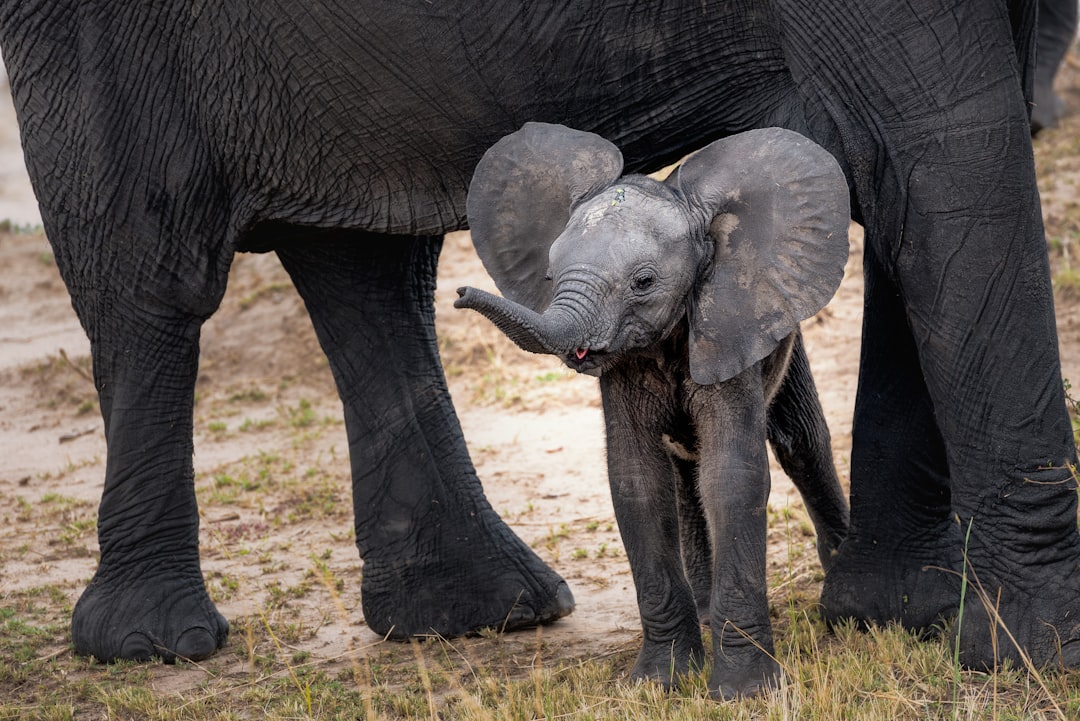
Baby elephants are a different story entirely. Newborn elephant calves arrive in the world covered in a coat of fine, reddish-brown or dark brownish-black downy hair — the difference from their parents is dramatic and immediately visible. In photographs of baby elephants, this fuzz is one of the first things that strikes observers: they look almost fluffy, a quality that vanishes as they grow.
This neonatal hair coat is thought to serve thermoregulatory functions. Newborn elephants are large compared to most newborn animals — already weighing 90 to 120 kg (200 to 265 lbs) at birth — but their surface-area-to-volume ratio is still much higher than an adult’s. An adult elephant maintains its temperature partly through sheer bulk: so much metabolic mass generating heat that overheating is the primary risk, not cold. A calf doesn’t yet have this advantage, and the natal hair coat provides a modest insulating layer during the critical early weeks.
The calf hair also has a sensory role: the fine hairs increase tactile sensitivity, which may help calves navigate close contact with their mothers and herd members in low-visibility conditions (elephants are born with relatively poor eyesight and rely heavily on touch and sound).
The transformation happens gradually. By six months to a year, most of the fine downy fuzz is gone, replaced by the sparser, coarser bristle pattern of adults. The head retains hair longest — young elephants commonly display a distinctive fuzzy “mohawk” along the crown well into their first year, a tuft of longer hair that gives juvenile elephants an endearingly scrappy look. By age two, the adult hair pattern is mostly established.
Why Do Elephants Have So Little Hair?
The evolutionary logic behind elephant hairlessness is tied to the same challenge that faces all large-bodied mammals in warm climates: heat dissipation. An African elephant isn’t at risk of getting cold — it’s at near-constant risk of overheating.
A large bull elephant generates an enormous amount of metabolic heat — estimates suggest a large bull produces the thermal equivalent of 5,000 to 10,000 watts during active movement. That heat needs to escape the body. Dense fur, which functions as insulation by trapping a warm air layer close to the skin, would be catastrophic in this context — it would prevent heat radiation and drive core temperatures to lethal levels during exertion.
Bare skin solves this problem by maximising conductive and radiative heat loss. Elephants have evolved several complementary cooling mechanisms, none of which involve fur:
- Ear radiators: The enormous ears of African elephants are laced with a dense network of blood vessels close to the surface. Elephants flap their ears to increase airflow over this vascular surface, cooling the blood before it returns to the body core — a biological radiator system.
- Mud and dust bathing: Elephants regularly coat themselves in mud and dust. This serves as sunscreen (elephant skin, while thick, can sunburn), as a cooling layer as the moisture evaporates, and as insect repellent. Fur would trap this material in ways that would reduce its effectiveness.
- Water immersion: Elephants wade into water when available, using it as a direct cooling mechanism. Their bare skin maximises heat transfer to the water.
Evolutionary pressure over millions of years selected heavily for reduced hair density in elephant lineages that moved into warmer environments. The ancestors of modern elephants — living in the Pliocene and earlier Pleistocene periods — inhabited more variable climates and likely carried more hair. As populations adapted to hot savanna and tropical forest environments, individuals with less hair shed heat more efficiently, survived better, and passed their low-hair genetics to offspring. Over geological time, this drove hair density toward the minimum functional level we see today.
Woolly Mammoths — Proof That Elephant Relatives Can Grow Full Coats
Here is where the story becomes genuinely extraordinary. Modern elephants are nearly hairless — but their closest evolutionary relatives were covered in one of the most impressive hair coats in mammalian history.
Woolly mammoth guard hairs could grow up to 90 centimetres — nearly three feet — in length, forming a sweeping outer coat over a dense, sheep-like underfur insulating layer.
Woolly mammoths (Mammuthus primigenius) diverged from the lineage leading to Asian elephants approximately 5.8 million years ago. As they spread into the cold steppes and tundra zones of Eurasia and North America during Pleistocene ice ages, they evolved a spectacular insulating coat: a double-layered system consisting of coarse outer guard hairs (up to 90 cm / 35 inches long) and a dense underfur layer — functionally similar to a sheep’s wool — that trapped warm air against the skin. Mammoths could survive ambient temperatures as low as −40°C.
We know this in extraordinary detail because woolly mammoth specimens have been recovered from Siberian permafrost with soft tissue and fur preserved. Frozen mammoths found at sites including Berezovka (1901) and Baby Lyuba (2007) retain their actual hair, allowing scientists to study the fibre structure, colour (a reddish-brown), and length directly. The hair has also been subjected to DNA analysis.
This genetic work is the crucial piece: comparison of woolly mammoth and modern elephant genomes reveals specific changes in genes associated with hair follicle density, hair shaft diameter, and the molecular pathways controlling sebaceous gland function (which conditions hair). Modern elephants carry related versions of these genes, but with regulatory differences that suppress dense hair growth. The genetic machinery for a full hair coat exists in the elephant lineage — modern elephants simply don’t activate it.
This finding has extraordinary implications for de-extinction research: the Colossal Biosciences project attempting to recreate a mammoth-like creature using Asian elephant genetic material targets exactly these hair-related genes as among the first to edit. See our article on mammoths vs elephants for a full comparison of these fascinating relatives.
The Tail Tuft — Elephant Hair with a Job
Of all the hair on an elephant’s body, the tail tuft is the most functionally specialised and visually striking. At the end of the elephant’s relatively short, thin tail grows a dense brush of extraordinarily stiff, wiry, dark hairs — sometimes described as looking like a bottle brush or a coarse paintbrush. See our guide to elephant tails for more on the tail’s structure and function.
Individual tail hairs are remarkable: they can grow to 30–45 cm (12–18 inches) in length, and they are not soft — they are stiff and almost wire-like, with a tensile strength significantly greater than scalp hair. The tuft can contain dozens of these individual fibres bundled together, creating a formidable swatter.
The function is unambiguous: the tail tuft is a natural fly-swatter. Elephants swish their tails constantly in the wild, using the stiff hairs to dislodge flies, ticks, and other insects from the hindquarters — regions the trunk cannot easily reach. The tail can be directed with surprising precision for an appendage at the end of such a large animal.
A cultural note worth adding: elephant tail hair has been harvested and woven into bracelets and jewellery in parts of sub-Saharan Africa for centuries, traditionally believed to bring good luck and protection. The practice persists in some communities today. However, it is now illegal in most range states and prohibited under CITES (the Convention on International Trade in Endangered Species), which restricts the trade of elephant products. If you encounter “elephant hair bracelets” for sale, they are either synthetic (most common today), from legal pre-ban stock (extremely rare and documented), or illegally sourced. This is worth knowing if you’ve searched for “elephant hair” and found jewellery results — the biology and the cultural practice share a name but not a context.
One final critical detail: elephant tail hairs, once removed or fallen, do not regrow. The hair follicles at the tail tip do not regenerate after damage or removal. This makes tail-hair harvesting permanently damaging to the individual animal — each hair taken is gone forever.
Elephant Eyelashes
Elephant eyelashes occupy a curious position in popular culture: they are frequently photographed, widely remarked upon, and consistently described as unexpectedly beautiful. Wildlife photographers often capture close-up shots of elephant eyes specifically because the long, curved, dark lashes framing those small, expressive eyes create such a striking image.
Functionally, elephant eyelashes serve the same purpose as in other mammals — protecting the eye from dust, debris, and insects. In elephants’ case, this is a particularly demanding job: elephants live in environments with high dust loads (African savanna, dry Asian forests), and their large, dark eyes are prominent targets for flies and other insects. The eyelashes form a physical barrier and help trigger the blink reflex when foreign objects approach.
The lashes grow from the upper and lower lids, with upper lashes notably longer — sometimes reaching 5 cm (2 inches) in length. They curve outward and slightly downward, which maximises the area of coverage in front of the eye. The surrounding eye socket is ringed with deeply wrinkled, folded skin with very sparse hair, but the lashes themselves are consistently well-developed in all three elephant species.
Elephant vs. Other Large Mammals
How does elephant hair compare to other large, thick-skinned mammals that share similar environments or evolutionary histories?
| Animal | Hair type | Coverage | Notable hair location | Primary purpose |
|---|---|---|---|---|
| African elephant | Sparse wiry bristles | Very low density (~400–1,000/m²) | Chin, eyelashes, tail tuft | Sensory, eye protection, fly-swatting |
| Asian elephant | Sparse wiry bristles, slightly denser on head | Very low density | Head dome, chin, tail, eyelashes | Same as African + head sensory |
| White rhino | Similarly sparse bristles | Very low; ear fringes and tail tuft | Ear edges, tail | Ear protection, fly-swatting |
| Hippopotamus | Almost hairless; a few bristle whiskers | Minimal — around mouth, ears, tail only | Muzzle whiskers | Sensory (whiskers) |
| Woolly mammoth (extinct) | Dense double coat (guard hair + underfur) | Full body coverage; guard hairs to 90 cm | Full body | Insulation against −40°C cold |
| Wild boar | Coarse bristle full coat | Full body | Dorsal crest bristles (raised when threatened) | Insulation, signalling |
The pattern is clear: large-bodied warm-climate mammals — elephants, rhinos, hippos — independently evolved toward minimal hair coverage as the dominant thermoregulatory strategy. Cold-climate versions of related lineages (woolly mammoths, woolly rhinos) went the opposite direction, developing dense coats. Body size and climate are the dominant variables; the genetics to grow hair exist in all these lineages.
The Bottom Line
Elephants have hair. Not much of it, not soft or dense enough to be called fur, but real, biologically genuine hair distributed across their body in a sparse pattern shaped by millions of years of evolution in warm environments. The tail tuft, eyelashes, chin bristles, and head hairs are not vestigial oddities — they serve real functions. The calf’s fuzzier coat is not a random trait but a thermoregulatory adaptation. And the existence of woolly mammoths proves that the elephant lineage is entirely capable of producing a full hair coat when the environment demands it.
Next time you see an elephant, look for the hairs. They’re there — you just have to know where to look.
Frequently Asked Questions
No — elephants do not have fur. Fur refers to a dense, soft coat of fine hairs that covers the body for insulation, like a cat or dog. Elephants have sparse, coarse, wiry bristle hairs at very low density (around 400–1,000 per square metre versus 60,000+ for a dog). These individual bristles are technically hair, but the coverage and texture are nothing like fur. The correct term is sparse bristle hair.
Newborn elephant calves are covered in a coat of fine reddish-brown or dark downy hair — much more visible than in adults. This natal hair coat is thought to help with thermoregulation: calves have a higher surface-area-to-volume ratio than adults and benefit from some insulation in their early weeks. The calf hair also increases tactile sensitivity for navigating close contact with the herd. The fuzz gradually thins and coarsens from around six months of age, with adult sparse-bristle pattern established by age two. The crown hair (the distinctive fuzzy “mohawk”) persists longest, often visible well into the first year.
Yes — woolly mammoths had one of the most impressive hair coats in mammalian history. Their double-layered coat consisted of coarse outer guard hairs up to 90 cm (35 inches) long and a dense underfur for insulation, enabling survival in temperatures as low as −40°C. We know this directly from permafrost-preserved specimens in Siberia, where actual mammoth hair has been recovered and studied. Genomic comparison with modern Asian elephants has identified the specific gene variants that gave mammoths their dense coats — variants that modern elephants possess in suppressed form.
No. Elephant tail hairs, once removed or naturally shed, do not regrow. The hair follicles at the tail tip do not regenerate after damage. This makes the harvesting of elephant tail hair permanently damaging to the individual animal. It is also illegal under CITES in most countries, as elephant tail hair was historically used in jewellery and bracelets (particularly in sub-Saharan Africa, where it was believed to bring good luck). Any new elephant tail hair products for sale today are either synthetic or illegally sourced.