Elephants are some of the largest and most iconic animals on Earth. They’re famous for their massive size, trunks, and tusks. But despite their notoriety, there’s a lot about elephants that people don’t know.
For example, many people are surprised to learn that elephants only live in Africa and Asia.
Why do elephants only live only in Africa and Asia? That’s what we’re going to explore in this post.
7 Reasons Why Do Elephants Live In Africa And Asia?
Here we’ll discuss 7 different reasons why elephants live in Africa and Asia.
1. Climate and Habitat
One of the main reasons why elephants only live in Africa and Asia is because of the climate and habitat. Elephants are tropical animals, which means they prefer warm climates. The two continents of Africa and Asia have a variety of tropical habitats that are perfect for elephants.
From dense rainforests to savannahs, there’s a lot of variety for elephants to choose from.
In contrast, Europe and North America don’t have any suitable habitats for elephants. The climate is too cold and the habitats are not conducive to elephant life.
2. African Elephants Are Different From Asian Elephants
Another reason elephants only live in Africa and Asia is that they exist two distinct kinds of elephants. Asian elephant and African elephant are two different species. African elephants is the Earth’s largest land animals.
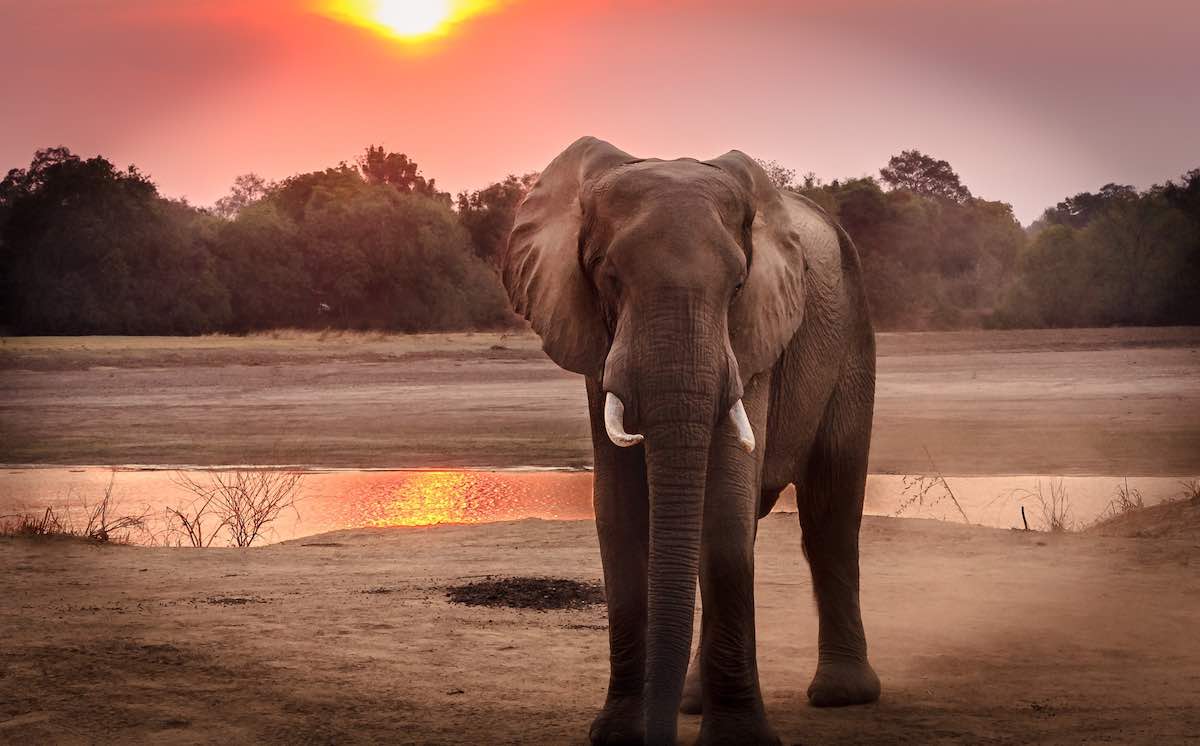
African bush elephants stand up to 13 feet at the shoulder and weigh between 4 and 7 tons, which makes them the largest land animals alive. Their ears are far bigger than an Asian elephant’s, and their trunk can reach around 7 feet in length.
Asian elephants are noticeably smaller, standing around 9 feet at the shoulder and weighing 2 to 5 tons, with small rounded ears. Habitat preference splits the same way: African bush elephants favour open savannah and grassland, African forest elephants live in the dense rainforest of the Congo Basin, and Asian elephants keep to tropical forest and scrub.
Recommended reading: What are the Differences Between African Elephant and Asian Elephants?
3. Historical Reasons
Another reason why elephants only live in Africa and Asia is because of historical reasons. Elephants have lived on the continents of Africa and Asia for millions of years. They were once widespread across the globe, but their populations dwindled over time.
Elephants and their close relatives used to live in Europe and North America, but they died out there around 10,000 years ago. The very last of them, an isolated woolly mammoth population on Wrangel Island in the Arctic Ocean, held on until roughly 1650 BC.
There are several theories about why elephants went extinct in these regions. One theory is that the changing climate made the habitats unsuitable for elephants. Another theory is that humans hunted them to extinction.
4. Political Reasons
A fourth reason why elephants only live in Africa and Asia is because of political reasons. Many African countries have laws that protect elephants from being hunted or harmed. These laws make it difficult for people to kill or harm elephants.
As a result, elephants can flourish in Africa. In contrast, Asian countries do not have the same level of protection for elephants. As a result, elephants in Asia are often hunted for their ivory tusks. The illegal ivory trade is a major problem in Asia and it’s one of the reasons why elephants are endangered.
5. Cultural Reasons
A fifth reason why elephants only live in Africa and Asia is because of cultural reasons. In many African and Asian cultures, elephants are seen as symbols of good luck and prosperity. As a result, people are less likely to harm or kill them.
In some cultures, elephants are even worshipped as gods. This cultural reverence for elephants helps to protect them from being harmed or killed.
6. Economic Reasons
A sixth reason why elephants only live in Africa and Asia is because of economic reasons. Elephants are a valuable commodity in both Africa and Asia. In Africa, they are often used for tourist attractions, such as safari rides.
In Asia, they are often used for labor, such as logging. As a result, there is a financial incentive to keep elephants alive on these continents.
7. Geographical Reasons
The seventh and final reason why elephants only live in Africa and Asia is because of geographical reasons. The two continents are separated by the Mediterranean Sea and the Sahara Desert.
This geographical isolation has helped to protect elephants from being hunted or killed. It’s also made it difficult for people to transport elephants to other parts of the world. As a result, elephants have remained primarily in Africa and Asia.
Where Did Elephants Once Live? A Brief History
It’s easy to think of elephants as exclusively African and Asian animals — but that’s only true today. Elephants and their relatives once roamed nearly every continent on Earth.
The elephant family tree traces back roughly 55 million years to Africa, where the earliest proboscideans evolved. Over millions of years, they spread across the globe via land bridges that connected continents during periods of lower sea levels. Mammoths and mastodons — close relatives of modern elephants — eventually populated North America, Europe, and Siberia in enormous numbers.
The woolly mammoth is perhaps the most famous of these ancient relatives. Adapted to the cold grasslands of the last Ice Age, woolly mammoths roamed from western Europe to the Bering land bridge and into North America. The last mainland woolly mammoths died out around 10,000 years ago — but a small island population survived on Wrangel Island in the Arctic Ocean until approximately 1650 BC, making them a contemporary of the ancient Egyptians.
What killed them off? The answer is a familiar double threat: climate change and humans. As the last Ice Age ended, warming temperatures destroyed the vast cold grassland habitats that mammoths and mastodons depended on. At the same time, expanding human populations hunted these large, slow-reproducing animals at a rate they could not sustain.
Today, only two elephant genera survive: Loxodonta (African elephants, including the bush and forest sub-species) and Elephas (Asian elephants). The Borneo pygmy elephant — the smallest living Asian elephant — is found only on Malaysian Borneo and is thought to be a genetically distinct sub-population that has been isolated on the island for thousands of years.
| Species / Region | Estimated Population | Conservation Status |
|---|---|---|
| African Bush Elephant | ~415,000 | Vulnerable (IUCN) |
| African Forest Elephant | ~100,000 | Critically Endangered (IUCN) |
| Asian Elephant | ~40,000–50,000 | Endangered (IUCN) |
| Borneo Pygmy Elephant | ~1,500 | Endangered (IUCN) |
Elephant Habitat by Species
“Elephant habitat” is not one thing. The three surviving species live in strikingly different environments, and each has adapted to the conditions it evolved in. Understanding those differences explains a lot about where you can and cannot find wild elephants today.
African Savanna (Bush) Elephant Habitat
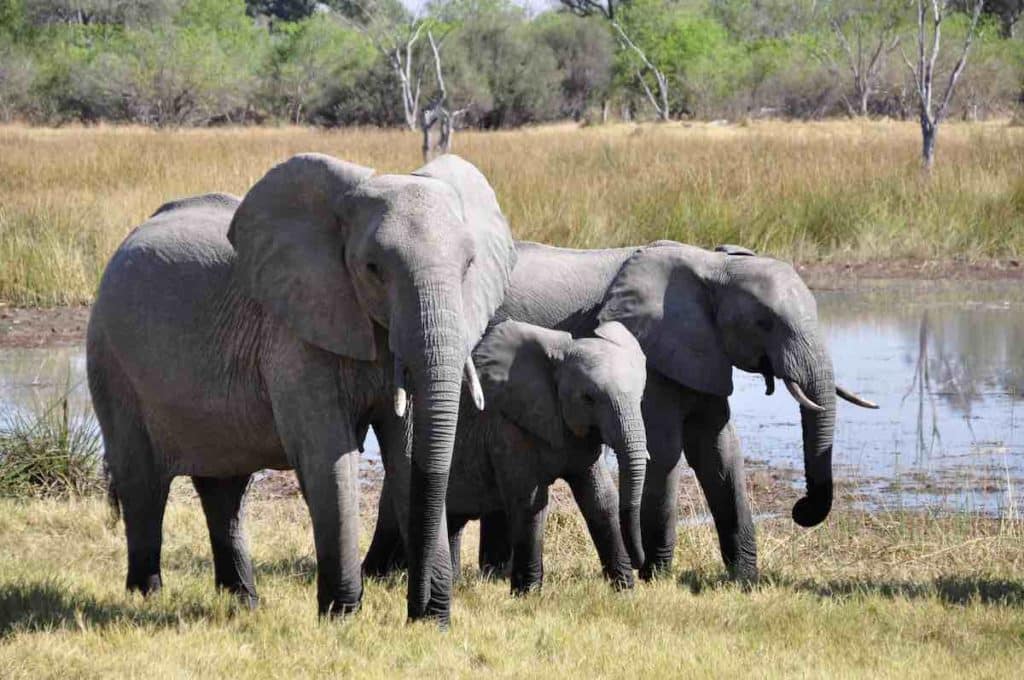
The African bush elephant is the most adaptable of the three. It occupies open grassland, wooded savanna, seasonal floodplains, marshes and semi-arid scrub across eastern and southern Africa. The one constant is water: a bush elephant drinks up to 50 gallons a day, so herds rarely settle more than a day’s walk from a river, pan or waterhole. In the dry season this pulls huge numbers toward permanent water, which is exactly why places like Chobe and Amboseli concentrate so many animals at once.
The most extreme example is Namibia’s desert-adapted elephants, which survive in near-desert conditions by memorising the location of scattered water sources across enormous home ranges.
African Forest Elephant Habitat
The African forest elephant lives in the dense tropical rainforest of the Congo Basin and West Africa, with Gabon and the Republic of Congo holding the strongholds. Its smaller body, straighter tusks and more rounded ears are all adaptations to moving through thick undergrowth. Forest elephants depend on natural clearings called bais, mineral-rich openings where herds gather to drink and feed. Because they disperse the seeds of large rainforest trees, they are often described as the forest’s gardeners, and their decline changes the make-up of the forest itself.
Asian Elephant Habitat
Asian elephants occupy tropical and subtropical forest, grassland and scrub across 13 countries in South and Southeast Asia. They favour the transition zone where forest meets grassland, which gives them both shade and grazing. The Indian elephant, the most numerous subspecies, ranges across the forests and grasslands of mainland India and Nepal. The Sri Lankan and Sumatran subspecies are restricted to their respective islands, and the Borneo pygmy elephant is confined to a small corner of Malaysian Borneo.
The critical difference from Africa is density of people. Asian elephant range overlaps some of the most densely populated farmland on Earth, so their habitat is far more fragmented, and human-elephant conflict is a much larger part of the picture.
What Countries Do Elephants Live In?
Wild elephants are found in roughly 37 African countries and 13 Asian countries. The populations are very unevenly spread: a handful of countries hold most of the world’s elephants, while many range states have only a few hundred left.
| Country | Species | Approx. Wild Population |
|---|---|---|
| Botswana | African bush | ~130,000 |
| Zimbabwe | African bush | ~85,000 |
| Tanzania | African bush | ~60,000 |
| Kenya | African bush | ~36,000 |
| Gabon | African forest | ~95,000 |
| India | Asian (Indian) | ~27,000 |
| Sri Lanka | Asian (Sri Lankan) | ~6,000 |
| Thailand | Asian | ~3,000–4,000 |
If you are planning a trip around any of these, our destination guides cover the specific parks and reserves in Botswana, Kenya, Tanzania, India and Sri Lanka, and the seasonal viewing guide explains when to go.
How Much Elephant Habitat Has Been Lost?
Range loss, more than any single other factor, explains why elephants now occupy such a narrow slice of the world. African elephants are estimated to occupy only around 15 percent of their historical range, and Asian elephants have lost an even greater share, with roughly 5 percent of their original range remaining intact.
The mechanism is rarely dramatic. Farmland expands into a corridor, a road cuts a migration route in half, and a single large population becomes several small isolated ones that can no longer mix. Fragmented herds are more vulnerable to poaching and local extinction, and they come into contact with people far more often. This is why modern conservation focuses heavily on protecting corridors between reserves rather than only the reserves themselves.
Final Thoughts
Even though there are many reasons why elephants only live in Africa and Asia, they are still in danger. The illegal ivory trade is a major threat to elephant populations, especially male elephants.
In addition, habitat loss and fragmentation are also major threats. These problems are caused by humans and they’re putting elephants at risk of extinction.
We need to do more to protect elephants and their habitats. Otherwise, we may lose them forever.
Recommended reading: Everything you need to know about Adopting and Elephant
Are Elephants Endangered?
The short answer is yes — and the picture is more serious for some species than others. The IUCN Red List, updated in 2021, classifies the three surviving elephant species as follows: African bush elephants are listed as Vulnerable, African forest elephants as Critically Endangered, and Asian elephants as Endangered. Fewer than 50,000 Asian elephants remain in the wild.
The primary threats driving these declines are well documented: ivory poaching (despite the 1989 CITES ban on the international ivory trade, illegal trafficking continues), large-scale habitat loss as forests and savannahs are converted to agriculture and human settlements, and human-elephant conflict as growing communities encroach on traditional elephant ranges.
There are some conservation wins worth noting. Kenya’s elephant population has grown from around 16,000 individuals in 1989 — when poaching was at its worst — to more than 36,000 today, thanks to stronger anti-poaching enforcement and community conservation programs. Botswana, which hosts the world’s largest single elephant population of around 130,000, has maintained stable numbers even after lifting its hunting ban in 2019.
If you want to help, a number of reputable organisations are working directly on elephant conservation: the WWF’s elephant programme, the African Wildlife Foundation, and verified elephant sanctuaries that provide refuge for rescued or injured animals. You can also consider adopting an elephant through a conservation charity — a symbolic adoption that funds on-the-ground protection work.
Frequently Asked Questions about Elephants living in Africa and Asia
There are a few elephants that live outside of Africa and Asia. For example, there is a small population of elephants in India that live in zoos or sanctuaries.
There are also a few captive elephants in Europe and North America. However, these populations are very small and they are not growing. So for the most part, elephants still only live in Africa and Asia.
Elephants can be found throughout Africa. They live in savannas, forests, and grasslands depending on their sub-specie. For example, the African forest elephant lives in the forests of Africa and the African bush elephant lives in savannas. The largest population of elephants is in Southern Africa which is the main African elephant habitat, but they can also be found in Central and West Africa.
Elephants are found throughout Asia. They live in forests, grasslands, and jungles. The largest population of elephants is in South Asia, but they can also be found in Southeast Asia and Central Asia.
No, elephants cannot live in the desert. The Sahara Desert is too hot and dry for them. They need to live in a habitat that has plenty of food and water.
Yes, the elephant population is endangered in Africa and Asia. In reality, the illegal ivory trade is a significant hazard to elephant populations. Furthermore, habitat loss and fragmentation are major threats.
According to World Wildlife Fund, the total number of elephants living in Africa and Asia is around 500,000. The majority of these elephants live in Africa. It’s estimated that only around 40,000 elephants are living in Asia.
Yes. Woolly mammoths and mastodons roamed Europe and North America until about 10,000 years ago. They were closely related to modern elephants but went extinct due to a combination of climate change and human hunting.
Botswana has the largest African elephant population, with an estimated 130,000 individuals — roughly one third of all African elephants. Zimbabwe and Tanzania follow with around 85,000 and 60,000 respectively.
No. There are no wild elephants in South America, and there never have been. Its closest equivalents were the gomphotheres, extinct elephant relatives that died out around 10,000 years ago. The only elephants in South America today are in zoos and sanctuaries.
The IUCN Red List publishes official range maps for all three species. Broadly, African elephants occupy a band across eastern, southern and central Africa, while Asian elephants are scattered across 13 countries in South and Southeast Asia. Both ranges are now fragmented rather than continuous.