An elephant is the largest land animal on Earth. These colossal creatures can weigh up to 6 tons and stand as tall as 5 meters (16 feet) when fully grown depending on the type of elephant.
An adult elephant’s strength and weight are impressive, but how much can an elephant lift? They have been known to uproot trees, break fences, and even break steel chains with their trunk or tusks.
The trunk’s muscle and strength make elephants capable of lifting up to 660-700 pounds (270-320 kg) with their trunk.
To find out how much weight an elephant can lift, we’ll explore their anatomy, their strength and weight in comparison to humans, and some examples of how much they can lift in real life.
Anatomy of an Elephant
An elephant’s body is made up of many different parts that allow them to survive and thrive in the wild. Their anatomy includes very strong bones, large muscles, a large brain, special sense organs, and thick skin that protects them from predators and the elements.
The Asian elephants have just one finger on the trunk tip while the African elephants have two fingers.
The bones of an elephant are very large, thick, and have much weight. This is due to their size and weight, which would have otherwise made them too weak to support their body.
They have only one-sixth the number of bones humans have and the vertebrae in their spine are more like a tail.
The muscles of an elephant are also very strong, but they aren’t very dense. This means they don’t have much strength per weight, but they are very long and can provide a lot of power when stretched.
This helps support their weight and allows them to lift objects and walk with much more ease.
An elephant’s head houses a large brain, two nostrils, two eyes, and a long, sturdy trunk. The trunk is actually a fusion of the nose and upper lip, and is the elephant’s primary means of both smelling and grabbing things.
Elephant’s Strength and Muscle Mass
While an elephant’s anatomy certainly makes them stronger than the average human, their size isn’t the only factor that contributes to their strength.
Their muscles are also much more powerful than ours. In fact, they have the second strongest muscles in the animal kingdom, behind only rhinos. In total, an Elephant has 40,000 muscles in their body.
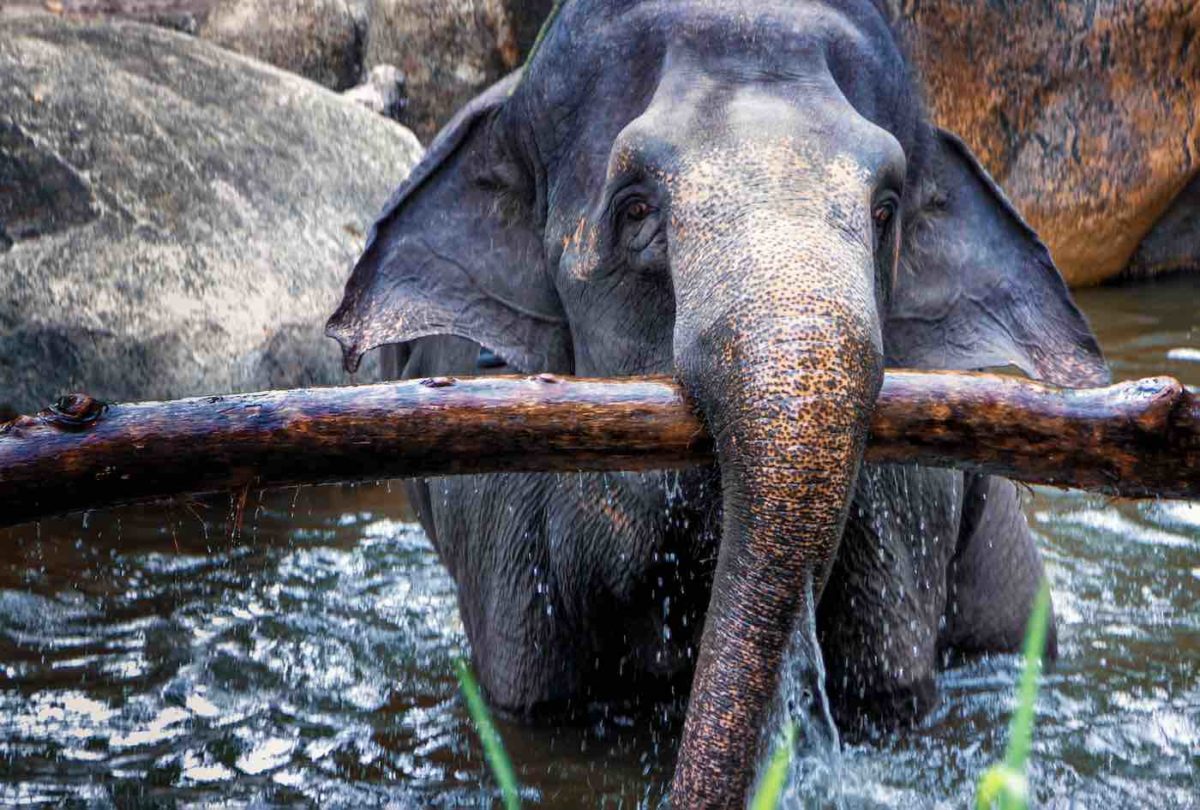
The largest and most mighty muscles in an elephant’s body are the trunk muscle. It has eight major muscles that make the trunk strong. The trunk’s muscle and strength make them capable of lifting up to 660-700 pounds (270-320 kg) with their trunk alone.
To put that into perspective, the normal human can only bench press 160 pounds (70 kg).
Their leg muscles are also very powerful. An elephant’s legs make up about 40% of their body weight, which gives them a lot of leverage to push and pull things.
Adult elephants have strong legs that can support their entire body weight.
How Does the Trunk Lift?
Unlike a human arm, the elephant’s trunk contains no bone whatsoever. It is made entirely of muscle and connective tissue — roughly 40,000 individual muscle units organized into eight major muscle groups. These groups work in opposing pairs, meaning one set contracts while the opposing set relaxes. This arrangement gives the trunk exceptional fine motor control across its full length, not just at the tip.
When an elephant lifts a heavy object, the trunk curls underneath it and the muscles around the tip create a grip. The pressure generated at the trunk tip can reach up to 13,000 psi — comparable to a hydraulic crane. Once a secure hold is established, the entire trunk extends upward, with the larger base muscles driving the lift. The combination of grip pressure and extension force is what allows an elephant to hoist logs, rocks, or other elephants’ calves with apparent ease.
That same trunk can also do the opposite. The elephant’s muscle control is precise enough to reduce grip force to nearly zero, allowing it to pick up a single blade of grass or cradle a fragile object without damaging it. No mechanical crane can replicate that range — from hydraulic-level pressure to near-zero force — in the same appendage.
Elephants vs Other Animals: Strength Comparison
Raw lifting numbers are impressive on their own, but context makes them extraordinary. How does an elephant’s strength stack up against some of the other most powerful animals on the planet?
| Animal | Estimated Lifting Capacity | Method |
|---|---|---|
| African Elephant | 600–700 lbs (trunk) / 2–3 tons (body) | Trunk + full body |
| Gorilla | ~1,800 lbs (10× body weight) | Arms |
| Grizzly Bear | ~1,100 lbs | Bite and claws |
| Rhinoceros | ~2,000 lbs (pushing) | Body charge |
| Human (world record) | ~1,100 lbs (deadlift) | Full body |
| Human (average) | ~155–185 lbs | Full body |
On a pound-for-pound basis, a gorilla is stronger than an elephant — gorillas can lift roughly ten times their own body weight, while an elephant lifts far less relative to its mass. But in absolute terms, the elephant’s total body strength is unmatched among land animals. When you factor in the full force an elephant can generate with its legs, neck, and torso together — not just its trunk — no other land animal moves as much weight.
What also sets the elephant apart is versatility. A gorilla’s strength is concentrated in its arms. A rhino’s power is directional — useful for charging, not for precise manipulation. The elephant can lift, carry, push, drag, dig, and delicately handle objects all with the same appendage. That combination of raw power and fine dexterity is unique in the animal kingdom.
What Do Elephants Lift?
Elephants are naturally nomadic creatures that travel vast distances to find food and water. They must be able to carry heavy things like food water, and themselves as they travel.
This is why an elephant’s ability to lift and carry is so important and why they are able to lift such large and heavy objects.
An elephant’s primary use for strength is lifting things. The adult elephant lifts so much weight using its trunk.
The elephant trunk can grab almost anything, and they often use it to lift logs and tree branches that are too heavy for them. It can lift heavy logs, it can also pick up a peanut or move a peanut with incredible accuracy.
An elephant’s trunk is attached to its upper lip, and it has a large number of muscles that taper down to the tip of the trunk.
As the trunk lifts, these muscles contract and create the vacuum that is powering the trunk.
When an elephant is lifting something, it can use both the muscles in its trunk and hind legs.
They typically raise their trunk and twist it to bend the object closer to them, and then use their hind legs to push the object off the ground.
Tusk Strength and Digging
The trunk gets most of the attention, but an elephant’s tusks are formidable tools in their own right. Tusks can pry up to 1 ton of material in a single levering action. Elephants use this force to dig for water in dry riverbeds, strip bark from trees for food, and lever fallen logs out of their path. In areas where water is scarce, the digging power of tusks can mean the difference between survival and dehydration for an entire herd.
African elephants tend to have significantly larger tusks than their Asian counterparts. A large male African elephant can carry tusks up to 10 feet long, weighing up to 130 pounds each. That extra length provides greater mechanical leverage, making African elephants more effective diggers and log-leverers. Asian elephant tusks are shorter and lighter on average, though they are still powerful tools — and, notably, many female Asian elephants have no visible tusks at all.
Elephants in the Logging Industry
For centuries across Southeast Asia, trained elephants were an indispensable part of the logging industry. A full-grown Asian elephant could carry or drag logs weighing 400–600 kg through dense jungle terrain that no wheeled vehicle could reach. They could navigate steep slopes, ford rivers, and maneuver timber through narrow forest corridors with a precision that early machinery could not match. Their strength-to-weight ratio, combined with their ability to follow precise commands, made them living machines ideally suited for the job.
The use of elephants in commercial logging has declined sharply in recent decades, driven by conservation concerns, international pressure, and the availability of modern mechanized equipment. Myanmar and Thailand still have communities where working elephants and their mahouts (handlers) maintain traditional relationships, though the scale is a fraction of what it once was. The fact that elephants could perform these tasks at all is a testament to their lifting and carrying capacity — they remain one of the most remarkable natural load-bearers ever to have worked alongside humans.
How Much Can An Elephant Lift?
An elephant’s strength and ability to lift depend on its size, fitness, and health.
An elephant can lift about 10% of its own weight when standing on two legs, which is about 500-600 kgs for a full-grown elephant.
The elephant can lift up to 50% of its own weight when lying down, which is about 2-3 tons for a full-grown elephant.
An elephant can also push a ton when standing on two legs, but it can only push a few hundred kilograms when lying down.
An elephant’s ability to lift and carry heavy things can vary based on its physical state. When healthy, an elephant’s strength is incredible.
An adult Elephant is capable of lifting up to 600-700 pounds (270-320 kgs) with their trunk alone.
Jason Bittel, National Geographic
How Strong Are Elephants?
An elephant’s strength is what makes it such a powerful animal, but there are other factors that determine how strong they are.
An elephant’s strength is determined by its muscles and bones. The bones of an elephant are very strong to support their body and weight, but they are also very heavy.
The bones are so heavy that they actually weigh more than an elephant’s muscles, which means their muscles are the stronger part of the entire body.
A small elephant weighs less than a large elephant, which means it also has less muscle and strength. This helps explain why a large elephant can lift more than a small one. Logical perhaps.
African vs Asian Elephants: Strength Differences
African bush elephants are the larger of the two main species, with large males reaching up to 13,000 pounds (roughly 6 tons). Their greater body mass translates directly to greater absolute strength — they can push, drag, and carry more in total than their Asian counterparts. African elephants also tend to have larger ear muscles, more pronounced shoulder musculature, and longer, heavier tusks, all of which contribute to their raw power profile.
Asian elephants are somewhat smaller, with large males topping out around 11,000 pounds (5 tons). What they lack in absolute size they more than compensate for in trainability and working relationship with humans — thousands of years of domestication have shaped Asian elephants into highly responsive working animals. In terms of trunk lifting capacity relative to body size, both species are broadly comparable. The trunk-to-body ratio and the fundamental muscle architecture are similar enough that a trunk lift of 600–700 pounds is within reach of a healthy adult of either species.
Bottom Line
An elephant is one of the strongest animals on the planet. They have incredibly strong muscles and bones that allow them to lift and carry heavy objects.
The average elephant can lift 10% of its own weight, which is about 4 tons. An elephant can also push a ton when standing on two legs, but it can only push a few hundred kilograms when lying down. When healthy, an elephant’s strength is incredible.

3 replies on “How Much Can An Elephant Lift?”
[…] elephantguide.com […]
[…] to reports, adult elephants can carry more than 700 pounds with their muscular trunks. Over the years, humans […]
[…] to reports, adult elephants can carry over 700 pounds with their muscled trunks. Over the years, humans have […]