
When you see an elephant, you might wonder what it’s thinking. They’re among the largest land animals on Earth, but they also have some of the strangest behavior.
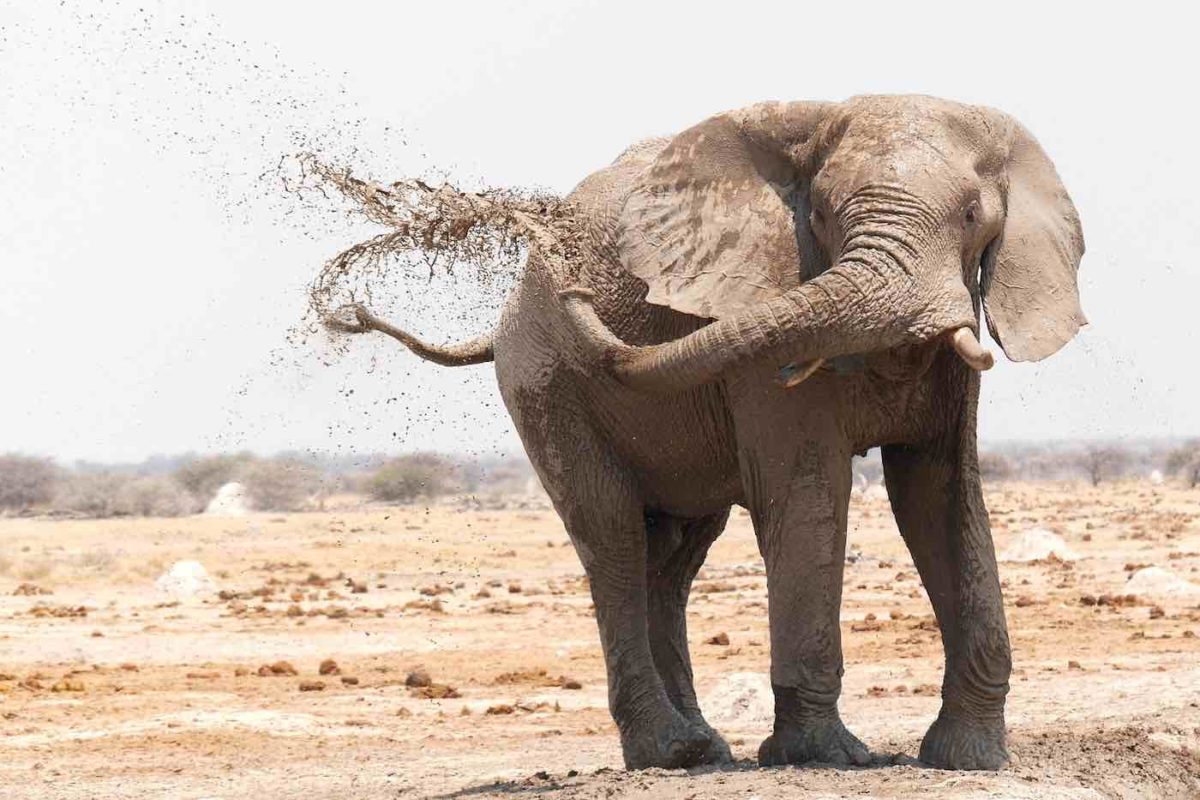
An elephant can lift a tree with its trunk, or run around, knock things over, and throw dirt. But is there a good explanation for why elephants like throwing dirt on themselves, and for all these other strange activities?
In fact, almost everything an elephant does is related to staying healthy and protecting themselves against the elements.
An elephant is one of the most fascinating animals in the world. They are known for their size and their intelligence, and social behaviors.
What exactly is the reason why elephants throw dirt on themselves, why the dust bathing? There must be some sort of logic behind it all. Let’s take a closer look.
How Do Elephants Behave?
There are a number of reasons why elephants, especially wild elephants might throw dirt on themselves. One reason is to protect themselves from insects.
The dirt acts as a barrier between the elephant’s skin and the insects. This is especially important in areas where there are a lot of biting insects, such as mosquitoes.
Another reason for this behavior is sun protection. Elephants, like humans, can suffer from sunburn and skin damage if they aren’t careful. You may have noticed that elephants prefer to do this when the sun is at its highest.
It is also believed that elephants use mud baths as a way to cool down. When it’s hot, the mud can act as a sort of natural sunscreen and heat protector, and when it’s cold, the mud bath can keep the elephant’s skin warm.
This is why you may see elephants throwing mud on themselves in both hot and cold weather.
Why Do Elephants Throw Dirt On Themselves?
The most common reason why elephants have dust baths is to protect themselves from insects like mosquitoes and bugs.
They use their trunks to pick up dirt, grass, and other materials from the ground and throw them on themselves, creating a barrier between themselves and the insects.
This behavior is often seen during the breeding season when many species of insects are attracted to the smell of the male elephant skin.
Another reason for this behavior is sun protection. Elephants, like humans, can suffer from sunburn if they aren’t careful with how long they’re in the direct light of UV-rays.
The Science Behind Dust Bathing
The mechanics of a dust bath are surprisingly precise. An elephant uses its trunk like a high-powered bellows, drawing in a large breath and then forcefully expelling air to launch a fine spray of loose soil up and over its back, ears, and belly. A single trunk-load can disperse dust several feet into the air, coating hard-to-reach areas the elephant cannot scratch with its feet or tusks. Young calves watch adults perform this maneuver and gradually develop the trunk control needed to replicate it — it is a learned skill, not purely instinct.
From a thermoregulation standpoint, dry dust works through a simple but effective evaporative process. When dust particles settle on moist or sweaty skin, they absorb surface moisture, and as that moisture evaporates it draws heat away from the skin. This cooling effect is modest compared to a full mud bath, but it is available even in arid environments where standing water is scarce. Elephants living in semi-desert habitats rely on this mechanism through the hottest midday hours when shade is limited and water sources may be miles away.
Beyond temperature control, the dry dust layer creates a physical barrier that biting flies and external parasites find difficult to penetrate. Tsetse flies, horseflies, and various tick species are all deterred by a thick coating of fine soil. Research on African savanna elephants has shown that individuals denied access to dust-bathing sites show higher rates of skin irritation and insect-bite lesions, underlining just how important the behavior is to day-to-day comfort and health.
Mud Baths vs Dry Dust: What’s the Difference?
| Mud Bath | Dry Dust Bath | |
|---|---|---|
| Primary purpose | Cooling, parasite deterrence | Insect barrier, sun protection |
| Temperature effect | Cools through evaporation | Absorbs surface moisture |
| Parasite protection | Long-lasting coating | Immediate barrier |
| Water required | Yes | No |
| How applied | Rolling, wallowing | Trunk spray onto back/sides |
When elephants have access to a waterhole or river, a mud bath is often the preferred option. The wet mud coats the skin in a thick layer that dries slowly, keeping the animal cooler for hours and providing a durable shield against insects. The mud also seals small cuts and abrasions, acting almost like a natural antiseptic bandage. In regions with reliable water sources — such as the floodplains of Botswana or the forests of Sumatra — elephants may wallow multiple times a day.
Dry dust bathing, by contrast, is the go-to solution when water is scarce. It offers a quicker application and an immediate deterrent effect against biting insects. Some elephants perform both in sequence: first rolling in mud and then, once partially dry, throwing dust on top. This double layer combines the long-lasting protection of mud with the fine-particle insect barrier of dust — an elegant two-step skincare routine that shows just how resourceful these animals can be.
Understanding Elephant Behaviors
There are a few behaviors that are very common with elephants but seem a bit strange to us. Let’s break them down.
Greetings
This is a very common gesture among elephants. They greet each other with the tips of their trunks touching. Sometimes, they even put them in each other’s mouths.
It’s like they smell each other’s breath, and possibly communicates something like “I am not going to hurt you.”
Straw Sucking
This is another common behavior, especially among baby elephants. When they first open their eyes, they can’t see very well. They use their trunks to find straws, leaves, and other small objects to suck on in order to build their strength.
A lot of elephants like to suck on straws. It’s a way for them to play with their food, and possibly get some extra nutrients from the plants they eat.
Walking Backward
Walking backward. When an elephant is walking backward, it is a sign that the animal is feeling uncomfortable or threatened.
If an elephant feels threatened or if there is a human nearby, the animal will often walk backward away from the source of the problem or towards a safer place.
Steaming
You may see an elephant sitting in a puddle of mud or a stream of water with its head facing upwards as steam rises from their heads.
This is a common behavior among elephants and is called “steaming” because it is believed that they do this to regulate their body temperature. It is also believed that they do this to remove toxins from their bodies.
Just like a mud- or steam bath that us humans would pay for at the spa!
Spray Their Tails With Dust
This is a behavior that is often displayed by male elephants. They do this in order to attract female elephants, and it is sometimes done in front of other elephants.
Male elephants use their tails to create a cloud of dust. Then, they use the dust to coat their tails. The females are attracted to the dust and will touch the male’s tail with their trunks. This indicates that they are willing to mate.
Shaking Their Trunks
The trunk is an elephant’s most important asset. It is used for many things, including grabbing food, drinking water, breathing, smelling, and communicating.
When an elephant is upset or mad, it will shake its trunk vigorously. This is a sign of aggression and is often directed toward humans. An elephant that is mad or upset will often shake its trunk as a sign of aggression.
African vs Asian Elephants: Do They Behave Differently?
African and Asian elephants share the dust-bathing behavior, but the two species do differ in some grooming habits and habitat preferences. Because they evolved in very different environments — open savannas versus dense tropical forests — their approaches to skincare and thermoregulation have taken slightly different forms, even if the underlying purpose is the same.
African Elephants
African elephants are the largest land animals on Earth, and their famously large ears are not just for show. Those ears are packed with a dense network of blood vessels, and by flapping them the elephant pumps blood close to the surface where it loses heat rapidly. This built-in radiator helps, but in the wide-open savanna there is often no shade to retreat to during the hottest part of the day, making dust bathing an essential backup. Studies of savanna herds in Kenya and Tanzania show that dust-bathing sessions peak between 10 a.m. and 2 p.m., exactly when solar radiation is strongest.
African elephants in certain regions — particularly in parts of Zambia and Zimbabwe — have also been observed rolling in red laterite clay rather than ordinary dry dust. Scientists believe this behavior may deliver mineral benefits beyond simple insect deterrence; the iron-rich clay could supplement dietary minerals absorbed through the skin or by incidental ingestion during the rolling process. Whatever the cause, the red-stained skin that results is a distinctive sight and a reminder that elephant self-care can be surprisingly sophisticated.
Asian Elephants
Asian elephants live in forests and grasslands across South and Southeast Asia where rainfall is higher and water sources are more reliable than on the African savanna. As a result, they tend to rely on mud baths more heavily than their African cousins, and pure dry-dust bathing is somewhat less frequently observed in the wild. When they do dust-bathe, the behavior is structurally the same — trunk spray, ear coverage, belly coating — but it is more often a supplement to a prior wallow rather than a standalone activity.
Asian elephants also show a particularly deliberate form of parasite control that involves rubbing against trees. A herd moving through forest will often stop at favored rubbing trees whose bark has been worn smooth by generations of use. The coarse bark dislodges ticks and skin parasites that water and dust alone cannot reach. Combined with their mud-bathing habits, this gives Asian elephants a broader toolkit of grooming behaviors compared to their African relatives, reflecting the richer resources available in forested environments.
How Do Elephants Take Care Of Them Selves?
Elephants are very big animals, and they need to eat a lot of food to maintain their weight. They also need to drink a lot of water. An adult elephant can drink up to 50 gallons (200–225 liters) of water a day!
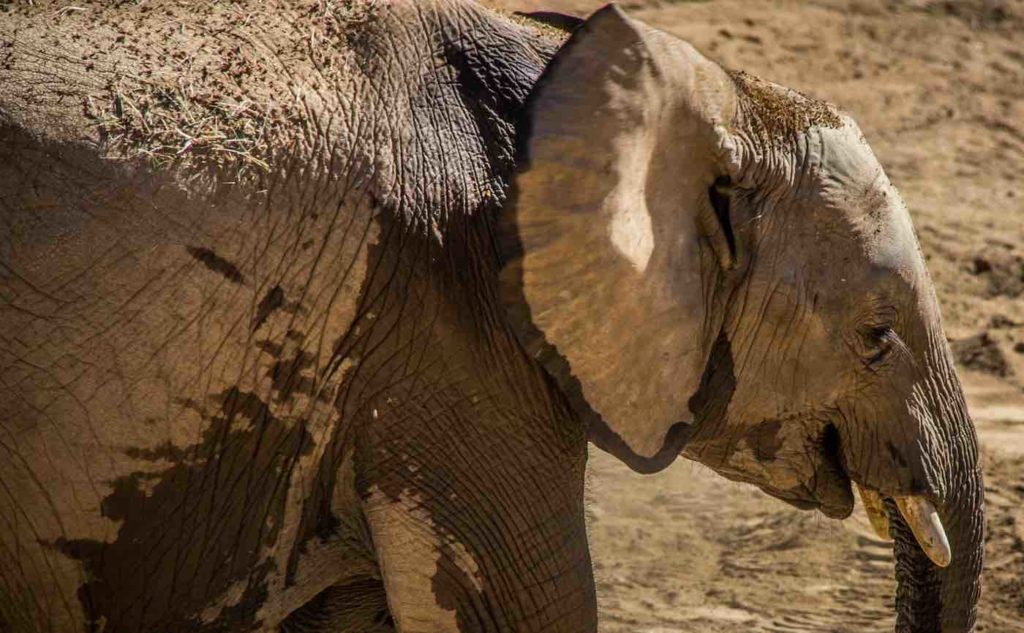
To avoid getting sunburned, elephants will often throw dirt or mud on their backs. This helps to protect their skin from harmful UV rays.
Another way that elephants take care of themselves is by using their trunks to spray water on their bodies. This helps to keep them cool in the hot weather.
Self-care within a herd is rarely a solitary affair. Mother elephants take an active role in bathing their calves, guiding them into shallow water and using their trunks to spray mud and water over the youngsters’ backs. Older siblings and aunts also participate, nudging calves toward wallowing spots and demonstrating the correct posture for a proper roll. This shared grooming strengthens the social bonds within the family group and ensures that calves learn the skin-care routines they will need to survive independently.
Dust bathing can also function as a genuinely social activity for older elephants. When one member of a herd begins to throw dust, others frequently join in, creating a communal cloud that coats the whole group at once. Researchers observing wild herds have noted that these group sessions tend to coincide with reunion events — when two family groups meet at a waterhole after time apart. The combined bathing that follows appears to serve both a practical hygiene function and a social bonding purpose, reinforcing ties between individuals through shared behavior.
Final Thoughts
Elephants are very interesting creatures. They are large, intelligent mammals that have survived for millions of years. They have a lot in common with humans, including the fact that they are social animals that like to live and work together with others.
All in all, elephants are fascinating animals, and they deserve our respect and admiration.
The fact that elephants instinctively know to coat their skin in dust or mud, that mothers teach calves the technique, and that herds reinforce the habit together speaks to a level of self-awareness and social intelligence that few other animals match. Dust bathing is not a quirky habit — it is a window into how deeply these animals understand their own bodies and their environment, and it is one more reason why protecting wild elephant populations matters so much.

One reply on “Why Do Elephants Throw Dirt On Themselves?”
[…] skin cells. This all-natural skincare regimen helps to maintain the health of their skin, guard against infections, & encourage improved general […]