
In the wild, elephants are cautious creatures that are easily spooked. Despite being the largest land animals on Earth, they are not without their fears — and many of those fears are deeply rooted in ecology, evolution, and lived experience.
What exactly are elephants afraid of? Do they have any natural predators? And what about that famous myth involving mice? The answers are more fascinating — and more scientifically grounded — than most people expect.
Are Elephants Really Afraid of Mice?
No — elephants are not afraid of mice, and there is no scientific evidence to support this claim. The idea is one of the most enduring animal myths in popular culture, largely popularized by cartoons and the 1941 Disney film Dumbo, but it has no basis in observed elephant behavior.

One reason this myth persists is that elephants do have relatively poor close-range vision. Their eyes are positioned on the sides of their head, giving them wide peripheral vision but limited ability to focus on small objects directly in front of them. A sudden movement near their feet — whether from a mouse, a stone, or a rustling leaf — can trigger a startle response, which observers may misinterpret as fear of the specific animal.
Some scientists believe the myth arose from African folklore. The story goes that a long time ago, an elephant stepped on a mouse and the mouse squeaked. The noise startled the elephant and it ran away. Since then, elephants have been said to be afraid of mice.
In reality, elephants are not known to be afraid of other small animals such as rats or rabbits either. The available evidence consistently does not support the claim. What does frighten elephants is far more interesting — and far more practical from a conservation standpoint.
The verdict: elephants are not genuinely afraid of mice. There’s no evidence for the old story — at most, a sudden-moving mouse triggers a startle reflex, not fear. What elephants truly avoid is something far smaller and buzzier.
| The common belief | The reality |
|---|---|
| Elephants are terrified of mice | A myth — no scientific evidence; at most a startle reaction to sudden movement |
| Mice crawl up their trunks and drive them mad | An ancient Greek tale with no basis in fact |
| Nothing can scare a creature that big | False — elephants genuinely avoid bees, and their biggest real fear is humans |
What Elephants Are Actually Afraid Of
Research across Africa and Asia has identified several genuine, documented triggers of fear in elephants. Understanding these fears has become an important part of both wildlife management and human-elephant coexistence strategies. For a broader overview of elephant behaviors, including how fear fits into their behavioral repertoire, the science is genuinely remarkable.
Bees
African honeybees are one of the most well-documented genuine deterrents to elephants. Research led by Dr. Lucy King at Save the Elephants demonstrated that elephants respond to the sound of disturbed bee swarms with a specific, distinctive alarm call — a low, rumbling vocalization accompanied by head-shaking and rapid retreat. This 2010 study, published in PLOS ONE, was groundbreaking in confirming that elephants have differentiated alarm calls for specific threats, similar to vervets and meerkats.
Why are elephants so concerned about bees? While their thick hide protects most of their body, elephants have vulnerable thin-skinned areas around the eyes, inside the ears, and at the tip of the trunk. A swarm of angry bees targeting these soft spots is genuinely dangerous — and elephants know it.
Ants
It is not just bees that give elephants pause. A 2010 study published in Current Biology by researchers from the University of Florida found that elephants in Kenya actively avoid feeding on acacia trees that are home to colonies of tree-dwelling ants (Crematogaster mimosae). The elephants could detect and distinguish between ant-occupied and ant-free trees, steering clear of the former even when hungry.
The mechanism is thought to involve smell and vibration — the ants swarm out rapidly when a tree is disturbed, and elephants have learned to associate certain trees with this unpleasant result. This is a remarkable example of how even the largest land animal can be deterred by creatures weighing a fraction of a gram.
Humans
For wild elephants across both Africa and Asia, humans represent by far the greatest source of fear. Decades of poaching, habitat destruction, and human-elephant conflict (HEC) have conditioned wild elephant populations to treat human presence as a serious threat signal.
Particularly striking research by Professor Karen McComb and colleagues at the University of Sussex found that African elephants in Amboseli National Park, Kenya could distinguish between different human ethnic groups based on voice alone. Recordings of Maasai men — who have a history of conflict with elephants over cattle — triggered significantly stronger defensive responses than recordings of Kamba men, who pose less of a threat. The elephants also responded differently to the color of clothing associated with each group.
This level of social discrimination suggests elephants maintain long-term memories of specific threat profiles — a finding that aligns with their well-established capacity for individual recognition and memory. For more on the conservation implications of this human-elephant relationship, see our overview of how many elephants are left in the world.
Loud Noises and Thunder
Elephants are easily startled by sudden loud sounds. Gunshots, vehicles backfiring, thunder, and even fireworks near national park boundaries can trigger panic responses in herds. This is less a phobia and more a highly calibrated startle reflex — in environments where poachers have historically used firearms, an instinctive flight response to sudden loud sounds is a survival advantage.
Interestingly, elephants in areas with no history of poaching tend to show less extreme reactions to gunshots than those in regions where hunting has occurred — further evidence that their fear responses are shaped by learned experience as much as instinct.
Unfamiliar Smells and Environments
Elephants use their extraordinary sense of smell — estimated to be the most acute of any land mammal, with around 2,000 olfactory receptor genes — to gather information about their surroundings. When encountering unfamiliar smells, particularly in new or disrupted environments, they will often pause, raise their trunks to sample the air, and proceed cautiously or retreat entirely.
This heightened olfactory vigilance is part of why certain deterrents such as chili barriers and beehive fences are effective — they exploit the elephant’s sensitivity to smell and sound in ways that signal danger without causing direct harm. You can also see this caution in other elephant self-protective behaviors, which are closely tied to their environmental awareness.
The Bee Fence: Turning Fear Into Conservation
One of the most elegant applications of elephant fear research is the development of beehive fences as a crop protection tool. Dr. Lucy King’s work with Save the Elephants demonstrated that when beehives are hung at intervals along the perimeter of a farm, the sound and smell of the bees — even when not actively disturbed — is enough to deter elephants from entering.
The alarm call study was pivotal: when recordings of disturbed bee swarms were played to elephant families through speakers, 94% of the families moved away from the sound, compared to just 27% when a control sound was played. The elephants also emitted their distinctive “bee alarm” rumbles, alerting other herd members to the perceived threat.
Beehive fence projects are now active in Kenya, Uganda, Tanzania, Mozambique, and Sri Lanka, with the dual benefit of deterring crop raids and providing local communities with honey as an additional income source. This approach — turning a genuine elephant fear into a non-lethal coexistence tool — is widely regarded as one of the most successful community-based conservation innovations of recent decades.
In a nine-year study in Kenya, elephants avoided farms fenced with beehives up to 86% of the time — turning a tiny insect into a powerful conservation tool.
How Elephants React When Frightened
Understanding elephant fear also means understanding what to look for in their body language. Elephants communicate distress and alarm through a rich combination of postures, movements, and vocalizations — many of which can be read as warning signs. This connects closely to flapping ears as a fear response, where ear position and movement play a central role in signaling emotional state.
Body Language Signals
When an elephant is alarmed or fearful, you will typically observe: ears spread wide and held out from the body (maximizing both their visual size and their ability to capture sound); head raised and tilted toward the threat; trunk raised and extended to gather scent information; and a general posture of tense alertness, with weight slightly forward.
A mock charge — where the elephant rushes forward, often stopping short — is a common first response to perceived threats. This is usually a warning rather than a genuine attack. A silent, head-down charge with ears pinned back is far more serious and indicates a committed threat response.
Group Defensive Behavior
When a threat is detected, adult elephants — particularly matriarchs — will often physically circle the younger members of the herd, creating a protective wall of bodies. This circling behavior has been documented in response to both predator threats and human disturbances, and reflects the deeply cooperative social structure of elephant herds.
Vocalizations
Elephants have a sophisticated vocal repertoire for communicating fear and alarm. Deep infrasonic rumbles — below the range of human hearing — can travel several kilometers and alert distant herd members to danger. Higher-pitched trumpeting is typically associated with acute alarm or excitement. The specific bee alarm rumble documented by Lucy King is a distinct subset of this system, showing that elephants have evolved differentiated signals for specific threat categories.
While African and Asian elephants share many of the same fundamental fears — humans, sudden loud noises, unfamiliar stimuli — there are meaningful differences shaped by their different ecological contexts. For a deeper look at why elephants only live wild in Africa and Asia, the evolutionary pressures on each species are worth exploring.
African elephants (Loxodonta africana and L. cyclotis) evolved in open savannas and woodland environments where lion predation on calves is a real and ongoing threat. Their responses to large felid vocalizations are correspondingly strong, and research has documented that they distinguish between lion roars by number and sex — responding more defensively to recordings of multiple male lions than single females.
Asian elephants (Elephas maximus), by contrast, evolved in dense forest environments where tigers are the primary predator of calves. Their fear responses tend to be oriented around ambush-style threats — sudden close encounters — rather than the open-country threat assessment more common in African populations. Asian elephants also have longer histories of close cohabitation with humans in agricultural landscapes across South and Southeast Asia, which has shaped complex and sometimes highly localized fear responses to specific human behaviors.
Both species, however, demonstrate the same core finding: their fears are not random or instinctive in a simple sense. They are learned, refined, and transmitted socially — a testament to the intelligence and cultural complexity of elephants in the wild.
What are Elephants afraid of when they’re young?
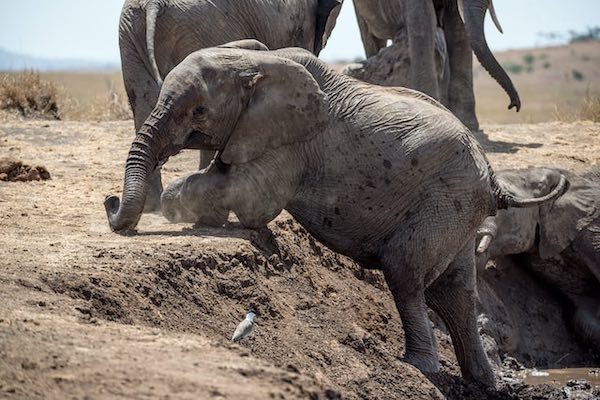
Separation from their Mother
As mentioned before, elephants are afraid of many things when they’re young. One of the things that they’re most afraid of is being separated from their mothers.
If an elephant calf becomes separated from its mother, it will often become lost and confused. This is because elephants have a very strong bond with their mothers and rely on them for guidance and protection.
If a calf is separated from its mother or their herd, it will often cry out for her, which can attract predators.
Predators
Elephants have a low survival rate when they’re young. It’s thought that up to 50% of calves don’t make it through their first year.
Baby elephants are much more vulnerable to attacks from lions, tigers, and other large predators. This is because they haven’t developed the size and strength to defend themselves from these animals.
Being Captured
Another thing that elephants are afraid of is being captured by humans. Elephants are often hunted for their ivory tusks, which are highly valuable on the black market. Additionally, elephants are captured and sold into the wildlife trade, used for entertainment or labor in conditions that often cause severe psychological distress.
Why Understanding Elephant Fears Matters
The science of elephant fear is not merely academic — it has direct and practical implications for conservation and community coexistence. As human populations expand into elephant habitats across Africa and Asia, human-elephant conflict has become one of the most pressing wildlife management challenges of our time.
Understanding what genuinely frightens elephants enables conservationists and farmers to design non-lethal deterrents that work with elephant psychology rather than against it. Beehive fences exploit their documented fear of bee swarms. Chili barriers leverage their acute olfactory sensitivity. Early warning systems — including SMS alerts and GPS collar tracking — allow communities to respond to elephant movements before conflicts escalate.
Karen McComb’s research on human voice discrimination has opened the door to acoustic deterrents tailored to specific threat profiles, while Lucy King’s bee fence work has shown that local communities can become active participants in elephant conservation rather than adversaries. For more on the broader picture, explore our guide to fascinating elephant facts and the wider elephant behaviors hub.
Ultimately, understanding what elephants fear — and why — is one of the most powerful tools we have for ensuring their survival in a rapidly changing world. The more we know about their inner lives, the better equipped we are to share the planet with them.
Frequently Asked Questions
No. There is no scientific evidence that elephants are afraid of mice. The myth likely originated from folklore and was popularized by cartoons and films. Elephants may be startled by any sudden small movement near their feet due to poor close-range vision, but this is a general startle reflex rather than a specific fear of mice.
Wild elephants are most afraid of humans, who represent their greatest ongoing threat through poaching and habitat encroachment. They are also genuinely deterred by African honeybees, respond strongly to sudden loud noises, and are cautious around unfamiliar smells. Research has documented specific alarm calls for bee threats and sophisticated discrimination between different types of human voices.
Elephants are afraid of bees because, despite their thick skin, they have vulnerable thin-skinned areas around the eyes, ears, and inside the trunk where bee stings can be genuinely painful and dangerous. Research by Dr. Lucy King found that elephants have a specific alarm rumble for bees and will retreat rapidly from the sound of a disturbed swarm.
Yes. Research by Professor Karen McComb at the University of Sussex found that African elephants in Kenya can distinguish between different ethnic groups by voice alone, showing stronger fear responses to the voices of people who have historically posed a greater threat to them. This demonstrates that elephant fear of humans is learned and socially transmitted, not simply instinctive.
Beehive fences, developed by Dr. Lucy King at Save the Elephants, hang hives at intervals around farm perimeters. The presence of bees deters elephants from crossing the boundary, reducing crop raids without harming the elephants. Communities also benefit from honey production. The approach is now used across multiple African and Asian countries as a low-cost, non-lethal human-elephant coexistence tool.