The Proboscidea is the superorder that includes elephants and mammoths, the Elephantidae. There are three families in this order: African Elephants, Asian Elephants, and Mammoths.
Only the elephant family is still around today. So, how big were mammoths compared to elephants?
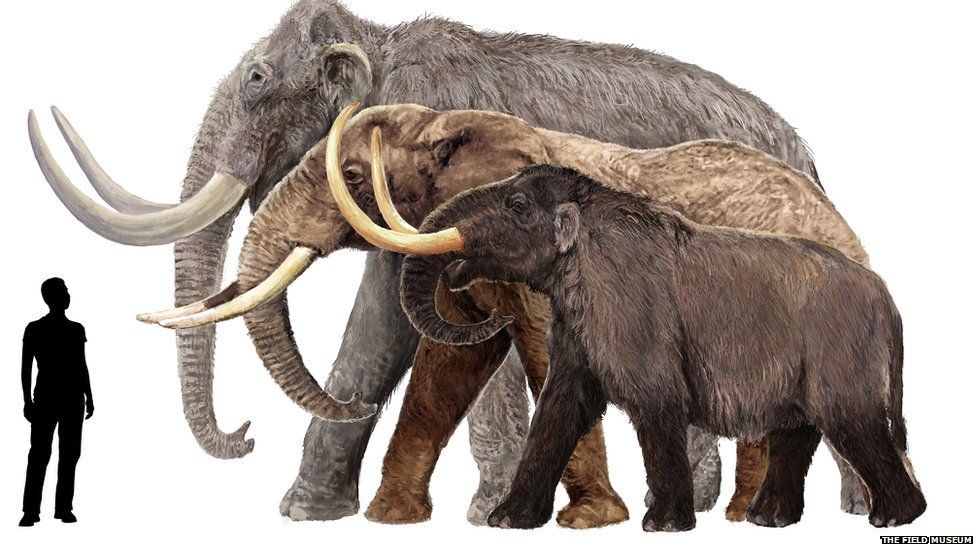
The woolly mammoth was not as large as people originally thought. In fact, they were only the size of modern African elephants. A male’s shoulder height would range from 9 to 11 feet, weighing approximately 6 tons.
Though many people incorrectly believe otherwise, elephants and mammoths are not closely related–they are distant cousins. Both animals coexisted peacefully with humans for a very long time.
Although male elephants will have the occasional violent outburst over things such as territory and mating rights, they are usually gentle animals.
In this article, we’ll compare and contrast elephants with mammoths – looking at why the former have persisted while the latter have perished.
Comparing Elephants and Mammoths
Although elephants and mammoths are closely related, they have distinct differences, largely due to the mammoth’s cooler climate adaptations. Let’s begin by discussing today’s elephant species.
| Feature | Woolly Mammoth | African Elephant | Asian Elephant |
|---|---|---|---|
| Shoulder height | 9–11 ft (2.7–3.4 m) | 8.2–13 ft (2.5–4 m) | 6.6–9.8 ft (2–3 m) |
| Weight | Up to 6 tons (5,400 kg) | Up to 7 tons (6,350 kg) | Up to 5 tons (4,500 kg) |
| Tusk length | Up to 16 ft (4.9 m), heavily curved | Up to 11.7 ft (3.6 m), straighter | Males up to 5 ft (1.5 m); females often tuskless |
| Coat | Thick double coat of long brown/reddish hair | Sparse short hair | Sparse short hair |
| Ears | Small, adapted for cold | Very large (heat regulation) | Medium-sized |
| Habitat | Tundra, grasslands (Arctic/subarctic) | African savanna and forests | South/Southeast Asian forests |
| Diet | Arctic grasses, shrubs, moss | Grasses, bark, fruit, roots | Grasses, bark, fruit, roots |
| Lifespan | ~60 years | Up to 70 years | Up to 60 years |
| Extinction status | Extinct (~10,000 BP; last isolated population ~4,000 BP) | Vulnerable (savanna) / Critically Endangered (forest) | Endangered |
| Closest living relative | Asian elephant | Not the mammoth | Woolly mammoth’s closest living relative |
African Elephant
African elephants (either African savanna or African forest) have necks that dip down, two extended trunk limbs for grasping purposes, and very large ears to help them stay cool.
The African bush elephant is the larger species of the two and lives in open grassy areas. On the other hand, the African forest elephant prefers living in wooded forests where there is more cover.
Asian Elephant
The Asian elephant may be the living relative of the mammoth, though this is still unconfirmed. Small in size, with rounded shoulders and a single trunk lobe, these elephants look different.
Tusks are not present in female Asian elephants and the population of Asian elephants is critically endangered.
Many species of mammoth used to exist, including the Male Woolly Mammoth, the Pygmy Mammoth, the Columbian Mammoth, and the Steppe Mammoth. However, these have now become extinct species.
Differences Between Mammoths And Elephants
1. Mammoths are Extinct
A key difference between mammoths and other species is that only one remains alive. Many factors led to the extinction of mammoths around 4,000 years ago, including environmental changes and human hunting.
Once the ice age ended, their lack of ability to adapt to a warmer climate made them go extinct.
The loss of elephant-friendly habitats and poaching contribute to the stress that is putting elephants and many other species in danger of extinction today.
2. The Tusks of Mammoths Were Larger
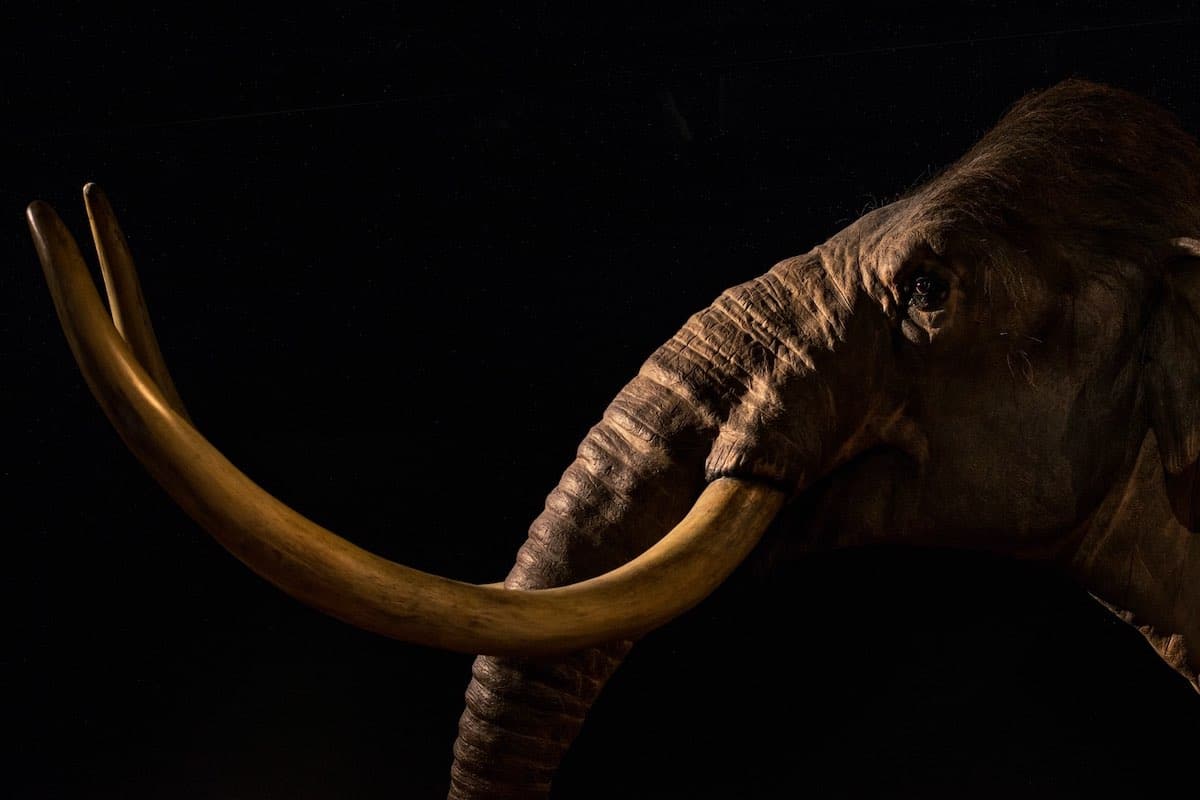
One key feature difference between elephants and mammoths is that the latter was larger and had longer tusks.
In addition to being able to reach lengths of up to 16 feet, mammoth tusks were also more twisted and curled than those true elephants. The longest elephant tusks recorded only measure 11 feet, 7 inches long.
Female Asian elephants stand out from other female elephants because they don’t have tusks. Similarly, male and female African elephant tusks are used for self-defense and to assert dominance over other males.
African and Asian elephants have long appendages called large tusks extending from the end of their trunks. These larger tusks are similar to our fingers in that they are sensitive and dexterous.
So just as we use our hands for gripping and picking up things, elephants also use their tusks.
3. Mammoths Possessed Thick Coats
As anyone who has seen one in person may attest, elephants have extremely sparse coverings of short, coarse hair. This gives the impression that they lack fur altogether.
The mammoth species didn’t have this problem – their thick coat allowed them to survive in freezing and icy climates.
Some of them even had two layers of coats so they could stay warm in the bitter cold. Male woolly mammoths could survive and even thrive in extremely cold climates thanks to their thick, hefty coats.
However, when their climate began to warm, their bulky hair disadvantaged them.
4. Their Habitats weren’t The Same
Elephants and mammoths share a common ancestor, though mammoths eventually adapted to cooler climates which allowed them to explore new areas, even North America. Elephants, however, were content staying where they were familiar and already fitted.
As mammoths evolved to survive better in colder climates, they eventually populated a much larger area than African or Asian elephants.
This is due to their size, as bigger mammals require more food which can be found by venturing over greater distances.
5. Different Body Shapes
Although many people think otherwise, elephants do not carry humps on their backs like mammoths. Unlike African elephants, who have sloping backs, the Asian elephant’s back is more round.
Not only do mammoths and Asian elephants have larger brains, these animals all have one thing in common: a rounded forehead. In contrast, a typical African elephant has foreheads slope directly down into its trunks.
The African elephant’s head and trunk are connected by a less prominent anatomical feature than the mammoth. The latter had a larger, more prominent dome-shaped forehead.
To finish, the African elephant’s ears are significantly longer when compared to both the Asian elephant and the mammoth.
The large mammals body heat is evenly distributed through its tremendous ears, permitting it to stay content in hot weather conditions.
Could Woolly Mammoths Be Brought Back?
The idea of de-extinction is no longer pure science fiction. Colossal Biosciences, a US biotechnology company, has been working since 2021 on a project to resurrect the woolly mammoth using CRISPR gene editing technology. Their approach takes the Asian elephant genome — the mammoth’s closest living relative — and edits in key mammoth traits, including cold-adapted haemoglobin, thicker fat layers, and a dense undercoat, to produce a cold-hardy “mammophant” adapted to the Arctic tundra.
In 2023, Colossal reported a significant technical breakthrough: the successful creation of elephant stem cells — the first time this had ever been achieved. In 2025, they reported further progress on key cold-adaptation gene edits, marking another step towards their eventual goal.
The ecological argument for bringing the mammoth back is compelling. Reintroducing large cold-adapted grazers to the Arctic could help restore grassland steppe ecosystems, compress permafrost, and potentially slow the release of greenhouse gases from thawing ground — a natural form of climate intervention at enormous scale.
Critics argue the resources could be better spent protecting living endangered species, and ethical questions remain open: what does it mean to create animals for an environment that no longer fully exists? Colossal aims for a living calf candidate within the next decade, though many scientists are sceptical of that timeline. Whatever the outcome, the woolly mammoth may yet be the most consequential animal of the 21st century — not just a relic of the Ice Age.
Recommended reading: Everything you need to know about the three species (!) of Elephants
Bottom Line
Woolly mammoths and modern elephants are more similar than most people realise — roughly the same size, sharing a common ancestor, and displaying comparable social intelligence. The woolly mammoth was not the colossal giant of popular imagination; it was essentially an Ice Age elephant in a fur coat.
The key difference is fate: mammoths couldn’t adapt when the climate warmed and human hunters arrived. Elephants survived — though today they face their own existential threats in habitat loss and poaching.
And in a twist of science stranger than any movie, the mammoth may not be gone forever. De-extinction research is actively underway, using the Asian elephant — the mammoth’s closest living cousin — as the foundation for bringing cold-adapted traits back to life.
FAQ – Elephants vs Mammoths
The North American imperial mammoth (M. imperator) was one of the largest mammoths, with a shoulder height of 4 meters (14 feet).
On average though, the mammoth were only the size of modern African elephants. A male’s shoulder height would range from 9 to 11 feet, weighing approximately 6 tons.
It’s impossible to determine who would win in a fight between an elephant and a mammoth since only one exist today. They lived in different environments and, therefore, wouldn’t encounter each other often. If only size of both body mass and tusks are taken into account, the Mammoth would win.
A new study says climate change is likely the cause behind why prehistoric mammoths, mastodons, and early elephants went extinct instead of overhunting by humans near the end of the last Ice Age.
Yes — elephants and mammoths are both members of the order Proboscidea and share a common ancestor. The woolly mammoth’s closest living relative is the Asian elephant, not the African elephant. Scientists have sequenced the woolly mammoth genome and found it differs from the Asian elephant genome by only about 0.6%.
Possibly — in theory. Colossal Biosciences, a US biotech company, is actively working to resurrect the woolly mammoth using CRISPR gene editing. Their approach involves editing the Asian elephant genome to reintroduce cold-adapted traits. As of 2025, they had successfully created elephant stem cells — a significant technical milestone. A viable calf candidate is still years away, and many scientists remain sceptical of the timeline.