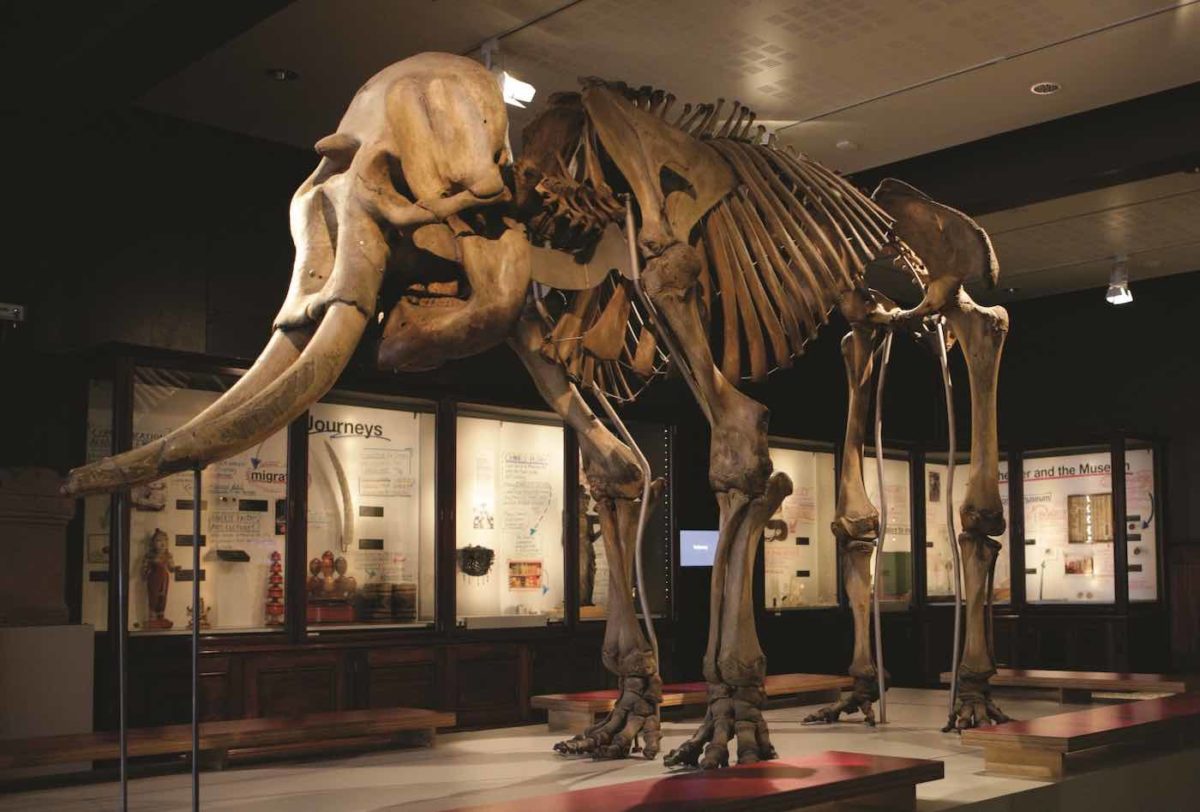
Despite carrying the largest body of any land animal on Earth — up to 14,000 pounds of muscle, fat, and organs — an African elephant does it all on roughly 179 bones. That is fewer than the 206 bones found in an adult human skeleton. Yet those 179 bones support a living creature that can stand over 13 feet at the shoulder and walk dozens of miles in a single day. The engineering behind an elephant’s skeleton is one of the most remarkable achievements in vertebrate evolution.
How Many Bones Does an Elephant Have?
The most widely cited figure for an African elephant is approximately 179 bones. The Asian elephant count varies slightly — a landmark 1982 study by Shoshani et al., published in the journal Elephant, documented 282 bones in a female Asian elephant (Elephas maximus maximus). That higher count includes some small sesamoid bones and structural variations that differ between individuals and between the two species.
For context, adult humans have 206 bones, a blue whale has approximately 177, and a domestic dog has around 319. So while elephants are by far the heaviest land animals alive today, their skeleton is surprisingly compact relative to their mass. Understanding the full anatomy of an elephant reveals how every structural element serves a purpose when you are engineering a body this large.
Bone counts can also shift across a lifetime. Elephant calves are born with more cartilaginous structures that gradually ossify — meaning they harden into bone — as the animal matures. This process continues well into adulthood, which is one reason why reported totals vary slightly across different studies and specimens.
The Elephant Skull
The elephant skull is the largest of any living land animal and makes up roughly one-third of the total skeletal mass. Yet for its size it is surprisingly lightweight, thanks to a structure called diploe — a honeycomb network of air pockets embedded within the bone. This cancellous architecture gives the skull exceptional structural integrity while dramatically reducing its weight. Without it, an elephant would struggle to hold its own head up.
The skull serves three critical functions. First, it protects the elephant’s brain, which weighs around 11 pounds — the largest brain of any land animal in absolute terms. Second, it provides the anchor points for the enormous muscle groups that control the trunk, which alone contains over 40,000 individual muscle bundles. Third, it houses the deep tusk sockets. Tusks are not superficial attachments — up to one-third of each tusk’s length is embedded inside the skull in bony alveolar sockets, making them extremely difficult to dislodge and anchoring the enormous mechanical forces generated during digging and combat.
The shape of the skull also differs markedly between the two species. African elephants have a more rounded, dome-like cranium with a single dome peak. Asian elephants have a distinctive twin-domed skull with a central indentation running front to back — a feature clearly visible when looking at the animal’s forehead from the front.
The Elephant Spine and Ribcage
Like almost every other mammal on Earth — from mice to giraffes to humans — elephants have exactly 7 cervical (neck) vertebrae. This is one of the most conserved features in mammalian anatomy. What varies is the count in the other spinal regions:
- Cervical vertebrae: 7
- Thoracic vertebrae: 19–21 (varies by individual)
- Lumbar vertebrae: 3–4
- Sacral vertebrae: 4–5 (fused)
- Caudal (tail) vertebrae: approximately 26
One of the most visible consequences of spinal structure is back shape. African elephants have thoracic vertebrae with tall neural spines that create a concave, saddle-backed profile when viewed from the side. Asian elephants have shorter neural spines and a more arched, rounded back — a reliable visual distinction between the two species even at a distance.
The ribcage is massive, housing and protecting the heart (which weighs approximately 26–46 pounds) and the digestive organs. Elephant ribs are notably flattened on their lower surfaces, an adaptation that helps brace the weight of the intestines — which in a full-grown elephant can extend over 100 feet in total length. An interesting anatomical quirk is that elephants cannot raise their ribcage during breathing the way most mammals do. Instead, the lungs are attached directly to the chest wall, and breathing is driven primarily by diaphragm movement.
The Elephant’s Unique Leg and Foot Bones
Elephant legs are often described as living columns, and that is structurally accurate. Unlike most quadrupeds, where the limb bones angle outward to some degree, elephant leg bones are stacked nearly vertically from hip to toe. This arrangement transfers the animal’s weight directly downward through the skeleton rather than relying on muscles to counteract angled forces — a critical adaptation when you weigh up to seven tons.
Despite their flat-footed appearance, elephants are technically digitigrades — they walk on their toes. A thick, fatty fibrous pad sits beneath the heel bone, acting as a built-in shock absorber with each step. This pad compresses under load and springs back, cushioning the impact of a multi-ton body and allowing surprisingly quiet movement. Researchers studying elephant speed have noted that a running elephant can reach 15–25 mph while generating remarkably little noise relative to its size.
Both African and Asian elephants have five toes on each foot, though not all toes carry visible nails externally. The typical nail count differs by species:
- African elephant: typically 4 toenails on the front feet, 3 on the back
- Asian elephant: typically 5 toenails on the front feet, 4 on the back
The leg bones also explain one of the most frequently asked questions about elephants: why can’t they jump? The answer lies in physics and bone structure. Nearly vertical limb bones and the enormous body mass mean there is no mechanical way for the muscles to generate the rapid downward thrust needed to leave the ground. The skeleton simply is not built for explosive vertical movement. Every elephant on Earth — no matter how young or how energetic — has never, and will never, jump.
African Elephant Skeleton vs. Asian Elephant Skeleton
While both species share the same fundamental mammalian skeletal blueprint, there are consistent structural differences that go well beyond size. These skeletal differences are closely tied to the environments each species evolved in and the ecological roles they play. Explore the full species breakdown to understand more about how African and Asian elephants diverged over millions of years.
| Skeletal Feature | African Elephant | Asian Elephant |
|---|---|---|
| Approximate bone count | ~179 | ~282 (per Shoshani et al.) |
| Skull shape | Single-domed, more rounded | Twin-domed with central indent |
| Back profile | Concave (saddle-backed) | Convex (arched/rounded) |
| Ear attachment to skull | Larger skull base for large ears | Smaller ear attachment area |
| Front toenails | Typically 4 | Typically 5 |
| Back toenails | Typically 3 | Typically 4 |
| Neural spine height | Taller — creates saddle shape | Shorter — creates arched shape |
Elephant Bones vs. Human Bones
Comparing the elephant skeleton to the human skeleton puts the differences in sharp relief. Humans have more bones overall, largely due to the complexity of the hand and foot with their many small bones. Elephants trade that fine-motor complexity for load-bearing efficiency.
| Feature | Elephant | Human |
|---|---|---|
| Total bones (adult) | ~179 (African) / ~282 (Asian) | 206 |
| Cervical vertebrae | 7 | 7 |
| Skull structure | Honeycombed diploe, air-filled | Solid bone with sinuses |
| Stance | Digitigrade (walks on toes) | Plantigrade (walks on full foot) |
| Limb bone angle | Near-vertical pillar | Angled for bipedal balance |
| Kneecap (patella) | Present in hind limbs | Present in both limbs |
| Bones continue growing | Throughout life | Stop at early adulthood |
What Are Elephant Tusks Made Of?
A common misconception is that elephant tusks are bones. They are not. Tusks are highly modified incisor teeth — specifically the upper second incisors — that erupt during the animal’s first year of life and continue growing throughout its entire lifespan. Unlike most teeth, they are never replaced once the permanent tusks come in.
Tusks are composed primarily of dentine, the same dense tissue that forms the inner layer of all teeth. The outer layer is a thin coating of enamel, though this tends to wear away near the tip over time. The dentine in elephant tusks has a distinctive cross-hatched pattern known as Schreger lines — visible in cross-section — which is unique to proboscideans (the elephant family) and is used by forensic scientists and customs officials to identify ivory.
Because tusks are teeth rather than bones, they are not counted in the elephant’s bone total. Both male and female African elephants typically carry tusks, while in Asian elephants, females rarely grow visible tusks and only some males do. The poaching pressure on tusked elephants has had a measurable evolutionary effect — elephant populations in heavily poached areas are increasingly producing tuskless individuals.
Interesting Elephant Bone Facts
- Elephant bones continue growing and remodeling throughout the animal’s entire life — a process called bone remodeling that allows the skeleton to adapt to changing weight and activity levels.
- The femur (thigh bone) is the largest single bone in an elephant’s body. In a large adult African elephant it can measure over 120 cm in length and weigh up to 47 lbs (21 kg).
- Elephant bone density is significantly higher than in most other mammals, which is part of why their skeletons can support weights of 8,000–14,000 pounds without fracture.
- Fossil evidence shows that the basic elephant skeletal blueprint has remained remarkably consistent for millions of years — the modern skeleton is recognizably similar to that of Mammuthus (woolly mammoth) relatives.
- Elephants share the seven-cervical-vertebrae constraint with almost all other mammals, including giraffes — despite the giraffe’s neck being orders of magnitude longer.
- The skull’s honeycomb diploe structure is similar to the lightweight spongy bone found in bird skulls — an independent evolutionary solution to the same engineering problem of minimizing weight while maintaining strength.
- An elephant’s foot pad can compress by several centimeters under load, then fully recover — acting like a natural suspension system with each step.
- Contrary to an old belief listed in some early zoology texts, elephant bones are not hollow. They are dense and heavily mineralized — the opposite of the hollow bones found in birds.
- Elephants cannot trot — they move directly from a walk to a running gait with no intermediate trot. This is directly related to the near-vertical leg bone arrangement.
- The stereotypic swaying behavior seen in captive elephants is thought to cause measurable stress on joint cartilage over time, potentially contributing to arthritis — one of the leading health problems in zoo elephants.
Frequently Asked Questions
An African elephant has approximately 179 bones. An Asian elephant has slightly more — a 1982 study by Shoshani et al. documented 282 bones in a female Asian elephant. For comparison, adult humans have 206 bones.
No. Elephant bones are dense and heavily mineralized — the opposite of hollow. The skull does contain air pockets (diploe) to reduce weight, but the load-bearing bones of the limbs and spine are solid and extremely dense to support the animal’s enormous body weight.
Tusks are modified incisor teeth, not bones. They are composed primarily of dentine (ivory) with a thin outer layer of enamel. Because they are teeth, they are not counted in the elephant’s bone total.
Elephant leg bones are stacked nearly vertically, like structural columns, to transfer their enormous body weight directly to the ground. This architecture, combined with their mass, makes it physically impossible for the muscles to generate the explosive upward thrust needed to leave the ground. No elephant — of any age or species — has ever jumped.
Through three key adaptations: near-vertical leg bones that act as load-bearing columns, extremely dense and mineralized bone tissue, and a lightweight but strong skull structure with internal air pockets. The thick fat pad under each foot also acts as a shock absorber, distributing weight across a wide surface area with each step.
The femur (thigh bone) is the largest single bone. In a large adult African elephant it can measure over 120 cm in length and weigh approximately 47 lbs (21 kg).