
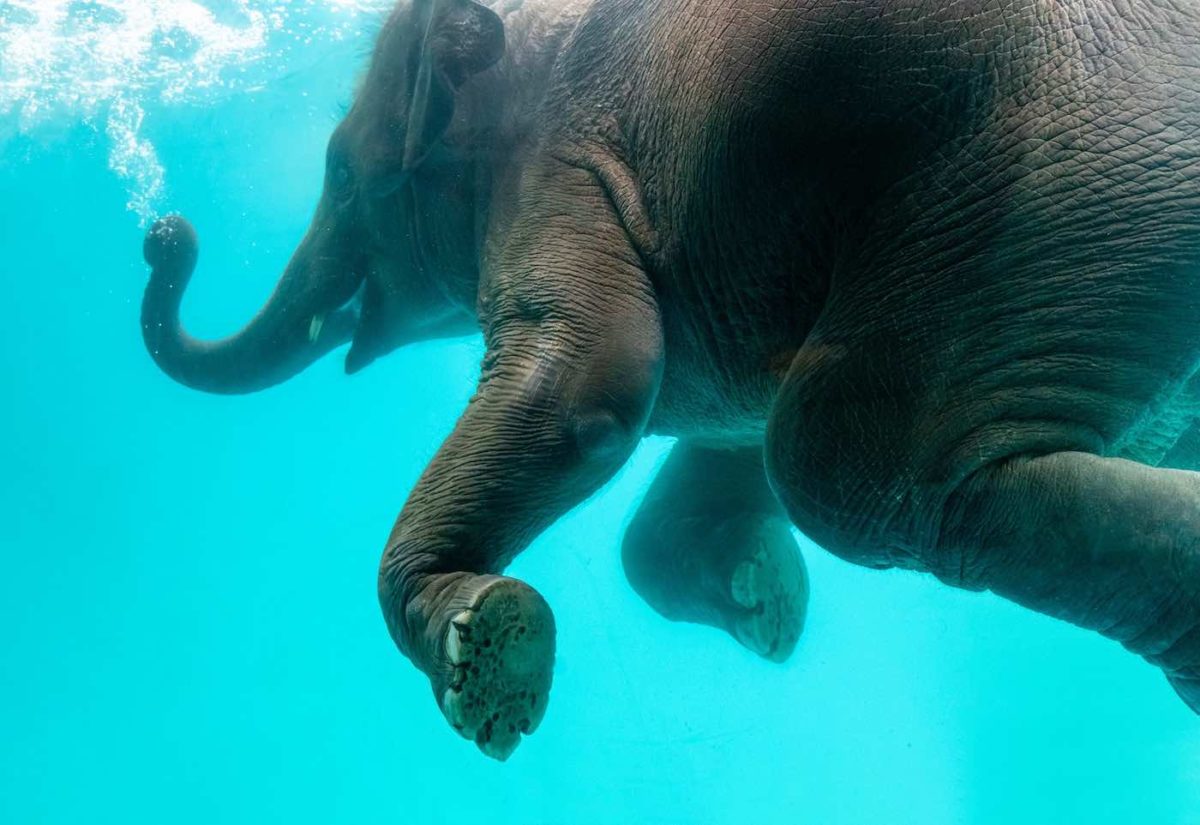
Watch a three-ton elephant wade into a river and you’d be forgiven for expecting it to sink. It doesn’t. Elephants are among the strongest natural swimmers of any land mammal, and they’ve been crossing rivers, lakes, and even short stretches of open ocean for as long as they’ve existed.
Yes, elephants can swim. They’re buoyant, strong, and comfortable in water. They paddle with all four legs, use their trunk as a snorkel to breathe while mostly submerged, and can cover distances of up to 48 km (30 miles) in a single swim. Every species of elephant, from African bush elephants to Asian elephants, swims well from an early age.
This guide covers how elephants swim, how far they can go, why they swim, how they breathe underwater, whether baby elephants can swim, and the one myth about elephants not being able to swim that still refuses to die.
Can Elephants Swim? The Quick Answer
| Can elephants swim? | Yes, all elephant species are strong swimmers |
| How fast do they swim? | Roughly 2 km/h (1.2 mph), sustained |
| How far can they swim? | Up to 48 km (30 miles) in a single swim |
| Can they swim underwater? | Yes, with the trunk raised as a snorkel |
| How long can they hold their breath? | About 2 to 3 minutes if fully submerged |
| Do baby elephants swim? | Yes, usually within the first few weeks of life |
Elephants Are Born Swimmers
Elephants are natural swimmers. Their sheer size is actually an advantage: they’re highly buoyant, their legs are powerful enough to paddle for hours, and their long trunk doubles as a built-in breathing tube when their head goes under.
Both African and Asian elephants swim well. Asian elephants in particular are documented crossing ocean channels between islands in Southeast Asia – there are records of herds swimming several kilometres between Indonesian islands, and between Sri Lanka and mainland India in the past.
What do elephants use to swim?
- All four legs. Elephants paddle like a dog on four limbs, with the front legs doing more of the steering and the back legs providing thrust.
- The trunk. The trunk is a 1.5 to 2 metre muscular tube that lifts above the water to act as a snorkel. Elephants breathe through it when their head is submerged.
- Body fat and air in the lungs. Elephants float. They don’t need to work hard to stay up; most of the effort goes into direction and speed.
- Ears. Some researchers think elephants use their huge ears for balance and steering in water, a bit like a ship’s rudder.
How Do Elephants Swim?
From above, a swimming elephant looks like it’s walking through invisible ground. The legs move in the same diagonal rhythm as a normal gait, but they’re pushing water instead of pressing against earth. The head and trunk stay at the surface, the body is mostly submerged, and the feet never touch the bottom.
Cruising pace is around 2 km/h (roughly 1 knot). That’s slow compared to a strong human swimmer in a pool, but elephants can sustain it for hours without obvious fatigue. They don’t sprint and they don’t panic – once they’re floating, they settle into a steady rhythm and stay in it until they reach land.
How Far Can an Elephant Swim?
The longest recorded elephant swim is around 48 km (30 miles) in a single session. Most documented long-distance swims fall in the 1 to 10 km range: crossing rivers, reaching islands, or escaping a dry riverbank.
- Rivers: A wide African river like the Zambezi or Luangwa is a routine swim for a bull elephant.
- Island hops: Herds in Sumatra and Borneo move between coastal islands by swimming.
- Historical crossings: Some researchers believe Asian elephants swam between India and Sri Lanka, and possibly reached now-separated islands over thousands of years.
Stamina isn’t the limit. Elephants can float and paddle almost indefinitely. The real constraints are cold water, currents, and whether there’s a safe exit on the far side.
Why Do Elephants Swim?
Elephants swim for a handful of clear reasons.
- Cooling down. Elephants are enormous and generate a lot of heat. Water is the fastest way to cool off, especially in the African and Southeast Asian summer.
- Crossing rivers. Herds often need to cross rivers on their seasonal migration routes or to reach food.
- Finding food. Aquatic plants, roots, and grasses on the far bank or on islands are part of their diet.
- Escaping predators and danger. Crocodiles and lions can’t follow a full-grown elephant into open water as effectively as on land.
- Play. Elephants clearly enjoy water. Young elephants especially roll, splash, and chase each other in shallow pools and rivers.
Can Elephants Swim Underwater?
Yes. Elephants can fully submerge their bodies and keep swimming, using their trunk as a snorkel. The tip of the trunk stays above the waterline while the rest of the body is underwater — the same mechanism explained in how elephants breathe.
This ability is unusual among large land mammals. Most big mammals either float high or sink and thrash. The elephant’s trunk solves a problem evolution didn’t solve for horses, cows, buffalo, or rhinos: you can be fully underwater and still breathe.
How long can elephants go underwater?
With the trunk at the surface, indefinitely – they’re still breathing. With the trunk fully submerged (no air supply), roughly 2 to 3 minutes. Elephants rarely hold their breath for that long in practice because they don’t need to. If the water is deep, they simply raise the trunk and keep moving.
What is the deepest an elephant has been recorded swimming?
There’s no clear scientific record of maximum depth because elephants swim at the surface rather than diving. Depth isn’t really the right question for elephants – distance and duration are. When the water is deeper than their standing height (around 3 metres for a large bull), they float and swim rather than wade.
Can Elephants Swim But Hippos Can’t?
Surprisingly, no. Hippos spend most of their lives in water, but they don’t actually swim in the classic sense. They walk along the bottom, push off, and glide. Elephants swim in the full sense: floating, paddling, and moving across open water.
Here’s how elephants compare to other large mammals when it comes to swimming ability:
| Animal | Swims? | Notes |
|---|---|---|
| Elephant | Yes, excellent | Paddles, floats, uses trunk as snorkel, can cross open water |
| Hippo | No, not really | Walks and pushes off the riverbed; doesn’t float well |
| Rhino | Yes, but reluctantly | Swims only when necessary; prefers to wade |
| Horse | Yes | Natural but tires quickly |
| Cow | Yes | Floats well, paddles competently |
| Giraffe | Disputed | Observed crossing shallow water; avoids deep water |
| Camel | Yes, surprisingly | Can swim long distances in coastal environments |
Do Elephants Like Swimming?
Yes. Videos of wild and captive elephants playing in water are endless for a reason – they love it. Young elephants are especially enthusiastic. They’ll wallow, roll, chase each other, and spend long stretches of the day in a river or pond when one is available.
Water also has practical benefits for them. It cools the body, cleans the skin, and helps dislodge parasites. For an animal that can generate enormous amounts of heat, access to water is close to a daily requirement during hot seasons.
Can Baby Elephants Swim?
Yes. Baby elephants start swimming very early – often within the first few weeks of life. Mothers and older herd members typically guide them into water gently, and the calves pick up the motion quickly.
That said, baby elephants are more vulnerable in water than adults. They’re smaller, less buoyant, and less experienced. In a strong current or deep water, an older elephant will often stay physically close, sometimes even allowing the calf to hold onto their tail with the trunk.
If you’re interested in early-life elephant behaviour more broadly, see our baby elephant facts guide.
Can an Elephant Drown?
It’s rare, but yes. A healthy adult elephant in good water conditions is very unlikely to drown. Drowning usually requires one of a few factors to stack up:
- Strong current pulling them into hazards
- Exhaustion on an unexpectedly long crossing
- Steep banks with no way out
- Injury or illness before entering the water
- A very young calf in deep water without adult support
Under normal conditions, elephants are competent enough that drowning is one of the less likely causes of death for them.
What Threats Do Elephants Face in the Water?
What is the biggest threat to elephants when they swim?
In most African rivers, the biggest threat is current and terrain rather than other animals. Steep-banked rivers with few exit points, flood-swollen rivers, and coastal riptides all cause more elephant deaths than predators.
Could a crocodile kill an elephant?
Rarely, and almost never an adult. Nile and saltwater crocodiles can and do attack elephant calves and occasionally very old or sick adults in shallow water. A healthy adult elephant is too large and too dangerous for a crocodile to handle, and elephants will actively defend their young with trunk blows and by driving crocodiles off.
There are a handful of documented cases of crocodiles grabbing an elephant’s trunk, but most end with the elephant pulling free. For more on what elephants are afraid of, see our elephant fears guide.
FAQ about Elephants and Swimming
Yes. All elephant species swim well. They paddle with all four legs, use their trunk as a snorkel, and can cover up to 48 km (30 miles) in a single swim. Swimming is a normal part of elephant life in rivers, lakes, and some coastal environments.
The longest documented elephant swim is around 48 km (30 miles). Most everyday swims are much shorter – a few hundred metres to a few kilometres to cross a river or reach food. Elephants have very high endurance in water and can sustain their paddling rhythm for hours.
Yes. Elephants use their trunk as a snorkel, lifting it above the water while the rest of the body stays submerged. This lets them keep breathing even when fully underwater. If they hold their breath with the trunk below water, they can last roughly 2 to 3 minutes, but in practice they rarely need to.
Yes. Baby elephants typically swim within the first few weeks of life, usually introduced to water by their mother and older herd members. They are less buoyant and more vulnerable than adults, so older elephants stay close, and calves sometimes hold onto an adult’s tail with the trunk.
Elephants swim at about 2 km/h (roughly 1.2 mph) as a sustained pace. They don’t sprint in water – they settle into a steady rhythm and maintain it for as long as needed.
Counterintuitively, yes. Hippos spend most of their lives in water but don’t actually swim – they walk along the bottom and push off. Elephants swim in the full sense: they float, paddle, and cross open water.
It’s rare but possible. A healthy adult in normal water conditions is very unlikely to drown. Drowning usually requires strong currents, exhaustion on a long unexpected swim, steep banks with no exit, or an underlying injury or illness. Young calves are more at risk than adults.
Conclusion
Elephants are among the best large-mammal swimmers on earth. They float naturally, paddle with all four legs, breathe through an evolved snorkel, and can cross stretches of water that most land animals wouldn’t even attempt. Anyone who’s watched a herd wade into a river has seen it: elephants don’t just tolerate water, they seek it out.
If you want to keep exploring, our guides on elephant population numbers, what elephants eat, and African vs Asian elephants all pair well with this one.

5 replies on “Can Elephants Swim? Yes – And Surprisingly Well”
[…] Read More […]
[…] Read More […]
[…] Source: “Can Elephants swim? They even swim underwater!” — Elephant Guide […]
[…] Source: “Can Elephants swim? They even swim underwater!” — Elephant Guide […]
[…] buoyancy: Their large and muscular body provides them with natural buoyancy, keeping them afloat and allowing them to swim […]