
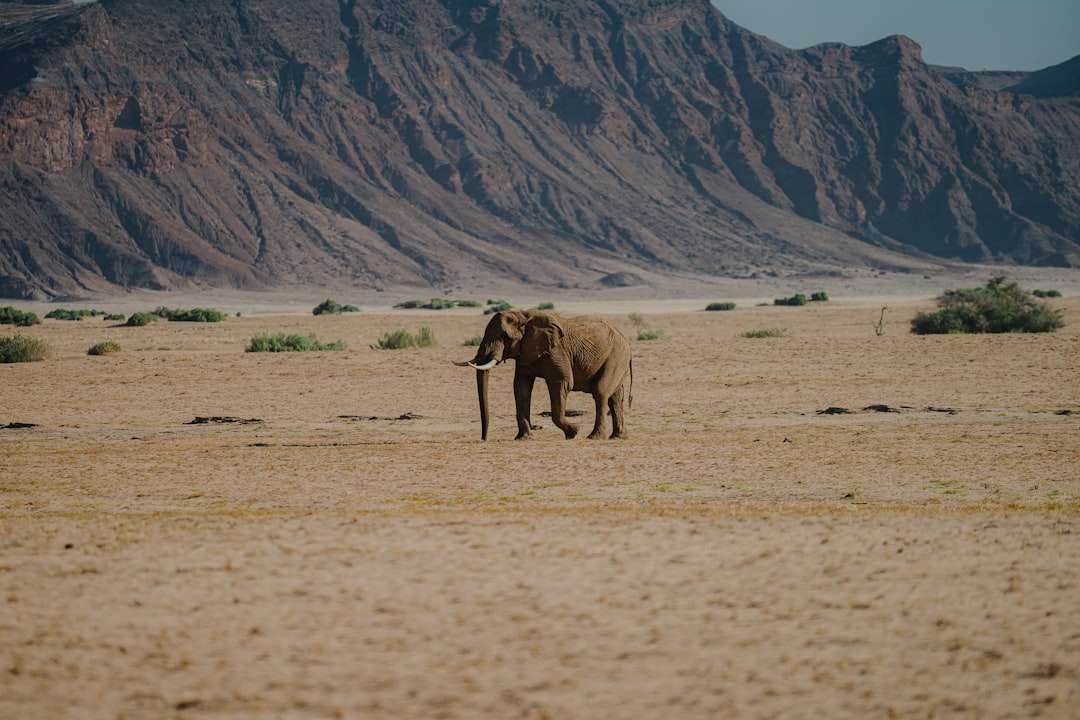
In the parched northwest of Namibia, elephants walk across some of the driest terrain any elephant on Earth calls home — crossing gravel plains and dry riverbeds, digging for water with their trunks and going days between drinks. These are Namibia’s famous desert-adapted elephants, and they’re one of the most remarkable stories in the elephant world. Here’s what they are, how they survive, and where to see them.
The short answer: desert elephants aren’t a separate species — they’re African bush elephants (Loxodonta africana) that have learned to survive in the Namib Desert. Only a few hundred remain, mostly in Namibia’s Kunene region (Damaraland), where they travel vast distances for water and pass that survival knowledge down through their matriarchs.
Are Desert Elephants a Separate Species?
No — and this is the first thing to clear up. Namibia’s desert elephants are the same species as every other African bush elephant; there’s no separate “desert elephant” species or even subspecies. What sets them apart is behaviour and physiology honed to an extreme environment, not genetics. Only Namibia and Mali host elephants living in true desert conditions. For the full species picture, see the three species of elephant.
How Desert Elephants Survive the Namib
Living in a desert forces adaptations that savanna elephants never need. Namibia’s desert elephants:
- Travel enormous distances for water — often 60+ km between water sources, following ephemeral riverbeds like the Hoanib, Hoarusib and Huab.
- Go days without drinking — far longer than a typical savanna elephant could tolerate.
- Dig their own wells — excavating the sand of dry riverbeds with trunks and feet to reach water below the surface.
- Live in smaller family groups — keeping herd sizes low to match scarce food and water.
- Appear longer-legged and leaner — an impression created by their body condition and the terrain, though they are anatomically the same animal as other bush elephants.
Above all, survival depends on knowledge. Matriarchs carry decades-long mental maps of where water and food can be found across hundreds of square kilometres, and pass that memory down the generations — a vivid example of why elephant memory is so vital to the species.
Desert elephants aren’t built differently — they survive on inherited knowledge, with matriarchs remembering water sources scattered across hundreds of kilometres of desert.
Desert-Adapted vs. Typical Savanna Elephant
| Trait | Namib desert elephant | Typical savanna elephant |
|---|---|---|
| Species | African bush elephant | African bush elephant (same) |
| Herd size | Smaller family groups | Often larger herds |
| Distance for water | Up to 60+ km | Usually much shorter |
| Time without water | Several days | Drinks near-daily |
| Water strategy | Digs wells in dry riverbeds | Uses rivers, pans, waterholes |
How Many Desert Elephants Are Left?
Estimates vary and are debated, but Namibia’s desert-dwelling elephants number only in the low hundreds — a tiny, fragile population. Their numbers rise and fall sharply with drought, which is by far the biggest natural pressure on them. They also face human-elephant conflict with the region’s communities and, controversially, occasional trophy-hunting auctions of desert bulls — a practice conservationists strongly contest given how few animals remain and how much herd knowledge a single old bull carries.
Where to See Namibia’s Desert Elephants
Desert elephants roam the Kunene region (also called Damaraland) in Namibia’s remote northwest, concentrating along ephemeral river valleys. The best time to look is the dry winter, roughly July to November, when elephants gather along the riverbeds and thinner vegetation makes them easier to spot. Key bases:
| Region | Kunene / Damaraland, northwest Namibia |
| Best time | July–November (dry season) |
| Palmwag Concession | Palmwag on Google Maps — 5,500 km² concession, elephants near the Uniab River |
| Hoanib & Huab valleys | Hoanib River on Google Maps — core desert-elephant range |
| Getting there | Fly into Windhoek (WDH), then light aircraft or 4WD; guided drives required in some conservancies |
Much of this land is managed by community conservancies (Torra, Sesfontein, Anabeb and others), where tourism revenue funds conservation and anti-poaching work — so visiting responsibly directly supports the elephants’ survival. See how to help save elephants for more on that model.
Watch: Namibia’s Desert Elephants
The bottom line
Namibia’s desert elephants are ordinary African bush elephants doing something extraordinary — surviving one of the harshest landscapes on the continent on inherited knowledge, long marches and hand-dug wells. Only a few hundred remain, which makes drought, conflict and hunting all the more consequential. Keep exploring: the three species of elephant, how elephants migrate, and how climate change affects their habitat.
Frequently asked questions
No. Namibia’s desert elephants are African bush elephants (Loxodonta africana) — the same species as savanna elephants. They’re distinguished by behaviour and survival strategies adapted to the desert, not by genetics, so they aren’t a separate species or subspecies.
They rely on the memory of their matriarchs, who know water sources scattered across hundreds of kilometres. They travel long distances between them, follow ephemeral riverbeds, and dig wells in the sand with their trunks and feet to reach water below the surface.
Only a few hundred — a small, fragile population whose numbers swing with drought. Exact figures are debated, but they remain one of the smallest and most vulnerable elephant populations anywhere.
In Namibia’s remote Kunene region (Damaraland), especially around the Palmwag concession and the Hoanib and Huab river valleys. The dry season, July to November, is the best time to find them.
They’re the same species but behave differently: smaller herds, journeys of 60+ km for water, the ability to go days without drinking, and well-digging in dry riverbeds. They can also look leaner and longer-legged, though anatomically they’re standard bush elephants.