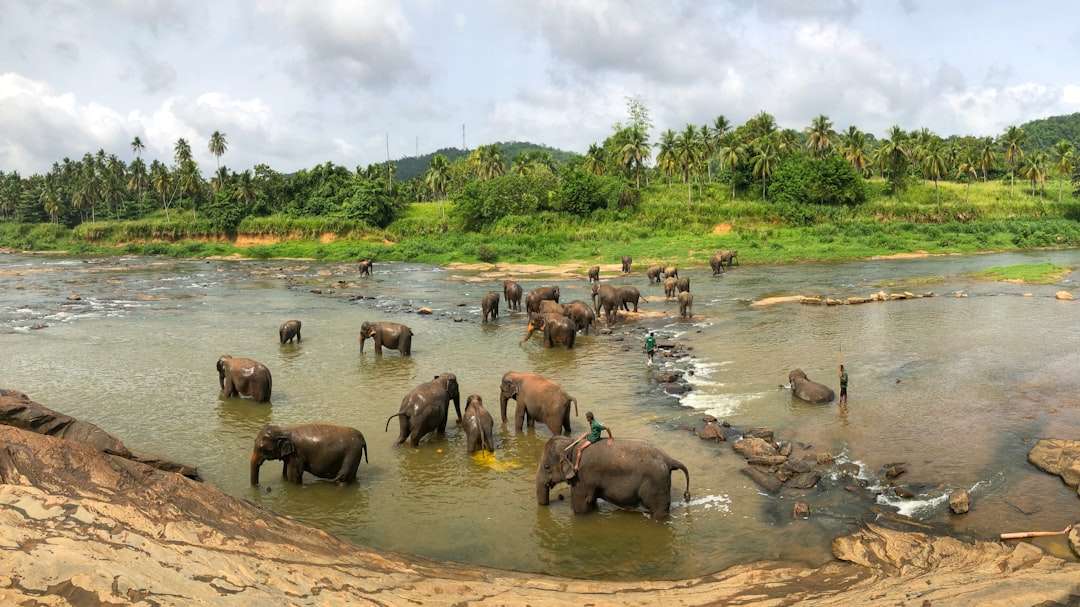
For its size, Sri Lanka may be the most reliable place on Earth to see wild elephants. This teardrop island — smaller than West Virginia — packs in the largest seasonal elephant gathering on the planet, a park where sightings are all but guaranteed year-round, and the highest elephant density in Asia. Here are the best places to see elephants in Sri Lanka, when to go, and how to do it ethically.
The short answer: for the famous “Gathering” of hundreds of elephants, visit Minneriya (Aug–Sept) or its quieter twin Kaudulla (Oct–Jan). For near-guaranteed sightings any time of year, go to Udawalawe. And choose the Udawalawe Elephant Transit Home over Pinnawala for an ethical, hands-off experience.
Elephants in Sri Lanka at a Glance
| Subspecies | Sri Lankan elephant (Elephas maximus maximus) — the largest Asian elephant subspecies |
| Wild population | ~7,451 (latest government estimate) — the highest elephant density in Asia |
| Share of world Asian elephants | Roughly 13–14% |
| Tuskers | Only ~6.5% of the population — unusually low, a legacy of historic poaching |
| Best overall park | Udawalawe (year-round); Minneriya/Kaudulla for “The Gathering” |
| Best months for The Gathering | August–September (Minneriya) |
About Sri Lanka’s Elephants
The Sri Lankan elephant is the largest of the three recognised Asian elephant subspecies, and the island holds the densest elephant population in Asia — roughly 7,451 animals in an area you can drive across in a day. One quirk sets them apart: only about 6.5% carry tusks, far fewer than in India, because generations of poaching selectively removed tusked bulls from the gene pool. Encouragingly, the share of young tuskers is now rising.
Sri Lanka also has one of the world’s most serious cases of human-elephant conflict — recent years have seen roughly 400 elephant and 150+ human deaths annually as farmland pushes into elephant range. Choosing responsible operators and ethical attractions is part of visiting well.
1. Minneriya National Park
Minneriya is home to “The Gathering” — the largest seasonal congregation of wild Asian elephants on Earth. As the dry season shrinks water sources across the region, up to 300–400 elephants converge on the receding shoreline of the ancient Minneriya Tank (a reservoir built in the 3rd century AD), drawn from up to 50 km away to graze the nutrient-rich grass exposed by the falling water.
It’s a genuine ecological spectacle, not a marketing line. Book an afternoon jeep for roughly the 2:30–6:00pm window, when elephants emerge to drink and feed in golden light. The one downside: at peak season the tank can draw 50+ jeeps at once, so if crowds bother you, consider Kaudulla (below).
Quick facts
| Elephants | Up to 300–400 at peak |
| Best time to visit | July–October (Aug–Sept peak) |
| Location | Minneriya National Park on Google Maps |
2. Kaudulla National Park
Kaudulla is The Gathering’s second act. As the Minneriya Tank refills with the coming rains, the same migratory elephants shift a short distance north to the Kaudulla Tank — often literally the same animals, one population moving between two reservoirs.
The payoff for visitors is a near-identical spectacle with far fewer vehicles (15–25 rather than 50+). If you’re travelling between October and January, Kaudulla is the insider’s choice for the Gathering experience without the crowds.
Quick facts
| Elephants | Large migratory herds in season |
| Best time to visit | October–January (Oct–Nov peak) |
| Location | Kaudulla National Park on Google Maps |
3. Udawalawe National Park
If you can only visit one park, make it Udawalawe. Unlike the Gathering parks, its elephants are resident and non-migratory, so sightings are effectively guaranteed on any day of the year — a typical safari turns up anywhere from 20 to 100 individuals.
Udawalawe is also home to the Elephant Transit Home, a rehabilitation facility for orphaned calves run on a strict minimal-human-contact philosophy: calves are fed from a viewing platform, never handled or ridden, and released back to the wild once grown (100+ have been successfully returned). It is the ethical opposite of a ride-and-bathe attraction — and the antidote to Pinnawala (below).
Quick facts
| Elephants | Resident population, 600–800 park-wide; sightings near-guaranteed |
| Best time to visit | Year-round (dry season May–Sept marginally better) |
| Location | Udawalawe National Park on Google Maps |
4. Yala National Park
Yala is Sri Lanka’s most famous park — celebrated for the world’s highest density of leopards — but it also holds a healthy resident elephant population of roughly 250–350, in small family groups and lone bulls.
Come here for the full Sri Lankan safari rather than elephants alone: the draw is the chance of elephants, leopards and sloth bears in one drive. Manage expectations on elephant numbers versus Udawalawe, but few places offer this breadth of big wildlife. Its quieter eastern extension, Kumana, adds birding and lower traffic.
Quick facts
| Elephants | ~250–350 park-wide |
| Best time to visit | February–June (dry season) |
| Location | Yala National Park on Google Maps |
5. Wasgamuwa National Park
Wasgamuwa holds Sri Lanka’s second-largest elephant population and sees a fraction of the tourist traffic of Yala or Minneriya — the off-the-beaten-path choice. Herds here can run up to 150 strong, and the elephants are less habituated to jeeps, giving a wilder, more natural encounter.
That wildness cuts both ways: guides here occasionally report mock charges, so a calm, experienced driver matters. Seasonality is less predictable than the big parks — confirm timing with a local operator close to your travel dates.
Quick facts
| Elephants | 150–200+ (second-largest in Sri Lanka) |
| Best time to visit | Varies — confirm with a local operator |
| Location | Wasgamuwa National Park on Google Maps |
6. Wilpattu National Park
Sri Lanka’s largest national park is famous for its villus — dozens of natural, sand-rimmed rain-fed lakes — a distinct landscape from the dry-tank parks. Elephants are present in smaller herds here, so treat Wilpattu as a “combine with elephants” park rather than an elephants-first one.
The real draws are the scenery, the leopards and the low crowds. It’s a natural add-on for travellers exploring the north-west near the ancient city of Anuradhapura.
Quick facts
| Elephants | Smaller resident herds |
| Best time to visit | February–October (dry season best) |
| Location | Wilpattu National Park on Google Maps |
7. Lahugala Kitulana National Park
Sri Lanka’s hidden gem: a tiny park with an outsized elephant density. During peak dry season, herds of nearly 150 elephants gather around the Lahugala tank — the only water source for miles — a striking concentration for such a little-known reserve that most guides overlook entirely.
It’s a convenient add-on for travellers heading to the east-coast surf town of Arugam Bay, and doubles as a strong birding site with 200+ species.
Quick facts
| Elephants | Herds up to ~150 in peak season |
| Best time to visit | July–August |
| Location | Lahugala Kitulana National Park on Google Maps |
A Note on Pinnawala Elephant Orphanage
Pinnawala is Sri Lanka’s most famous elephant attraction and its most searched — so it’s worth addressing honestly. Despite the “orphanage” name, it operates as a breeding-and-display facility, and animal-welfare organisations including the Born Free Foundation have documented practices such as chaining (including bulls in musth) and bullhook training. Responsible-travel platforms have delisted it.
If your goal is to see rescued elephants ethically, the Elephant Transit Home at Udawalawe is the materially better choice: it keeps human contact minimal, uses no chains or hooks, and releases its calves back to the wild. We’d steer you there instead. For more on choosing well, see how to help save elephants.
Beyond Safari: Elephants in Sri Lankan Culture
Sri Lanka’s relationship with elephants runs deep. The Esala Perahera in Kandy — the island’s largest Buddhist festival, held each August — parades 50 to 100 lavishly decorated elephants through the streets by torchlight, led by a majestic tusker carrying a replica of the Sacred Tooth Relic of the Buddha. Elephants have been woven into Sri Lankan royal and religious tradition for over two thousand years, which is part of what makes seeing them in the wild here feel so resonant.
Conclusion
Nowhere else offers guaranteed sightings, the planet’s largest elephant gathering, and hidden-gem density in a country this compact. Time your trip to the park: Udawalawe any time, Minneriya in August–September, Kaudulla from October. And travel responsibly — choose the Udawalawe Transit Home over Pinnawala, pick operators that keep a respectful distance, and remember that the elephants you’ve come to see are at the centre of a real and worsening conflict with the people who share their island. Compare other destinations in our guide to the best places to see elephants, or plan around the seasons with our seasonal elephant viewing guide.
Frequently asked questions
It depends on the park. For “The Gathering” at Minneriya, August–September is peak; Kaudulla takes over from October to January. Udawalawe is the exception that needs no season — its resident population is visible year-round, with the May–September dry season marginally easier.
The Elephant Transit Home at Udawalawe is the far more ethical choice. It rehabilitates orphaned calves with minimal human contact and releases them to the wild. Pinnawala, despite the “orphanage” label, is a breeding-and-display facility with a documented history of chaining and bullhook training.
Yes, on a licensed park safari with an experienced driver it’s standard, low-risk tourism. The serious human-elephant conflict in Sri Lanka affects rural communities near elephant corridors, not visitors on a jeep safari.
The latest government estimate is around 7,451 wild elephants — the highest elephant density of any country in Asia, and roughly 13–14% of the world’s wild Asian elephants, in a country about the size of West Virginia.
Most don’t. Only about 6.5% of Sri Lankan elephants carry tusks — unusually low, a legacy of poaching that selectively removed tusked bulls. The Sri Lankan elephant is also the largest of the three Asian elephant subspecies.