
Ask most people how many knees an elephant has and they’ll say four. Ask a zoologist, and you’ll get a more complicated answer. The popular “four knees” fun fact that circulates endlessly on social media is one of those irresistible pieces of trivia that sounds authoritative — and is almost entirely wrong. Elephants do have knees, but understanding exactly where they are, and what that large forward-bending joint in the front leg actually is, requires a closer look at the remarkable anatomy that lets these animals carry up to 7,000 kilograms on four pillar-like limbs.
The short answer: Elephants have two true knees — one in each hind leg. The large forward-bending joints visible in their front legs are not knees at all; they are the carpus, the anatomical equivalent of a human wrist. The “four knees” claim is a myth. All four-legged mammals share the same basic limb configuration: true knees (stifle joints) only in the back legs, wrist-equivalent joints in the front.
The “Four Knees” Myth — Let’s Set the Record Straight
The claim that elephants are “the only animal with four knees” has been repeated in wildlife documentaries, pub quiz nights, and across the internet for decades. It is wrong — and the error stems from a confusion between what a joint looks like and what it actually is.
To understand why, consider how we identify joints in our own bodies. A knee is defined anatomically by its specific bones: the femur (thigh bone) articulating with the tibia (shin bone), stabilised by the patella (kneecap) and a complex of ligaments. This joint — the stifle joint in veterinary terminology — only exists in the hind limbs of four-legged animals. Full stop.
The front limbs of all quadrupeds, including elephants, horses, dogs, and cats, are built on a completely different structural plan. The upper section is the humerus (upper arm bone). Below that comes the elbow — which bends backward, not forward — and then the radius and ulna (forearm bones). Below those is the carpus. In humans, the carpus is the wrist. In an elephant, the carpus is the large, prominent joint that people mistake for a knee when viewing the animal from the side.
Why does the carpus fool us? Because in elephants, it bends forward — toward the front of the animal — just as a hind-leg knee does. This directional similarity is where the confusion originates. But shared bending direction does not make two joints the same thing. A carpal joint contains entirely different bones, ligaments, and tendons than a stifle joint, and serves a different biomechanical function.
To reiterate: horses have two knees, dogs have two knees, lions have two knees. Elephants have two knees. No four-legged animal has four knees. The myth persists because it sounds exotic and surprising — but the zoology simply does not support it.
Front Leg Anatomy — What’s Actually There
Stand beside an elephant and look at its front leg. You will see a thick, column-like structure with one clearly visible forward-bending joint roughly in the middle of the leg. That joint is the carpus — the wrist. Above it, embedded deep in the muscular mass of the upper limb, is the elbow. Below it are the metacarpal bones, and below those are the toes, sitting atop a large digital cushion pad.
Working from top to bottom, the front leg skeleton runs:
- Shoulder socket (scapula + humerus head) — the articulation between the shoulder blade and the upper arm bone
- Humerus (upper arm bone) — runs downward inside the upper leg; thick and short relative to human proportions
- Elbow (olecranon) — this joint bends backward and is largely invisible from the outside; you can locate it as a bony protrusion on the rear surface of the upper leg
- Radius and ulna (forearm bones) — run parallel from elbow to wrist
- Carpus (wrist / the visible “knee”) — this is the forward-bending joint you see prominently from the side; it is the anatomical wrist, not a knee
- Metacarpals (hand bones) — short and compact, buried in the lower leg
- Phalanges (toe bones) — elephants have between four and five toes depending on the species and individual
One feature that makes elephant front-limb anatomy unusual is that the elbow is so deeply embedded in the leg’s muscular bulk that it barely registers visually. In a horse or dog, the elbow is a clearly visible bony prominence at the top rear of the foreleg. In an elephant, the pillar-like build conceals it almost entirely. This concealment reinforces the illusion that the carpus is the “only knee” — when in reality the elbow is also present, just hidden.
It is also worth noting that, unlike in humans, the elephant’s forearm bones (radius and ulna) cannot rotate. Elephants cannot supinate or pronate their front feet — they are permanently fixed in a forward-facing orientation, which suits their role as load-bearing columns rather than manipulative limbs.
Hind Leg Anatomy — Where the True Knee Lives
The true elephant knee — complete with a patella — exists only in the hind legs. What you see bending forward in the front legs is, anatomically speaking, a wrist.
The hind legs of an elephant are where you will find the true stifle joint — the anatomical knee. The skeletal sequence runs:
- Hip socket (pelvis + femur head) — connects the hind limb to the pelvis
- Femur (thigh bone) — the longest bone in the hind leg, running from hip to knee
- Stifle joint / true knee (femur + tibia + patella) — this is the genuine knee; it bends forward, toward the front of the animal, and contains a kneecap (patella)
- Tibia and fibula (lower leg bones) — run from knee to hock
- Hock (tarsal joint / ankle) — the prominent backward-bending joint visible on the lower hind leg; this is the anatomical ankle, equivalent to a human heel-to-ankle joint
- Metatarsals (foot bones) — compact bones between hock and toes
- Phalanges (toe bones) — same structure as the front foot
The hock adds another layer of confusion to the anatomy. On the back of the lower hind leg, there is a large, prominently angled joint that bends backward. To a casual observer, this can look like a reversed knee — a second, upside-down joint in the same leg. In fact, it is the hock: the ankle joint, equivalent to the joint between your heel and the lower shin. It bends backward because, like all the joints below the true knee in a hind leg, it is part of the foot-and-lower-leg assembly that pushes off the ground during locomotion.
So the hind leg, from the outside, appears to have two “knees” — one bending forward (the true knee) and one bending backward (the hock/ankle). Neither should be confused with the front-leg carpus, which is a third distinct joint type.
The patella (kneecap) in elephant hind legs is a genuine kneecap, present and functional. It sits in a groove on the distal femur and serves the same purpose as the human kneecap: protecting the joint and providing a mechanical advantage for the quadriceps muscle as it straightens the leg. The front legs have no patella, because they have no knee — a clean anatomical confirmation of what we have described above.
Elephant Leg Joint Comparison Table
| Joint | Elephant front leg | Elephant hind leg | Human equivalent |
|---|---|---|---|
| Proximal socket | Shoulder (scapula/humerus) | Hip socket (pelvis/femur) | Shoulder / Hip |
| Upper limb bone | Humerus (upper arm) | Femur (thigh) | Humerus / Femur |
| Middle joint | Elbow — bends backward (olecranon); largely hidden in leg mass | Stifle / TRUE KNEE — bends forward; contains patella | Elbow / Knee |
| Lower limb bones | Radius + Ulna (forearm) | Tibia + Fibula (shin) | Forearm / Shin |
| Distal joint | Carpus (WRIST) — bends forward; the visible “knee-looking” joint | Hock / Tarsus (ANKLE) — bends backward; the prominent lower rear joint | Wrist / Ankle |
| Foot bones | Metacarpals + phalanges | Metatarsals + phalanges | Hand / Foot bones |
| Kneecap (patella) | Absent | Present | Absent in arm / Present in leg |
The Pillar Stance — Why Elephant Legs Look the Way They Do
If you compare an elephant leg to a dog leg, the difference is immediately obvious. A dog’s leg is angular: you can see the knee bend outward, the hock angle clearly, and the entire limb functions as a spring-loaded lever system. An elephant leg, by contrast, looks more like a tree trunk — straight, thick, and nearly featureless.
This is the “columnar stance” or “pillar stance,” and it is a direct adaptation for supporting extraordinary body weight. An adult African elephant can weigh up to 7,000 kg (15,000 lbs) — roughly the weight of five family cars. Supporting that mass requires a fundamentally different structural strategy than a dog, cat, or even a horse employs.
In a columnar stance, the bones are stacked almost vertically beneath the body, like load-bearing columns in a building. Rather than relying on muscular effort to hold angled joints against gravity (as a dog does when its knee is bent), the elephant transfers most of its weight directly downward through bones that are nearly in a straight vertical line. This is mechanically efficient — it requires less continuous muscular energy to stand still — but it comes at the cost of agility and the spring-loaded locomotion style seen in lighter mammals.
The angular joints — the wrist, elbow, hock, and knee — are all present in elephant legs, but they are embedded within thick masses of muscle, fat, and connective tissue rather than presenting as visible bony prominences. The leg surface is smooth and cylindrical. This architecture distributes compressive force evenly through the cross-section of the limb and reduces the risk of joint failure under extreme load.
Elephant leg bones are also unusually dense and compact. Unlike the long, gracile bones of a galloping animal like a cheetah, elephant limb bones have thick cortical walls and relatively small internal cavities, maximising their compressive strength. The femur of an adult African elephant is among the strongest bones, relative to its owner’s body weight, of any land animal.
Elephant Feet — The Hidden Heel
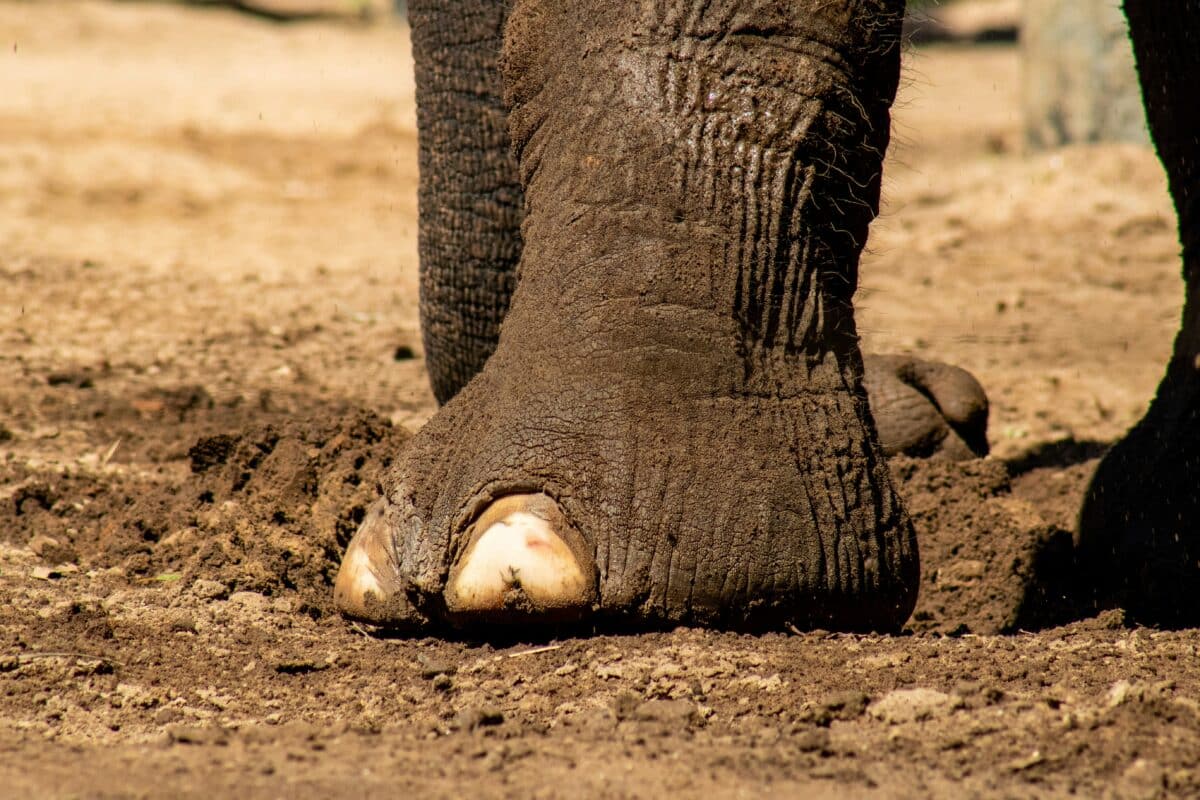
Elephant feet are as misunderstood as their knees. From the side, an elephant appears to walk flat-footed — its foot seeming to contact the ground along its full length, like a human foot. In reality, elephants are semidigitrade: they walk on their toes, with the heel elevated off the ground, but this raised heel is completely concealed within a large, fatty digital cushion pad.
The digital pad is a dense mass of fibrous fatty tissue and cartilage that sits beneath and behind the toes, filling the space between the toe bones and the ground. It has several critical functions:
- Shock absorption: each step of an adult elephant delivers enormous ground-reaction force; the pad compresses on impact and rebounds as the foot lifts, acting as a biological suspension system
- Weight distribution: it spreads force across a broad surface area, reducing peak pressure on any single point and preventing the ground from giving way
- Silent movement: despite their size, elephants are remarkably quiet walkers; the pad muffles footfall sound, an advantage in predator avoidance and stalking of waterholes
- Grip on uneven terrain: the pad conforms to irregular surfaces, giving elephants surprising sure-footedness on rocky ground and steep slopes
The raised heel means that what looks like the bottom of an elephant’s foot is actually the underside of its toes and their supporting pad — not a flat sole. If you could X-ray a walking elephant’s foot, you would see the toe bones angled downward toward the ground, with empty space above the heel, exactly as in a dog or cat foot — just filled in with a massive pad of tissue that makes the whole structure appear flat.
Can Elephants Kneel?
Yes — but with important caveats. Trained working elephants in parts of Asia have historically been taught to kneel as a working posture, allowing handlers or riders to mount. The motion involves bending the front legs at the carpus (the wrist joint) and lowering the front of the body toward the ground, while the hind quarters remain higher. This is not a true anatomical kneel in the way a human kneels on their knee joint; it is the front-leg version, bending through the wrist-equivalent.
Wild elephants do not typically adopt a full kneeling posture. When they want to lie down to sleep or rest, elephants lower themselves to the ground by first bending the front legs to bring the chest down, then folding the hind legs, and finally rolling onto one side. They sleep lying flat, not on their knees. Getting up reverses the process: the hind legs push up first, then the front legs straighten.
Elephants may also partially kneel to reach low vegetation, to access water in shallow depressions, or to allow a calf to nurse more easily. These partial postures use the front leg flexion at the carpus. A full bilateral kneel — both front legs bent with the body resting on the front “knee” surfaces — is uncommon in unmanaged wild populations but not anatomically impossible.
Elephant Legs and Locomotion
The columnar leg design shapes everything about how elephants move. Their primary gait is a fast walk — an asymmetric four-beat gait in which each leg moves independently. Despite their pillar-like legs, elephants can reach speeds of around 25 km/h (15 mph) in a fast walk, which is their fastest sustainable gait.
Unlike most quadrupeds, elephants never achieve a full run in the traditional sense. In a gallop or run, all four feet briefly leave the ground simultaneously (a moment of suspension). Elephants never have a suspension phase — at least one foot is always on the ground. Biomechanically, their fast walk resembles a pendulum rather than a spring, with energy transferred through the legs as compression rather than elastic rebound. This also explains why elephants can’t jump: the leg architecture and body mass make achieving vertical ground clearance for all four limbs at once physically impossible.
What elephants sacrifice in explosive speed they gain in endurance and terrain capability. Their broad feet and cushioned pads allow them to traverse rocky, muddy, or steep ground that would challenge larger wheeled vehicles. Mountain-dwelling forest elephants in Uganda have been documented ascending and descending slopes exceeding 45 degrees — a feat that requires the full articulation of their knee, hock, and wrist joints despite the columnar appearance of the legs at rest.
The Bottom Line
Elephant leg anatomy is genuinely fascinating — not because of a myth about four knees, but because of the real engineering solution evolution arrived at for supporting the largest land animal on Earth. Two true knees (in the hind legs), two wrist-equivalent joints (in the front legs), a hidden elbow, a concealed heel, and a built-in shock-absorbing pad: the full picture is considerably more interesting than the simplified fun fact suggests. Next time you see an elephant walk, look for the forward-bending joint mid-way up the front leg — and know that you’re watching a wrist at work, not a knee.
Frequently Asked Questions
Elephants have two true knees — one in each hind leg. The stifle joint (knee) contains the femur, tibia, and patella (kneecap) and is found only in the rear limbs. The prominent forward-bending joints in the front legs are the carpus — the anatomical wrist — not a knee. So the correct answer is two knees, not four.
Yes — elephants have kneecaps (patellae) in their hind legs. The patella sits in a groove on the distal end of the femur and protects the stifle joint while providing mechanical advantage for the muscles that extend the leg. The front legs have no kneecap, because they have no true knee joint.
Yes. Elephants bend their hind-leg knees (stifle joints) during normal walking and when lying down to sleep. Trained elephants can also be made to “kneel” by bending their front legs at the carpus (wrist joint), lowering the front of the body to the ground. In the wild, elephants lie on their side to rest rather than kneeling.
No — this is a myth. Elephants have two knees, not four. All four-legged mammals (horses, dogs, cats, and elephants alike) have true knees only in their hind legs. The front-leg joint that resembles a knee in elephants is the carpus (wrist). No quadruped has four knees.