The elephant is the largest land animal on Earth — a creature of extraordinary power, intelligence, and complexity. And yet, tucked behind those enormous haunches, hangs a tail that looks almost comically modest in comparison. Typically measuring just 3 to 5 feet long and ending in a scraggly tuft of wiry black hair, the elephant’s tail is easy to overlook. But look closer, and you’ll find it’s one of the most quietly versatile tools in the animal kingdom — a fly swatter, a mood barometer, a guiding rope for calves, a cooling device, and a defensive weapon, all rolled into one. This is everything you need to know about the elephant tail.
Quick fact: An elephant’s tail typically measures 3–5 feet long and ends in a tuft of stiff, wiry hairs that can grow over a foot in length — the elephant’s built-in fly swatter.
What Does an Elephant’s Tail Look Like?
At first glance, an elephant’s tail looks simple — a thick rope tapering to a wispy end. But its structure is more considered than it appears.
The tail originates from a thick, muscular base at the hindquarters, measuring roughly 10–15 cm in diameter. From there it tapers steadily into a narrower, rope-like shaft. The skin covering the tail is the same wrinkled, sparsely-haired grey skin found across the rest of the body — it’s not particularly furry along its length.
At the very tip, however, the tail ends in something distinctive: a brush or tuft of stiff, coarse, wiry black hairs. These individual hairs are more like thick bristles than conventional fur — closer to straw or horsehair in texture. Each hair in this tuft can grow between 12 and 18 inches (30–45 cm) long, making them the longest hairs on an elephant’s body (outside of eyelashes). The overall tail, including this tuft, typically measures between 3 and 5 feet (90–150 cm) in total length.
One important note: if the tail hairs are removed — whether by predator, human, or accident — they do not grow back. The follicles are not replaced. This makes the tail tuft both more precious and more vulnerable than it might appear.
In terms of posture: when an elephant is relaxed, the tail hangs loosely and sways gently with movement. When alert or in motion, it can stiffen. The position of the tail is, in fact, one of the clearest real-time indicators of an elephant’s emotional state — something we’ll return to in the communication section below.
Five Functions of an Elephant’s Tail
The elephant tail may be modest in size, but it pulls its weight across five distinct roles. From practical pest control to emotional signalling, each function reveals another layer of this underappreciated appendage.
A Built-In Fly Swatter
The most immediately obvious function of the elephant’s tail is insect control. The thick savanna air is rich in biting flies, tsetse flies, and other insects, and an elephant’s enormous body offers an enormous landing surface. The tail exists, in large part, to deal with this problem.
The stiff tuft of hairs at the tip acts like a natural fly swatter — or more precisely, like a whisk broom. An elephant can swish it with surprising precision across the backs of its legs, its buttocks, and its hindquarters, dislodging insects that would otherwise be unreachable by the trunk or feet. The coarseness of the hairs matters here: softer fur would simply brush around insects rather than flicking them away.
In areas with heavy insect pressure — around waterholes, in dense bush, during the wet season — you’ll often see elephants swishing their tails almost continuously. It’s one of the most constant and involuntary-looking movements an elephant makes, which is perhaps why it’s so easy to underestimate.
A Language Without Words
Elephants are highly communicative animals — they use sound, touch, scent, and body language in an extraordinarily rich social vocabulary. The tail is one of the body’s most readable texts — and experienced elephant observers learn to read it almost unconsciously.
Here’s how tail position maps to emotional state:
- Relaxed / neutral: tail hangs loose and low, swinging gently with the rhythm of walking. This is the baseline — a calm, unstressed animal.
- Alert / attentive: the tail stiffens and lifts slightly. This is often the first visible sign that an elephant has noticed something — before the ears fully fan out or the head raises. Watch for this on game drives — it frequently precedes a more obvious display by several seconds.
- Excited / greeting: the tail flicks and waves, sometimes vigorously. Combined with ear flapping and excited vocalisations, you often see this when herd members are reunited after a separation.
- Fearful / submissive: the tail is tucked between the hind legs. Subordinate animals — especially younger elephants in the presence of an assertive elder — frequently display this.
- Dominance display: tail held high, in combination with ear fanning and a high head position. A clear signal of confidence and assertiveness.
Within a herd, these tail signals are part of the constant social communication that keeps the group coordinated — particularly important when visibility is low in dense bush or during night movement.
Keeping Calves Close
One of the most endearing sights in elephant observation is the walking chain: a line of elephants moving through the bush, each young calf with its trunk — or mouth — loosely wrapped around the tail of the adult directly in front of it.
On long migration walks, newborn calves curl their tiny trunks around their mother’s tail and simply follow — the tail becoming a lifeline between them.
This tail-holding behaviour is functional as much as it is touching. For a calf navigating long distances — across unfamiliar terrain, through tall grass, in the dark — keeping physical contact with an adult is both navigational and reassuring. The tail gives them a “lead” to follow that requires no conscious decision-making: hold on, keep moving.
The behaviour is most common between mothers and their youngest calves, but in larger family groups, older calves sometimes chain together — each holding the tail of the one in front, forming an orderly, physical convoy. It’s one of the clearest visible demonstrations of the elephant’s intensely social nature, and one of the reasons the bond between a baby elephant and its family group is so striking to observe.
Cooling Down
Elephants have a significant thermoregulation challenge. Their enormous body mass generates substantial heat, and unlike most mammals they have almost no sweat glands. They rely on a range of strategies — ear fanning, mud bathing, seeking shade — to manage their temperature.
The tail plays a supporting role here. By swishing the tail, an elephant creates a small but consistent airflow across the backs of the legs and hindquarters — an area where blood vessels are close to the surface. Just as their ears play a role in temperature regulation through a network of surface blood vessels, the tail’s movement helps move warm air away from heat-exchanging surfaces.
This isn’t a primary cooling mechanism — that role belongs firmly to the ears — but in combination with ear fanning, it’s a meaningful contribution. On hot still days, you’ll often see tail-swishing and ear-fanning happening simultaneously, a double-fan system working together.
A Last Line of Defense
The elephant’s tail also plays a role in defense — and while it’s not the animal’s primary weapon (that would be the tusks or the feet), it’s more capable than it looks.
The tail’s defensive function works on two levels. The first is passive: when an elephant turns its hindquarters toward a threat, the tail becomes the outermost point of the body — a sensor that can detect contact from behind before the elephant can see what’s approaching. The thick, muscular base means a tail flick can be a surprisingly forceful deterrent.
The second level is active: an elephant can and will strike with the tail. The base is dense and muscular, and a direct blow from it can land with significant force on a predator approaching from the rear. Lionesses that hunt elephants — documented particularly in the Savuti region of Botswana, where prides have learned to take down young elephants at night — typically approach from the rear specifically because it’s the most vulnerable angle. The tail gives some warning and deterrence against exactly this approach.
For elephants that feel threatened, understanding the specific signals of threat response — including tail position — helps explain how these animals manage danger in the wild.
African vs Asian Elephant Tails
The two main elephant species — African (further divided into savanna and forest subspecies) and Asian — differ in a range of physical characteristics, and the tail is no exception.
| Feature | African Elephant | Asian Elephant |
|---|---|---|
| Average tail length | Up to 5 feet (150 cm) | Slightly shorter on average |
| Tail hair tuft size | Generally larger, longer, and more pronounced | Often shorter or thinner tuft |
| Tail used to communicate | Yes — tail position widely used as mood signal | Yes — same broad patterns, less studied |
| Tail position at rest | Hangs freely, swings with movement | Hangs freely, similar relaxed posture |
| Hair regrowth if removed | Does not regrow | Does not regrow |
The most noticeable practical difference is the hair tuft. African elephants — particularly savanna elephants — tend to have a more prominent, fuller brush of tail hairs. Asian elephants can have noticeably sparser or shorter tufts. The functional difference is minor, but it makes African elephant tails visually more distinctive from a distance.
Why Is an Elephant’s Tail So Small?
This is the question that makes most people look twice at an elephant. How does the world’s largest land animal end up with what appears to be a vestigial afterthought of a tail?
The answer lies in what tails are for — and what elephants already have instead.
In many animals, the tail serves a locomotion function. A cheetah uses its long tail as a rudder during high-speed turns. Monkeys use prehensile tails to grip branches. A dog wags its tail as a complex social signal broadcast to animals at a distance. A fish’s tail is its primary propulsion system.
Elephants need none of this. They don’t make sharp turns at speed. They have a trunk for all manipulation tasks — grasping, reaching, lifting, touching. Their social signals are conveyed through vocalisations (including infrasound), scent, ear position, and body posture. There’s no evolutionary pressure for a long, complex, or prehensile tail.
What remains is the functional minimum: long enough to swat insects across the hindquarters, thick enough at the base to serve as a tactile sensor and occasional weapon, with a tuft of hair coarse enough to do the fly-swatting job properly. That’s it. Evolution is parsimonious — it doesn’t maintain structures that aren’t earning their keep.
The pattern holds across large mammals generally. Hippos have small, thin tails. Rhinos have narrow, sparse tails. Large aquatic mammals lost them almost entirely (whale flukes are a repurposed tail, but the tail itself is gone). Among large land mammals, reduced tails are the rule, not the exception — because large body mass means large energy costs, and every structure that isn’t functionally essential tends to shrink over evolutionary time.
The Bottom Line
The elephant’s tail is one of nature’s quiet success stories. Compact, unfussy, and easy to overlook — but doing five distinct jobs simultaneously: swatting insects, broadcasting mood, guiding calves, supporting thermoregulation, and providing a last line of rear-facing defense.
Its relative smallness isn’t a design flaw — it’s a design optimisation. Elephants evolved one of the most sophisticated and versatile appendages in the animal kingdom in their trunk. The tail, freed from locomotion and manipulation duties, became a precisely sized multi-tool instead.
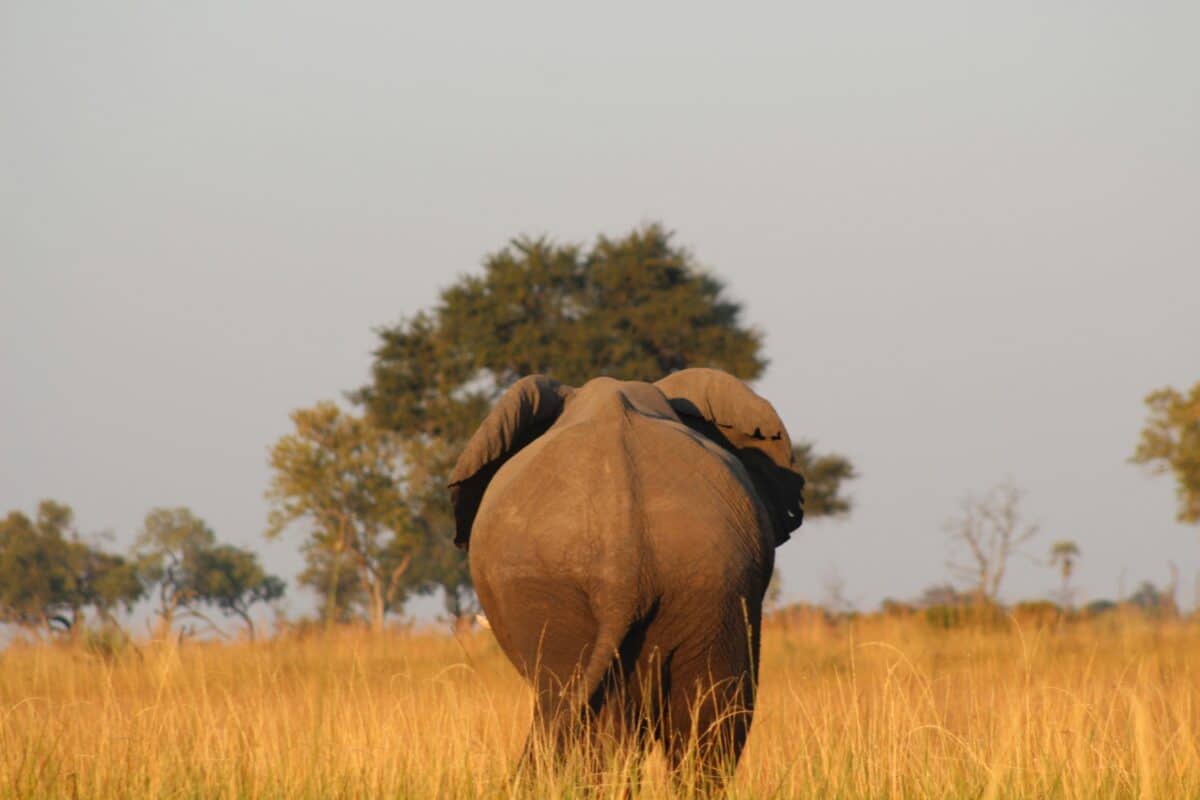
Next time you see an elephant from behind, watch the tail. Is it hanging loose? Stiff and raised? Flicking? Tucked? You’re reading one of the clearest emotional readouts the animal has. And if there’s a calf nearby with its trunk wrapped around that tail — you’re seeing one of the most ancient and instinctive bonds in the animal world.
Frequently Asked Questions
How long is an elephant’s tail?
An elephant’s tail typically measures between 3 and 5 feet (90–150 cm) in total length, including the tuft of wiry black hairs at the tip. The hair tuft itself can contain individual hairs that grow 12–18 inches (30–45 cm) long, making them the longest hairs on the elephant’s body. The tail appears short relative to the elephant’s enormous body size, but is fully functional for its purpose.
What do elephants use their tail for?
Elephants use their tail for five main purposes: as a fly swatter (the stiff hair tuft flicks insects away from the hindquarters), as a communication tool (tail position signals mood — relaxed, alert, fearful, dominant), as a guide rope for calves on long walks, as a supplementary cooling device (the swishing movement creates airflow), and as a rear-facing defense tool against predators approaching from behind.
Why do baby elephants hold their mother’s tail?
Baby elephants wrap their trunk or mouth around the tail of the adult directly in front of them as a way of staying physically connected during movement — particularly on long migrations or through difficult terrain. It’s a combination of navigational guidance and emotional bonding. The physical contact reassures the calf and removes the need for constant decision-making about where to go. In larger family groups, calves sometimes chain together, each holding the tail of the one in front.
Do African and Asian elephants have different tails?
Yes, there are some differences. African elephants generally have a larger, longer, and more pronounced tuft of stiff hairs at the tip of the tail. Asian elephants often have a shorter or thinner tuft. Both species have tails of broadly similar length and use them for the same functions. Neither species can regrow tail hairs if they are removed, as the follicles are not replaced.

One reply on “Elephant Tail: What It’s For, How Long It Is, and What the Hair Does”
[…] Quote from the source: … […]