
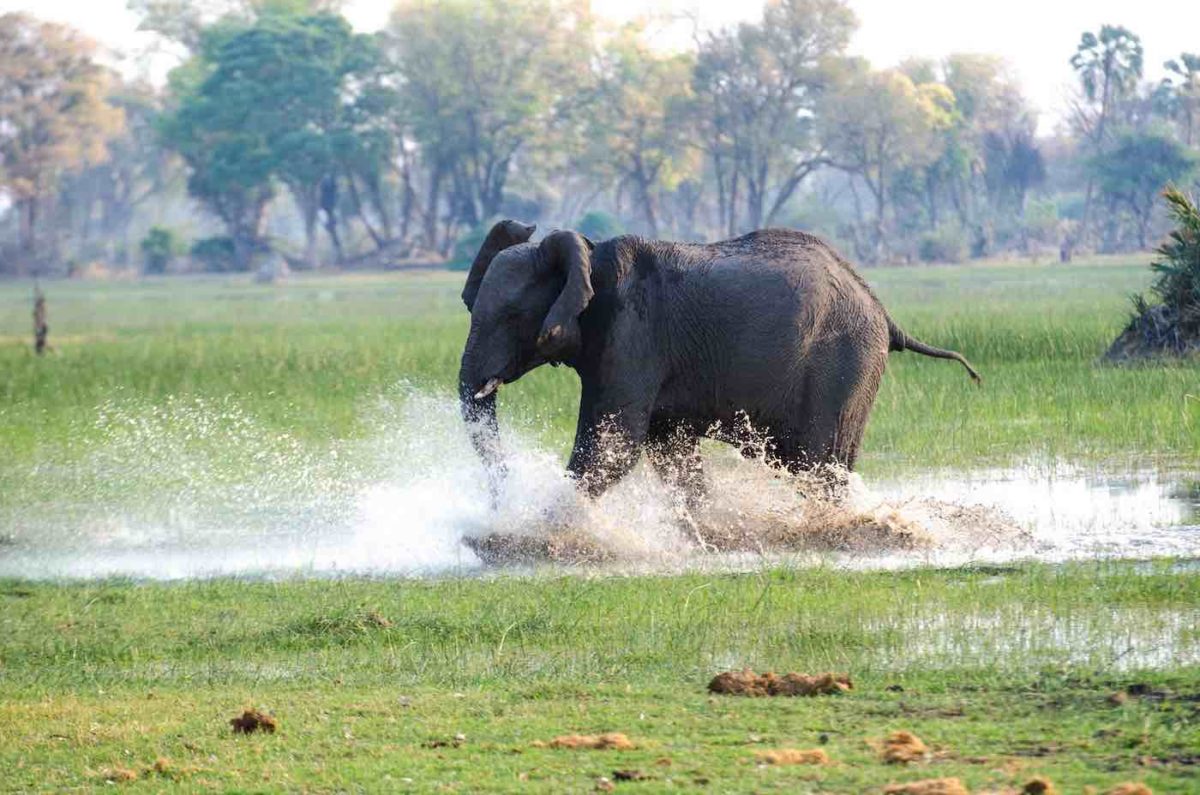
Most people are surprised to learn that elephants can outrun a sprinting human. Despite weighing up to 13,000 pounds and moving on legs that resemble stone pillars, an African elephant can hit 25 miles per hour (40 km/h) at top speed — fast enough to close ground on a fleeing threat in seconds. Their speed is a reminder that size and agility are not opposites, and that evolution has found ways to make even the largest land animal on Earth surprisingly quick when the situation demands it.
How fast can elephants run?
The direct answer: African elephants can reach speeds of up to 25 mph (40 km/h) at maximum effort. Asian elephants are somewhat slower, topping out at approximately 15 mph (24 km/h) at a hard run, with some reports as high as 17 mph in shorter bursts. Both figures are considerably faster than the average adult human’s running pace of around 8–10 mph.
For context, Usain Bolt’s world record sprint speed is approximately 28 mph — meaning a charging African elephant could nearly match the fastest human who has ever lived over a very short distance. For anyone but an elite sprinter, the math is not favorable. The best advice in elephant country has always been: don’t run.
At normal walking pace, elephants move at a leisurely 3–4 mph, covering enormous distances each day through sustained, unhurried travel. Understanding the full range of elephant movement connects to elephant anatomy — particularly the design of their limbs and feet, which are built for both endurance and explosive power.
African elephant speed vs. Asian elephant speed
The speed difference between the two main elephant species comes down to body size, leg structure, and habitat. African savanna elephants are the largest land animals on Earth — bulls can reach 13,000 pounds (6,000 kg) — and yet their long legs and open-terrain habitat mean they can generate impressive stride length. Asian elephants are smaller on average (bulls up to 11,000 pounds / 5,000 kg) and live in denser forest environments where explosive sprint speed is less useful than careful, controlled movement through vegetation.
| Metric | African Elephant | Asian Elephant |
|---|---|---|
| Top speed | ~25 mph (40 km/h) | ~15 mph (24 km/h) |
| Average walking speed | 3–4 mph (5–6 km/h) | 3–5 mph (5–8 km/h) |
| Average bull weight | 10,000–13,000 lbs (4,500–6,000 kg) | 8,000–11,000 lbs (3,600–5,000 kg) |
| Primary habitat | Open savanna, woodland | Tropical forest, grassland |
There are also differences within species. Forest elephants (Loxodonta cyclotis) — the smaller of the two African species — move more nimbly through dense vegetation than their savanna cousins, though their absolute top speed is lower. Calves of any species are proportionally faster relative to their body size, and can move at 14 mph or more from just a few months of age.
Do elephants gallop?
This is one of the most interesting questions in elephant biomechanics — and the answer is technically no, but in a fascinating way. Conventional galloping involves a flight phase where all four feet leave the ground simultaneously as the animal springs forward. Horses, dogs, and cats all do this.
Elephants don’t gallop in the traditional sense. At top speed, their gait is better described as a “fast walk” — the footfall pattern remains a walk sequence, with at least one foot on the ground at all times. However, research published in the journal Nature by John Hutchinson and colleagues at the Royal Veterinary College found that at high speeds, elephants do use their front legs in a spring-like, bouncing manner that resembles a run biomechanically, even though the footfall pattern remains walk-like. Their back legs behave differently to their front legs at speed, adding to the complexity.
In practical terms, this means elephants never fully leave the ground during their top-speed movement — but they do generate and store elastic energy in their limbs in a way that functions similarly to a run. The distinction matters scientifically but makes little difference to anyone being charged by one.
How far can an elephant run at top speed?
Not very far. Top speed for an elephant is a burst activity — typically sustained for no more than a few hundred yards before the animal slows to a trot or walk. The sheer mass that needs to be accelerated and decelerated generates enormous heat and energy expenditure, and elephants do not have the cardiovascular capacity for sustained sprinting the way, say, a horse does.
However, elephants are extraordinary long-distance walkers. Research using GPS collars on African elephants has tracked individuals covering 30–50 miles per day during dry-season migrations, maintaining that pace day after day for weeks. The secret is efficiency at slow speed — a walking elephant uses remarkably little energy per unit of distance compared to other animals of similar mass, thanks to the pendulum-like motion of their pillar-like legs.
So the picture is this: explosive over short distances, relentless over long ones. An elephant’s daily ranging behavior — foraging, traveling to water, socializing — is covered at walk pace. What elephants eat and where they need to go to find it largely determines how far they travel each day.
Elephant speed vs. other African animals
How does an elephant’s top speed compare to the other large animals that share the savanna? The comparison table below puts it in perspective.
| Animal | Top speed | Notes |
|---|---|---|
| Cheetah | 70 mph (112 km/h) | Fastest land animal; short-burst sprinter |
| Lion | 50 mph (80 km/h) | Short bursts only; typically hunts below 40 mph |
| Wildebeest | 50 mph (80 km/h) | Sustained speed of 40+ mph in migrations |
| Giraffe | 37 mph (60 km/h) | Surprisingly fast; ungainly but effective |
| Rhinoceros | 34 mph (55 km/h) | White rhino; dangerous at close range |
| African elephant | 25 mph (40 km/h) | Burst speed; covers ground faster than most humans |
| Hippopotamus | 19 mph (30 km/h) | Dangerous despite modest speed |
| Human (elite sprint) | 28 mph (45 km/h) | Usain Bolt’s peak; most people run 8–12 mph |
Notably, an elephant is faster than a hippo and — for most people — faster than a human. Lions can outrun elephants comfortably, but healthy adult elephants are rarely targeted by predators. Their size, defensive capabilities, and the protective behavior of the herd make them a very unattractive target. Young calves are occasionally taken by lions in coordinated attacks, which is one reason elephant herds close ranks so tightly around vulnerable members. Learn more about what elephants are afraid of and how they respond to perceived threats.
Why are elephants so fast despite their size?
Several biomechanical adaptations allow elephants to generate speed that their bulk would seem to rule out.
Pillar-like limb structure
Elephant legs are built more like columns than the bent-leg design of most mammals. This upright limb posture means that the bones bear much of the load rather than muscles and tendons, which dramatically reduces the muscular energy needed for simply standing still. It also means that at walking speed, the legs swing like pendulums — storing and releasing energy with minimal muscular effort. When speed is required, those same columnar limbs drive enormous ground-contact forces into the terrain with each stride.
Large muscle mass and stride length
An elephant’s hindquarters and shoulder muscles are enormous — among the most powerful of any terrestrial animal. At top speed, stride length can exceed 15 feet (4.5 meters). Combined, power and stride length more than compensate for the relatively low stride frequency (elephants take far fewer steps per second than a galloping horse).
Padded feet for shock absorption
Elephant feet contain a thick fibrous pad of fatty, connective tissue beneath the bones that acts as a natural shock absorber. This distributes weight across a wide area, reducing ground pressure per square inch, and returns elastic energy during each stride. It also makes elephants surprisingly quiet for their size — their footfalls are muffled in ways that allow them to move through bush with less noise than you would expect. Learn more about their remarkable foot design in our guide to elephant anatomy.
When do elephants run?
Elephants are calm, unhurried animals most of the time. Running is reserved for specific situations.
Defensive charges: When a herd is threatened — by predators, other elephants, or humans — adults, especially matriarchs and bulls, will charge the perceived threat at speed. Understanding elephant behaviors helps distinguish a mock charge (ears spread wide, much noise, stops short) from a full charge (ears pinned back, head lowered, silent), which is a genuine attack.
Fleeing genuine danger: Despite their size, elephants do sometimes flee. Coordinated lion attacks on calves can cause a herd to run. Poaching pressure in areas with high human activity has made some populations notably more skittish and prone to flight responses.
Social excitement: Elephants also run during positive social contexts. Herd reunions after periods of separation are often accompanied by excited running, spinning, and vocalizations. Young elephants play-chase each other regularly, and this social running is an important part of developing coordination and social bonds.
The swaying behavior sometimes seen in captive elephants is a separate matter entirely — a stress indicator linked to inadequate enrichment, not movement or speed. If you’ve noticed this and wondered what it means, our article on elephants swaying and distress behaviors explains it in detail.
Frequently asked questions about elephant speed
Almost certainly not. An African elephant’s top speed of 25 mph (40 km/h) is faster than any but the most elite human sprinters, and it reaches that speed far more quickly from a standstill than a human can. The average adult human runs at 8–10 mph — less than half an elephant’s top speed. On open ground, running from a charging elephant is not a viable strategy.
Elephants typically walk at 3–4 mph (5–6 km/h) during normal daily movement. When traveling purposefully — moving toward water or following a migration route — they can sustain a faster march of 6–8 mph over long distances. Despite this moderate walking speed, elephants can cover 30–50 miles per day when motivated, thanks to the efficiency of their pendulum-like gait.
Elephants charge in response to perceived threats to themselves or their herd, particularly to calves. Common triggers include sudden approaches at close range, surprising an individual (especially a solitary bull or a mother with a young calf), loud noises, and unfamiliar scents. Mock charges — with ears spread and much noise — are warnings. Silent charges with pinned ears and lowered head are genuine attacks and should be treated accordingly.
Yes — elephants are strong and enthusiastic swimmers. They use their trunks as a natural snorkel, keeping the tip above water while fully submerging their bodies to cross rivers and lakes. Swimming speed is around 1–2 mph, but they can sustain it for many miles. Elephant herds regularly cross large rivers during seasonal migrations, and calves are guided and supported by adults during crossings.

2 replies on “How Fast Can An Elephant Run?”
[…] around on the Moon. In other words, they are huge. They are fast, too, being able to move at up to 30 miles per hour, much faster than a human can run. Their trunks are amazingly dexterous but also strong; they have […]
muy interesante aprendes mucho