Elephant tusks are one of the most recognizable features in the animal kingdom. They’re also one of the most misunderstood. Many people assume tusks are horns, that they grow back if broken, or that all elephants have them. None of these are quite right.
Elephant tusks are elongated upper incisor teeth, not horns. They grow continuously throughout an elephant’s life at roughly 17 cm (7 inches) per year. If a tusk breaks, it does not grow back – unlike rhino horns, which do regenerate. Not all elephants have tusks: most African elephants (male and female) do, while in Asian elephants only some males grow visible tusks.
This guide covers what tusks are made of, whether they grow back, how big they can get, why elephants need them, what’s happening with tuskless elephant populations, and what elephant tusks are worth – the question that sits behind the entire ivory poaching crisis. Tusks are also a recurring motif in elephant imagery, from statues to elephant tattoos.
Elephant Tusks at a Glance
| What are tusks? | Elongated upper incisor teeth |
| Material | Dentine (ivory), with an enamel tip worn off early in life |
| Growth rate | Around 17 cm (7 inches) per year, throughout life |
| Do they grow back if broken? | No |
| Maximum recorded length | ~3.5 m (over 11 ft) per tusk |
| Maximum recorded weight | ~102 kg (225 lb) per tusk |
| Do all elephants have them? | No. See the species breakdown below. |
Do Elephant Tusks Grow Back?
No. Elephant tusks do not grow back once they’re broken or removed.
Tusks are teeth, not horns, and like human teeth they grow from a pulp cavity at the base. If the pulp itself is damaged (broken close to the gum line, pulled out, or cut off at the root), the tusk is gone for life. Elephants don’t have a second set of tusks waiting to come in.
If the tusk is chipped or broken further out along its length, the remaining portion continues to grow and will extend over time – but it won’t replace what was lost. The tusk simply continues from wherever the living tissue still is.
Why don’t elephant tusks grow back?
Because they’re permanent teeth, and mammals generally don’t regrow permanent teeth. Elephants’ tusks erupt once (around age 2) and then grow for the rest of the animal’s life from the living root. Lose the root and there’s no biological machinery to start a new one.
Elephant tusks vs rhino horns: why one grows back and the other doesn’t
This is the question people actually want answered. Rhino horns regrow after being cut (slowly, over years) because they’re made of keratin – the same stuff as fingernails and hair – and they grow from the skin. Elephant tusks are teeth that grow from a nerve-rich pulp. Two completely different structures.
| Elephant tusk | Rhino horn | |
|---|---|---|
| Material | Dentine (ivory), living tissue | Keratin (non-living) |
| Grows from | Pulp cavity / root, deep in skull | Skin on the snout |
| Grows back if removed? | No | Yes, slowly |
| Nerves inside? | Yes | Minimal |
| Pain when broken/cut near base? | Yes, significant | Very little, if cut above the growth zone |
Does it hurt an elephant if a tusk is cut off?
Yes, if the cut reaches the pulp. Tusks have living tissue and nerves for a significant portion of their length – roughly the inner third stays inside the skull and the next section contains nerve tissue. Cutting into that region is like hitting a nerve in a human tooth. Only the outer “solid ivory” portion of the tusk can be trimmed painlessly, and very few elephant tusks are so long that this is practical.
What is an Elephant Tusk Made Of?
Elephant tusks are elongated upper incisor teeth. They’re built from the same layers as a regular tooth – though the cheek teeth elephants use for chewing are an entirely different structure with a remarkable story of their own:
- Dentine – the main body of the tusk, and what we call “ivory”.
- Enamel – a thin cap at the very tip of the tusk, worn off early in life by digging and feeding.
- Pulp – living tissue, blood supply, and nerves that run through the inner root.
About a third of the tusk’s total length is hidden inside the skull, anchored in a deep socket. That’s why a tusk that looks 1.5 metres long outside the elephant’s mouth is often closer to 2 metres overall.
How Long Can Elephant Tusks Grow?
Tusks grow throughout an elephant’s life at roughly 17 cm (about 7 inches) per year. In practice, most elephants have tusks in the 1 to 2 metre range because of wear at the tip. A handful of old bulls in protected populations grow tusks long enough to earn a separate nickname.
What’s a “big tusker” elephant?
A “big tusker” (sometimes called a “super tusker”) is an elephant – almost always a mature male African elephant – with tusks so long they nearly reach the ground. Informally, that means tusks weighing more than about 45 kg (100 lb) each. Big tuskers are rare. Decades of poaching have removed most of them from the wild, and the genetic pool has shifted in many populations away from producing them.
The most famous big tusker
The most famous big tusker was Ahmed, a Kenyan bull who lived in Marsabit National Park until his death in 1974. Ahmed’s tusks reportedly weighed around 68 kg (150 lb) each. He was placed under 24-hour armed guard by presidential decree to protect him from poachers – the only elephant in history to have had that kind of protection.
Even larger tusks exist in museum collections. A pair of tusks held in the Natural History Museum in London weigh around 100 kg and 102 kg respectively, from an elephant shot in Kenya in 1898.
What Do Elephants Use Their Tusks For?
Tusks are tools. Elephants use them constantly and often show a preference for one tusk over the other, just like humans are right or left-handed. The favoured tusk is usually shorter and more worn down.
- Digging for water. In dry seasons, elephants use tusks to break the ground and reach underground water or damp soil.
- Stripping bark. The bark of certain trees is a food source. Tusks are perfect for levering it off.
- Lifting and moving branches. Elephants will shift fallen trees or push aside heavy vegetation with their tusks.
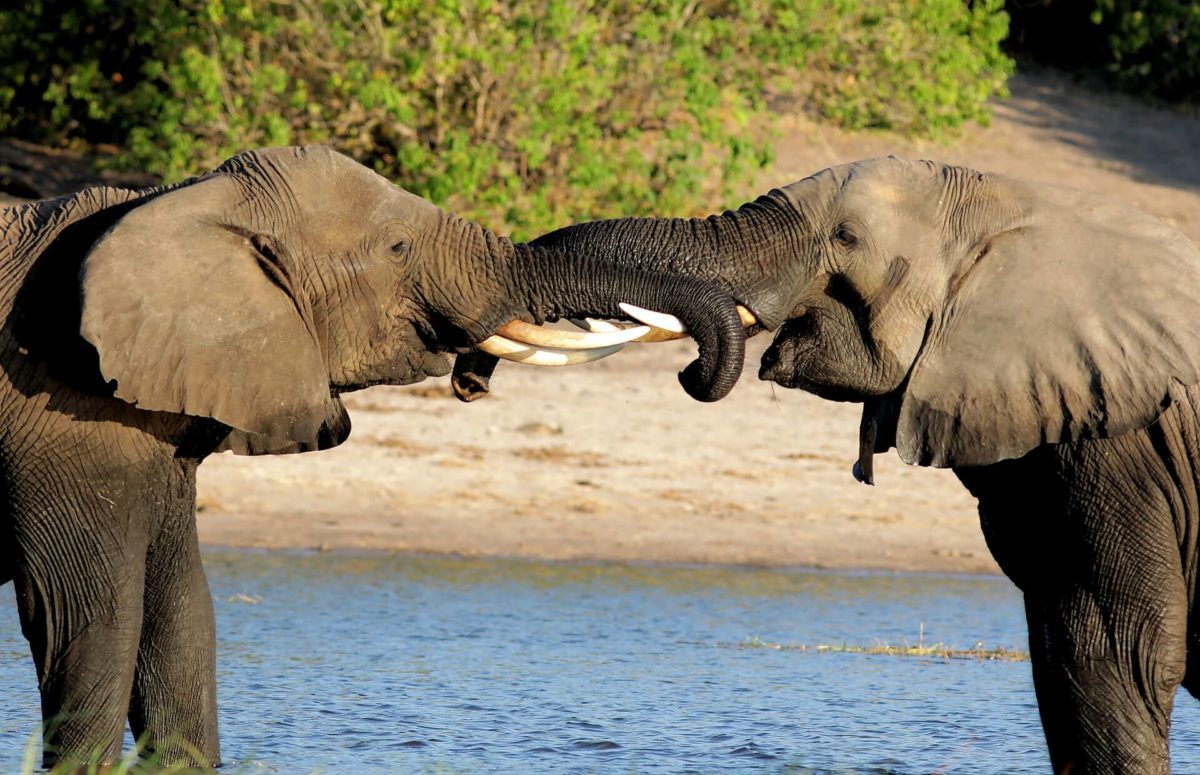
- Defence. Against predators and other elephants during musth or territorial conflicts. Tusks are dangerous weapons.
- Fighting other elephants. Bulls jostle and spar with their tusks during musth or over access to females.
- Digging out mineral deposits. Salt and minerals are scraped out of rock or soil with the tusks.
Our guide on why elephants destroy trees covers the stripping and uprooting behaviour in more detail.
Do All Elephants Have Tusks?
No. Tusks vary significantly by species, sex, and increasingly by region.
| Species / Sex | Have tusks? |
|---|---|
| African bush elephant, male | Yes, large |
| African bush elephant, female | Yes, smaller than males |
| African forest elephant, male | Yes, long and straight |
| African forest elephant, female | Yes, smaller |
| Asian elephant, male | Some (called “tuskers”); others have no visible tusks (called “makhnas”) |
| Asian elephant, female | Usually no visible tusks – at most small “tushes” |
Asian elephants without visible tusks are called “makhnas”. They still have rudimentary tusks – tiny “tushes” that rarely protrude beyond the lip – but nothing comparable to the tusks of their African cousins. Our guide on African vs Asian elephants covers the full species comparison.
Tuskless Elephants: An Evolution Driven by Poaching
In several African populations, female elephants are increasingly being born without tusks at all. The clearest case is Gorongosa National Park in Mozambique, where decades of heavy poaching during the country’s civil war removed most tusked females from the breeding population. Research published in Science in 2021 showed that tuskless females – previously around 2 to 4 percent of the population – now make up roughly 33 percent of older females in the park.
This is evolution happening fast. Poachers targeted tusked elephants, tuskless females were more likely to survive and reproduce, and their genes spread. Similar shifts have been documented in parts of Kenya, Tanzania, and Uganda. It’s a stark example of how human pressure reshapes wildlife on a generational timescale.
Can a female elephant have tusks?
Yes, in African elephants both sexes typically have tusks, though female tusks are smaller and thinner. In Asian elephants, females almost never have visible tusks – they may have small tushes that don’t extend past the lip.
Can elephants survive without tusks?
Yes. Tuskless elephants live full lives. They adapt their behaviour – feeding on different plants, finding other ways to access water, and relying more on their trunk for tasks where a tusked elephant would use the tusk. The trade-off is that they’re less able to strip bark, dig, or defend themselves physically against rivals.
Why do male elephants still have tusks?
The genetic variant linked to tusklessness appears to be lethal in male elephants – so tuskless males don’t survive to reproduce, and the trait spreads only through females. That’s why tuskless African populations are overwhelmingly female.
What is an Elephant Tusk Worth?
On the illegal market, a single elephant tusk can be worth several thousand to tens of thousands of US dollars depending on size and quality. Raw ivory has fetched anywhere from $500 to $1,500 per kg on the black market in recent years, with prices fluctuating based on enforcement pressure and demand.
This is the core reason for the ongoing elephant poaching crisis. A tusker’s tusks are worth more than most local annual incomes in countries where elephants live, creating a brutal economic incentive.
How many elephants are killed yearly for their tusks?
Estimates vary, but conservation groups have tracked yearly losses in the tens of thousands at the peak of the poaching crisis in the 2010s. More recent figures suggest around 10,000 to 15,000 African elephants are killed each year for ivory, though enforcement, sanctuary investment, and demand-reduction campaigns have brought the numbers down from their worst levels. For current population totals, see how many elephants are left in the world.
Is ivory the same as elephant tusks?
Mostly. “Ivory” in the historical trade refers almost entirely to elephant tusk material (dentine). The term can technically cover other animals’ teeth and tusks – walrus, narwhal, hippo, warthog – but the ivory trade is synonymous with elephant poaching for practical purposes.
Is ivory soap made from elephant tusks?
No. Ivory Soap is a brand name – it was marketed in the 1800s for its pale colour and soft feel, not because it contains actual ivory. No elephant tusk material is used in Ivory Soap or any other mainstream consumer soap product.
Are Tusks Horns?
No. This is the single most common elephant tusk myth. Horns are made of keratin (like hair and fingernails) and grow from the skin – rhinos, cows, goats, and antelope have horns. Tusks are teeth, made of dentine, anchored in the skull. They’re evolutionarily unrelated.
FAQ about Elephant Tusks
No. Elephant tusks do not regrow once the root is damaged or the tusk is removed. Tusks are teeth, and like human teeth, an elephant only gets one set for life. If a tusk is chipped further out along its length, the remaining part continues to grow, but it won’t restore what was lost.
Teeth. Elephant tusks are elongated upper incisor teeth, made of dentine (ivory) and anchored in the skull. Horns are made of keratin and grow from the skin. The two are completely different structures. This is why rhino horns grow back after being cut and elephant tusks do not.
No. Most African bush and forest elephants have tusks (both males and females). In Asian elephants, only some males grow visible tusks and females usually don’t. A growing number of females in heavily-poached African populations are also being born without tusks – in parts of Mozambique, tuskless females now make up around a third of older adult females, up from 2 to 4 percent historically.
In African elephants, yes – both males and females typically have tusks, though female tusks are smaller and thinner. In Asian elephants, females almost never have visible tusks; they may have tiny ‘tushes’ that don’t extend beyond the lip.
Elephant tusks grow continuously at roughly 17 cm (about 7 inches) per year throughout the elephant’s life. Most adult elephants have tusks in the 1 to 2 metre range because of wear at the tip from daily use.
Yes, if the cut reaches the pulp cavity, which holds living tissue and nerves. Roughly the inner third of a tusk sits inside the skull, and nerve tissue extends beyond that. Only the outer ‘solid ivory’ portion can be trimmed without causing pain, and this is rarely practical.
Elephants use their tusks for digging for water, stripping bark off trees, moving branches, fighting rivals, defending themselves and their young, and digging out mineral deposits. Most elephants show a preference for one tusk over the other, similar to human handedness.
On the illegal ivory market, tusks have sold for roughly $500 to $1,500 per kg in recent years. A large pair of tusks from a mature bull can represent tens of thousands of US dollars – which is the economic force behind the elephant poaching crisis.
In Summary
Elephant tusks are teeth, not horns. They grow throughout an elephant’s life at roughly 17 cm a year but don’t grow back if they’re broken off or cut out. Not all elephants have them, and thanks to decades of poaching, more and more female African elephants are being born without them.
For more on elephant species, see our guides on African vs Asian elephants, African bush vs forest elephants, and global elephant populations.

5 replies on “Do Elephant Tusks Grow Back? Everything You Need to Know”
nice article Olivia. We have visited Namibia 5 times. Here is a question
elephant’s tusks stop growing when they reach the age of around 25 years. Is this true or false…
My question is, I know tusks can help an elephant, but why does not the WWF sedate the elephants, remove their tusks and make them less desirable to poachers ? Save them from being wiped out at the same time.
[…] as much as two adult humans, with no skeleton inside it. Our guides to the elephant trunk and elephant tusks cover both in […]
[…] the tusks and legs have limitations in reaching certain areas due to their structure and […]
[…] include tusks, the tusks are teeth, not horns, and they keep growing throughout life. Our guide to elephant tusks covers the anatomy if you want the design to be […]